
Type “Butcher Education Center” into a search box and you will find confident pages about mastering the art of meat. Read a little closer and something odd appears. None of those pages names a course list, a tuition fee, or a single student. There is a reason for that. No school that teaches butchery carries this name. The name belongs to two buildings named after a man called Thomas Butcher, and neither building has anything to do with cutting meat.
This guide gives you the honest answer first. Then it covers the real subject behind the name: butcher education in 2026. You will learn how to become a butcher, which butcher training programs are real, what the work pays, and which certificates matter.
What Is the Butcher Education Center?
Two places carry the name, and both are easy to check. In Warren, Michigan, the Butcher Educational Center is a Warren Consolidated Schools building. It houses the Macomb Mathematics Science Technology Center, a middle school maths and science centre, and a visual and performing arts programme. The building was once Thomas Butcher Junior High School, named after a person, not after the trade.
At Emporia State University in Kansas, the Butcher Education Center is another building named after a former university president, Thomas W. Butcher. It houses the sociology, anthropology, and criminology department and a centre for early childhood education. University plans to demolish the ageing building have been on the books since 2014. No meat is cut there.
So the name is real, but the school is not. Search results that describe a “Butcher Education Center” as a place to learn butchery are spun pages. They borrow a real building name and attach invented courses to it. If a training provider cannot show you a real address, a real course list, and real graduates, treat it the same way.
What Does a Butcher Actually Do?
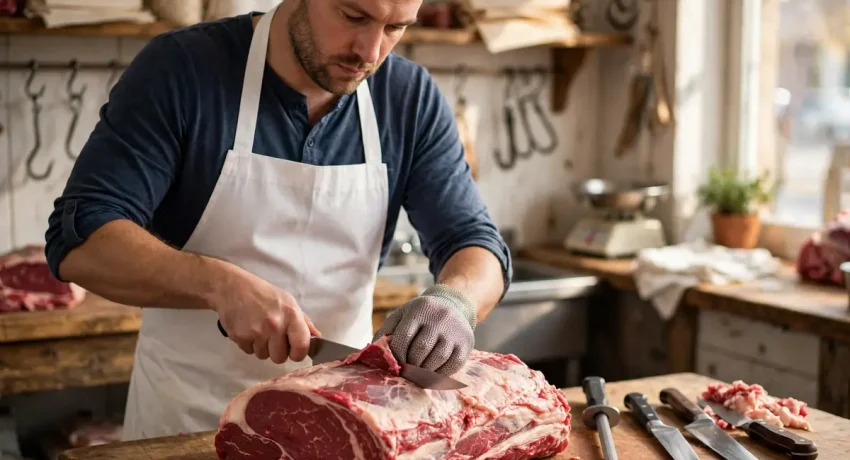
A butcher prepares meat for sale and for cooking. The daily work splits into two worlds: retail and processing. Retail butchers work in butcher shops and supermarket meat departments. They cut steaks, chops, and roasts to order, trim fat, bone out joints, grind mince, and talk to customers about cooking times and portion sizes.
Processing workers handle larger volumes in plants. They cut, trim, and prepare meat and seafood for wholesale and retail sale, often on a line, with strict hygiene rules and cold rooms. The US Bureau of Labor Statistics (BLS) counts both groups together as meat, poultry, and fish processing workers. In 2025, that group held about 359,300 jobs in the United States. Butchers and meat cutters held about 138,400 of those jobs, and meat, poultry, and fish cutters and trimmers held about 149,800.
Both settings share the same core skills. You need to know the anatomy of beef, pork, lamb, and poultry. Breaking a carcass into wholesale parts comes next, then into retail cuts. Sharp knives, safe hands, and clean surfaces matter on every shift. Weighing, wrapping, labelling, and storing everything at the right temperature finishes the job.
What Is the Difference Between a Butcher and a Meat Cutter?
A butcher vs meat cutter comparison comes down to scope. Butchers usually handle whole carcasses, break them into primals, and make retail cuts, often while serving customers. A meat cutter, sometimes called a meat trimmer, usually works with pre-cut pieces, trimming, portioning, and packaging them. In practice the titles overlap, and the BLS groups them together, but butchers tend to do more whole-animal work and more customer contact.
Do You Need a Degree to Become a Butcher?
No degree is required to become a butcher. Most butchers learn the trade through a mix of short training and on-the-job experience. A high school diploma, or its equivalent, helps. It gives you the basic maths and reading skills the job needs, and most schools and apprenticeship programmes ask for one.
That said, formal training has real value. A short course teaches you the cuts, the food safety rules, and the knife skills in weeks instead of years. An apprenticeship pays you while you learn. A meat science degree opens doors to quality control, product development, and management roles that a cutting bench alone rarely offers. The right route depends on where you want to end up, not on a single qualification.
What Are the Main Routes Into Butchery in 2026?
There is no single path into this trade. Four routes cover almost every working butcher, and each one suits a different starting point.
How Does On-the-Job Training Work?
Most new butchers start as meat counter assistants or apprentices in a shop or supermarket. You begin with wrapping, weighing, and cleaning. Then you move to trimming, portioning, and basic cuts under supervision. An experienced butcher watches your knife work and corrects your grip, your angles, and your speed. This route costs nothing in tuition, and you earn from day one. It is also the slowest route to full skill, because teaching time competes with the day’s orders.
What Short Courses Are Available?
Short butchery courses suit career changers and small farmers who need real skills fast. The University of Maine runs a Meat Cutting School through its Cooperative Extension. It lasts three days, costs $500, and earns a micro-badge for learners who pass each section quiz at 80% or higher. Students learn to cut beef, swine, poultry, and small ruminants into wholesale and retail cuts, plus knife safety, food safety, meat quality, grinding, and the USDA, state, and custom-exemption inspection rules.
SUNY Cobleskill offers a meat processing and food safety microcredential built from four short courses: beef processing, pork processing, lamb and goat processing, and HACCP principles. Students practise slaughter, primal fabrication, precision and retail cutting, portion control, packaging, and sanitation. The University of New Hampshire runs a Meat Processing and Food Safety Certificate built on three online American Meat Science Association (AMSA) courses plus one in-person lab session. Free registration for that programme ended on 30 June 2026, when its funding expired, and courses now carry a small registration fee.
What College and University Programmes Teach Butchery?
Longer programmes suit people who want a full qualification. In Utah, the state higher education system runs a Meat Services programme of 27 credits and 840 clock-hours. Courses cover an introduction to meat services, safety, beef cutting, pork and lamb cutting, and value-added products, with hands-on lab work throughout.
Eastern Oklahoma State College offers a two-year Associate of Applied Science in Meat Processing and Food Safety, combining academic study with practical training in carcass evaluation, meat processing, merchandising, and food safety. Hinds Community College in Mississippi runs a one-year meat merchandising programme covering fish, poultry, beef, and pork. Colorado State University offers a meat science and food safety programme covering meat safety and quality, storage life, carcass composition, meat microbiology, and grading.
Canada has its own strong options. Fanshawe College in Ontario runs a 30-week Professional Butchery Techniques programme leading to an Ontario College certificate. Graduates can move into a Retail Meat Cutter apprenticeship or add a culinary skills certificate. Quebec runs a Retail Butchery programme of 900 hours, lasting seven and a half to ten months depending on the training centre, with listed costs around $13,293 to $15,000.
How Do Apprenticeships Work in the UK and Ireland?
Britain runs the most structured apprenticeship route in the English-speaking world. The Level 2 Butcher Apprenticeship lasts about 18 months and covers meat preparation, food safety, and product quality while you work in paid employment. At Level 3, the Advanced Butcher Apprenticeship lasts 18 to 24 months and adds technical butchery, supervision, and food safety management. Both combine paid work with one day of college training each week and end with an independent assessment. Successful Level 3 apprentices can join the Institute of Meat and use the letters M.Inst.M after their name. Bishop Burton College, named Training Provider of the Year at the 2026 Institute of Meat Awards, and Sparsholt College both run these apprenticeships. Sparsholt asks for five GCSEs at grades 9 to 3, including English and maths.
Ireland runs a two-year Craft Butchery apprenticeship. Apprentices learn on the job with an approved employer and a workplace mentor who has at least three years of relevant experience, plus off-the-job training. Completion earns a Certificate in Craft Butchery at QQI Level 5, which opens the way to Level 6 courses.
How Long Does It Take to Become a Butcher?
Training time varies more than most people expect. A short course can teach the basics in days. A full apprenticeship takes years. This table shows the honest range, using real programmes named in this guide.
| Route | Typical length | What you get |
|---|---|---|
| Short course (Maine Meat Cutting School) | 3 days | Micro-badge, core cutting and safety skills |
| Microcredential (SUNY Cobleskill) | Four short courses | Beef, pork, lamb and goat processing plus HACCP |
| Certificate (UNH Meat Processing and Food Safety) | Three online courses plus one lab day | AMSA certification courses, hands-on lab training |
| College programme (Utah Meat Services) | 840 clock-hours | 27-credit certificate, full retail cutting skills |
| College programme (Fanshawe, Canada) | 30 weeks | Ontario College certificate |
| Apprenticeship (UK Level 2) | About 18 months | Paid work plus college day, end-point assessment |
| Apprenticeship (UK Level 3) | 18 to 24 months | Advanced craft skills, Institute of Meat membership |
| Apprenticeship (Ireland) | 2 years | QQI Level 5 Certificate in Craft Butchery |
| Associate degree (Eastern Oklahoma State) | 2 years | Associate of Applied Science in Meat Processing and Food Safety |
| Master Meat Crafter (Wisconsin) | 2 years, part time | Six three-day workshops plus an in-plant project |
None of these routes makes you a master butcher on its own. Speed and judgement come from repetition. Most working butchers say the first two years teach the cuts, and the next five teach the craft.
What Will You Learn in Butcher Training?
Good training covers the same ground in every country, even when the course names differ. Animal anatomy comes first. You learn where each muscle sits, which cuts come from which primal, and how bone structure shapes every decision. Beef breaks into chuck, rib, loin, round, brisket, shank, plate, and flank. Pork breaks into shoulder, loin, belly, and leg. Lamb follows a similar map at a smaller scale. Whole animal butchery means using the whole carcass, from primals to trim, with as little waste as possible.
Knife skills come next. You learn to hold, sharpen, and steel a knife, and to cut with the blade rather than forcing it. A sharp knife is safer than a dull one, because it does not slip. You also learn the band saw, the grinder, and the slicer, plus the safety glove that protects your free hand.
Food safety runs through everything. You learn to keep raw meat cold, to separate raw and ready-to-eat products, to clean and sanitise surfaces, and to spot the pathogens that cause food poisoning. Safe cooking temperatures matter too: beef to 145°F, poultry to 165°F, and fish to 145°F. Yield and value-added work follow. You learn to trim without waste, to turn trim into mince and sausage, and to cure, smoke, and marinate. Customer service closes the loop in retail work, because a butcher who can explain a cut sells more of it.
What Certifications Do Butchers Need?
No single butcher certification covers all butchers. The rules depend on your country, your state, and your employer. Three credentials matter most.
What Is HACCP Certification?
HACCP stands for Hazard Analysis and Critical Control Points. It is a food safety management system that finds and controls hazards from production to consumption. Meat and poultry plants in the United States must run HACCP plans under USDA Food Safety and Inspection Service rules. The system covers biological, chemical, and physical hazards, and it follows seven principles: hazard analysis, critical control points, critical limits, monitoring, corrective actions, verification, and record keeping. Training in HACCP is often required for manager-level roles in meat businesses, and SUNY Cobleskill includes it as one of its four microcourses. HACCP certification for butchers is one of the most useful credentials in processing work.
What Is ServSafe Certification?
ServSafe is the food safety training programme of the National Restaurant Association, and it is the leading credential of its kind in the United States. The ServSafe food manager certification uses a 90-question proctored exam and covers HACCP principles, food safety management, and regulatory compliance. It is valid for five years, though the exact period varies by state. The Food Handler certification is shorter, with 40 questions, and lasts about three years. Many states require at least one certified food protection manager on site during operating hours, so this credential helps in retail and restaurant work.
What Other Credentials Are Worth Having?
The American Meat Science Association runs certification courses in meat science, food safety, and processing, used in the University of New Hampshire certificate programme. Indeed’s career guidance also notes a butchery certification linked to the American Meat Institute, now part of the North American Meat Institute, requiring 320 hours of instruction and renewal after three years, with an exam exemption for people with at least eight years of experience. For experienced professionals, the University of Wisconsin runs a Master Meat Crafter programme: six three-day workshops over two years, covering animal harvest, fresh meats, food safety and meat microbiology, meat curing, cooked and emulsified sausage, and fermented and dry-cured products, plus an in-plant research project and a mentoring duty. The 2026 to 2027 programme costs $12,500, payable in full or in eight quarterly instalments.
How Much Do Butchers Earn in 2026?
Butcher salary 2026 figures depend on experience, location, and employer, and the honest numbers come from official and survey sources rather than job ads.
The US Bureau of Labor Statistics reports a median annual wage of $40,140 for butchers and meat cutters in May 2025, or about $18.84 per hour for the wider processing group at $39,190. PayScale’s 2026 data puts the average hourly pay for a butcher or meat cutter at $19.50, with a range from $12 to $25 per hour and total pay from $26,000 to $54,000 a year. A meat cutter salary in a processing plant often sits close to the retail figure, since the BLS counts both jobs in the same wider group. Entry-level workers sit near the bottom of that range, while experienced butchers and specialists can reach $25 to $30 per hour.
Britain tells a similar story. The Craft Butchers 2026 wages survey found butchers earning an average of £14.48 per hour, with a range from £12.75 to £16.50. Apprentices averaged £9.11 per hour, and shop managers averaged £15.78, reaching £21.50 at the top.
Several factors push pay up or down. Big-city shops and processing plants usually pay more than small rural ones. Specialists in whole-animal butchery, charcuterie, or dry ageing can charge more for their skill. Shop managers and master butchers earn more than counter staff. Overtime, weekend work, and holiday shifts add to the total, and self-employed butchers who run their own shops keep the profit but carry the risk.
What Is the Job Outlook for Butchers?
The butcher career outlook is steady rather than spectacular. The BLS projects employment of meat, poultry, and fish processing workers to grow 4% from 2025 to 2035, about as fast as the average for all occupations. That adds about 13,300 jobs over the decade, with about 39,800 openings each year, mostly from people leaving the trade or retiring.
Demand stays solid for a simple reason: people keep eating meat, and someone has to cut it. Supermarkets, butcher shops, and processing plants all need skilled hands. Canada reports a critical shortage of skilled butchers, with industry groups citing thousands of unfilled roles. That shortage is one reason Fanshawe College built its 30-week programme around hands-on training and employer partnerships.
Two trends shape the trade. Whole-animal butchery and nose-to-tail cooking have grown in craft shops and restaurants, rewarding butchers who can break down a carcass rather than just open boxes of pre-cut meat. At the same time, large plants keep automating the simplest cuts, which makes skilled hand work more valuable, not less. A butcher who can talk to customers, advise on cooking, and make value-added products is harder to replace than one who only slices.
What Tools Does a Butcher Need?
Butcher tools and knife skills are the heart of the trade, and the kit is small but specific. The breaking knife handles large primal cuts. The boning knife, with its narrow flexible blade, follows bones and joints. The trimming knife cleans fat and silver skin. The cleaver splits bone and chops through joints. A honing steel realigns the edge between sharpenings, and a whetstone restores it when the steel no longer helps.
Bigger equipment matters too. A band saw cuts through bone and frozen blocks. A grinder turns trim into mince. A slicer cuts deli meats thin and even. A vacuum packer extends shelf life. A mesh safety glove protects the hand that holds the meat. Beginners should not buy the most expensive kit first. A training programme usually supplies tools, and employers provide the big machines. Buy good knives once your hands know what they need.
What Skills Make a Good Butcher?
Manual dexterity sits at the top of the list. You work with sharp steel all day, and clean, confident cuts come from practice. Stamina matters too. Butchers stand for long shifts, lift heavy carcasses, and work in cold rooms. Strength helps, but technique matters more than brute force.
Basic maths runs through the job. You weigh portions, calculate yields, price by weight, and work out how much of a carcass becomes saleable meat. Attention to detail keeps food safe and customers happy. A missed bone fragment or a mislabelled pack can cost a shop its reputation.
Communication rounds out the skill set. Retail butchers explain cuts, suggest cooking methods, and handle special orders. A calm manner helps when a customer wants a roast cut a certain way for a family dinner. Good butchers listen first, then cut.
How Do You Choose the Right Butcher Training?
Five checks separate real training from spun promises. First, check the provider’s real identity. A genuine school or college has a verifiable address, named instructors, and a published course list. If the only evidence is a web page with stock photos and no address, walk away. Second, count the hands-on hours. Butchery is a physical skill, and a course with no bench time teaches you to watch, not to cut.
Third, ask who recognises the qualification. A certificate from a university extension, a state college, or an industry body such as the American Meat Science Association carries weight with employers. One from an unnamed website does not. Fourth, compare the cost against the outcome. A $500 three-day course that teaches real cutting is good value. A $12,500 two-year master programme suits a working professional, not a beginner. Fifth, ask about jobs. Real programmes name employers, apprenticeship partners, or placement routes. If a provider cannot name a single employer, its course is a guess.
Can You Learn Butchery at Home?
You can learn part of it at home, but not all of it. Home cooks can practise knife skills, learn the primal cuts, and study food safety from books and videos. You can break down a chicken, trim a pork loin, and grind your own mince with a home grinder. That builds useful knowledge.
Home practice has clear limits. You cannot learn carcass breakdown without a carcass, and most homes lack a band saw, a cold room, and a mentor watching your hands. Food safety mistakes at home can make people ill, so temperature control and hygiene matter more, not less, when you practise alone. A short course with a real instructor closes those gaps in days. If you are serious about the trade, treat home practice as preparation, not as the training itself.
What Are the Downsides of the Job?
Honest guides mention the hard parts. Butchery is cold work. Cold rooms sit near freezing, and your hands feel it by the end of a shift. It is physical work too. Lifting, standing, and repeating the same motions can strain backs, wrists, and shoulders. Cuts and nicks happen, even to experienced butchers, which is why the safety glove and sharp knives matter.
Hours can be early and long. Shops open before customers arrive, and plants run shifts that start before dawn. Weekend and holiday work is common, because those are the busiest days for meat sales. Pay starts modest, and the trade rewards patience more than quick money. None of this stops people from loving the work. It does mean you should go in with open eyes.
Frequently Asked Questions
Is the Butcher Education Center a real butcher school?
No. The name belongs to two buildings named after a man called Thomas Butcher: one in Warren, Michigan, run by Warren Consolidated Schools, and one at Emporia State University in Kansas. Neither teaches butchery. Real training comes from the colleges, extension programmes, and apprenticeships listed in this guide.
How long does it take to become a butcher?
A short course takes three days. A college certificate takes weeks to months. An apprenticeship takes 18 months to two years. Most butchers keep learning for years after that, because speed and judgement come from repetition.
Do butchers need a licence?
There is no single butcher licence in the United States. Employers usually want food safety training, such as ServSafe or HACCP, and plants must run HACCP plans under USDA rules. The UK and Ireland use formal apprenticeships with end-point assessments and recognised certificates.
How much do butchers earn?
The US median wage for butchers and meat cutters was $40,140 a year in May 2025, according to the Bureau of Labor Statistics. PayScale’s 2026 data shows an average of $19.50 per hour, with a range from $12 to $25. Experience, location, and employer all shift the figure.
Is butchery a good career in 2026?
It is a steady one. The BLS projects 4% growth from 2025 to 2035, with about 39,800 openings a year in the wider processing group. Canada reports a shortage of skilled butchers. The work is physical and cold, but skilled butchers who handle whole animals and talk to customers stay in demand.
What is the best way to start?
Start with a short hands-on course, then find paid work or an apprenticeship in a shop or plant. Add food safety training early, and keep learning the cuts until they feel natural. That combination of a course, a job, and a certificate is the fastest honest route into the trade.
Butcher education is not a mystery school with a grand name. It is a practical trade with real courses, real apprenticeships, and real pay. The “Butcher Education Center” turns out to be two buildings named after a man, not a place that teaches the craft. The real education happens on the bench, in the cold room, and in front of a customer who wants a steak cut just right.