
Walk into a garden that stops you in your tracks, and there is often one reason. A single tree, placed exactly where your eye lands first. For a growing number of designers, that tree is a fruitless olive. Its twisted trunk looks old before its time. Silver-green leaves catch the light, and the tree asks for almost nothing in return.
The Majestic Beauty fruitless olive does this job better than most. It gives you the full Mediterranean look with no fruit to stain the patio — no mess on the path, no purple splats on the car. Its canopy stays neat, its growth stays slow, and its shape only gets better with age.
This guide to olive tree garden design shows you how to use it as a design element, not just as a plant. You will find 14 ideas for courtyards, front yards, patios, pools, and small gardens, plus companion plants, materials, and lighting. The goal is simple. Make one tree carry the whole garden.
Why Does the Majestic Beauty Olive Work So Well in Garden Design?
Start with the shape. A mature Majestic Beauty olive grows into a sculptural form that no shrub can match. The trunk twists and thickens with age. Branches reach out in uneven, graceful lines. Even in winter, when many gardens look bare, the tree holds its form. It is evergreen, so the structure never disappears.
Then comes the colour. Silver-green leaves sit between grey and green, which makes them easy to pair with almost anything. They cool down hot stone, soften white walls, and calm bright terracotta. Against dark charcoal fencing or black window frames, the pale foliage glows. Few trees offer that much contrast with so little effort.
Size is the third reason. A Majestic Beauty fruitless olive typically reaches 25 to 30 feet tall at maturity, with a similar spread, so it reads as a real tree rather than a large shrub. Yet it grows slowly, which means the design you plan today will still look right in five years. Fast growers can wreck a layout in two seasons. This one will not.
Finally, there is the fruitless part. A fruiting olive drops olives on paths, patios, and driveways. The fruit stains stone and draws insects. Majestic Beauty, a cultivar of Olea europaea known as ‘Monher’, produces little to no fruit. That single trait opens up design options that a fruiting olive would ruin. You can plant it over a pale stone terrace, hang a dining table under it, or run a gravel path right past its trunk.
One practical note before we design: this tree needs full sun and well-drained soil, and it thrives in USDA zones 8 to 11. It handles cold down to about 15°F. If you want the full planting, watering, and pruning details, they live in our companion guide. This article stays focused on design.
What Are the Design Rules Before You Start?
Good fruitless olive tree landscape design follows a few rules. Learn them first, and every idea below will work better.
Rule one: one hero, not a crowd. A single Majestic Beauty olive, used as an olive tree focal point, makes a stronger statement than three average trees. Give it room. Let it stand alone against a wall, a fence, or open sky. When the eye has one clear focal point, the whole garden feels calm and intentional.
Rule two: protect the negative space. Designers call the empty areas around a feature “negative space,” and olives need plenty of it. Gravel, pale stone, or a simple lawn around the trunk lets the tree breathe. Crowd it with shrubs, and you lose the sculpture. Keep the ground plain, and the tree does the work.
Rule three: stay in the silver-grey-green family. The olive’s leaves set the palette. Build around them with lavender, rosemary, santolina, sage, and grey-green grasses. Add white stone, pale gravel, and warm terracotta. Avoid loud flower colours near the trunk. A restrained palette makes the tree look expensive.
Rule four: mix textures, not colours. Contrast comes from surfaces. Rough bark against smooth stone. Fine olive leaves against bold agave. Soft lavender against hard gravel. When textures clash in a good way, the garden feels layered without getting busy.
Rule five: think about sightlines. Stand where you will actually look from — the kitchen window, the front door, or the patio chair. The tree should sit on that line of sight. A beautiful tree hidden behind a shed is wasted. Place it where you will see it every day.
Rule six: plan for the sun. Olives need at least six hours of direct sun a day, and they look best in it. Morning light makes the silver leaves shimmer. Late afternoon sun turns the trunk gold. A shaded corner will leave the tree thin and unhappy, so pick the sunniest spot you have.
Which Design Ideas Suit a Majestic Beauty Olive?
Here are 14 Mediterranean garden ideas for using this tree, from grand courtyards to tiny balconies. Each one works on its own. Mix two or three across a larger garden, and the whole property starts to feel like a Mediterranean retreat.
1. Anchor a Courtyard With a Single Tree
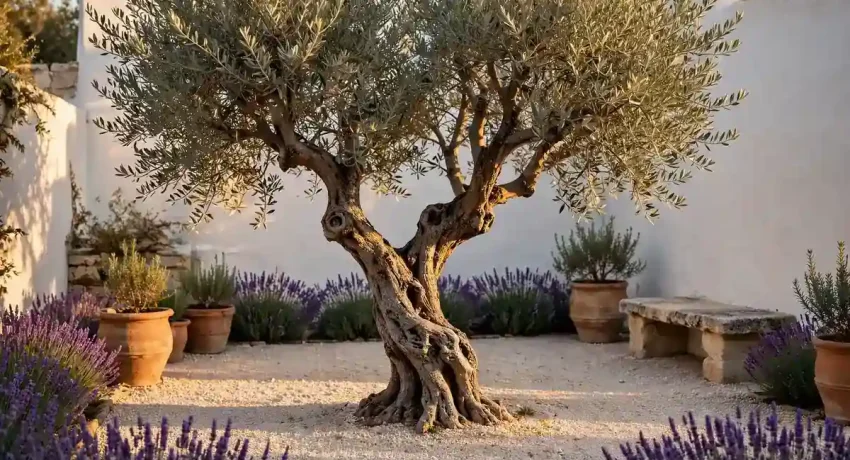
This is the classic move, and it still wins. Plant one Majestic Beauty olive as an olive tree focal point in the centre of a courtyard, or slightly off-centre for a more natural feel. Surround it with pale gravel or decomposed granite. Add a stone bench nearby. Keep the walls plain and light. The tree becomes the entire design. An olive tree courtyard like this needs little else to feel complete. Glass walls around the courtyard make it visible from inside the house, so the garden doubles as living art. For a walled courtyard, one tree is enough. Two would fight for attention.
2. Flank the Front Door With a Matching Pair
Symmetry at the entrance never fails. Place a Majestic Beauty olive in a large pot on each side of the front door. Use matching containers, terracotta or stone, and keep the trees clipped to a similar shape. The pair frames the doorway and tells visitors that the house is cared for. Because the variety is fruitless, no olives will drop on the steps. In a narrow entry, choose younger, slimmer trees, while a wide entry can take bigger trees whose canopies arch toward each other.
3. Make One Tree the Front Yard Focal Point
One well-placed olive can change the feel of a whole front garden, and an olive tree front yard is the easiest place to see the effect. Plant it slightly off-centre, not dead in the middle, and surround the base with gravel or low, drought-tolerant planting. Rosemary and santolina work well. A curved bed edge softens the layout. The tree adds height and age to a flat front yard, and its silver leaves stand out against any house colour. For curb appeal, this single move beats a dozen small shrubs.
4. Line a Driveway for an Elegant Entrance
An olive tree driveway turns a plain approach into an arrival. A row of olives along the drive creates rhythm. Space the trees evenly, about 15 to 20 feet apart, and keep the ground beneath them simple with gravel or low groundcover. The repeated trunks create rhythm. At night, small uplights at the base of each trunk make the driveway feel like a private avenue. Young, slender trees work best here, since they form a clean line without crowding the cars.
5. Grow One in a Giant Terracotta Pot on the Patio
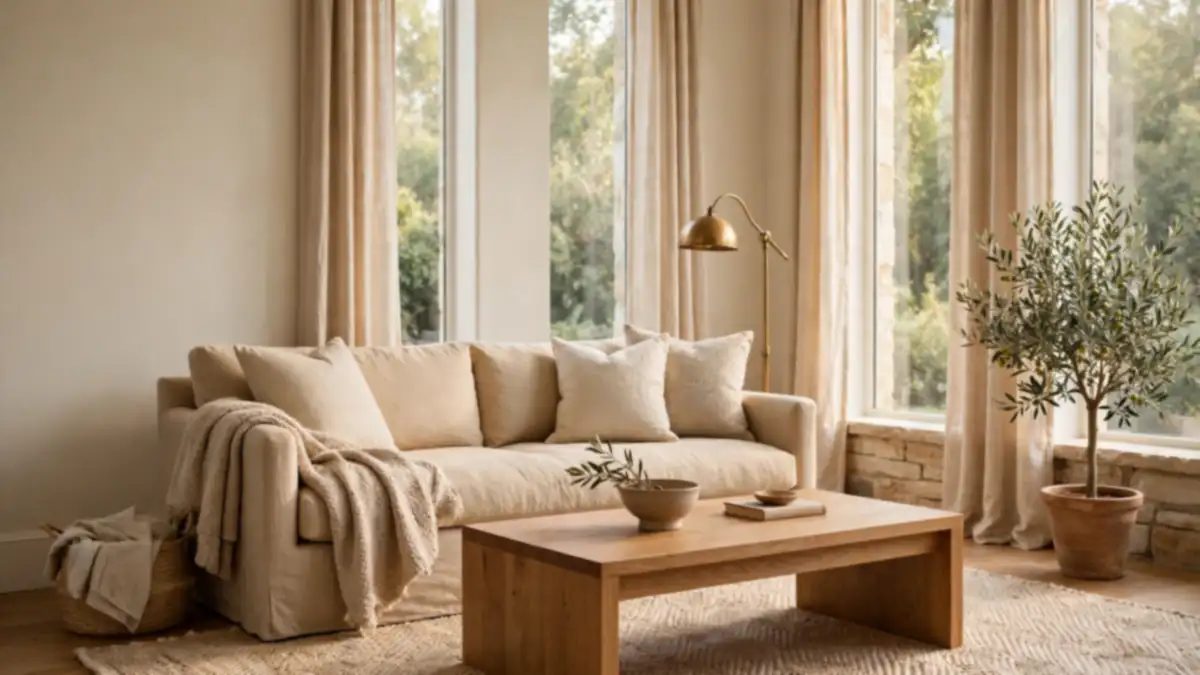
No garden bed? No problem. An olive tree in pots is one of the easiest ways to enjoy this tree without a garden bed. A Majestic Beauty olive grows well in a large container, as long as the pot drains freely and the tree gets full sun. Terracotta is the classic choice. It breathes, it drains, and its warm colour plays beautifully against silver leaves. For an olive tree patio display, choose a pot at least 24 inches wide for a young tree. Place it where it anchors a seating area, perhaps beside an outdoor sofa or at the corner of a dining terrace. Underplant the pot with lavender or creeping thyme for a finished look.
6. Shade a Poolside Terrace
Pools and olives belong together, and an olive tree poolside gives dappled shade without dropping fruit into the water, which is exactly why the fruitless varieties were bred. Plant it a few feet back from the pool edge so roots stay clear of the coping. Pair it with pale stone decking and a couple of loungers. Lavender and agave nearby complete the resort feel. Avoid planting it so close that the canopy overhangs the water, since even evergreen leaves shed a little. A few feet of distance solves the problem.
7. Create an Outdoor Dining Room Under the Canopy
An olive canopy makes the best outdoor dining roof. It filters the sun, lets air move, and never traps cooking smoke the way a solid pergola can. Place a table and chairs under a mature tree, or plant a young tree beside a dining terrace and let it grow into the role. A gravel floor keeps things clean. String lights in the branches turn dinner into an evening event. Because there is no fruit to fall on the table, the spot stays usable all season.
8. Build a Gravel Garden Island Around the Trunk
Give the tree its own island. Mark a circle or soft oval around the trunk with stones, bricks, or a low timber edge. Fill it with pale gravel. Add a few boulders and one or two low companions, such as lavender or a small agave. The island reads as a designed feature, not just a tree in a lawn. It also keeps mowers and foot traffic away from the roots. Round islands suit formal gardens. Free-form shapes suit relaxed, naturalistic ones.
9. Raise the Tree on a Stone Pedestal or Planter
Lift the tree, and you lift its presence. A raised circular planter, built from stone or rendered block, gives the olive a pedestal effect near an entrance or along a path. White stone and pale gravel brighten the base while keeping attention on the twisted trunk. Rounded shrubs at the edge soften the hard lines. This trick works well on flat ground, where a tree at grade level can look lost. The height also improves drainage, which olives love.
10. Soften a Fence or Wall With a Row of Olives
A bare fence is a design problem, and an olive tree privacy screen is the softer answer. A row of small olive trees along the boundary forms a screen that still lets light through. Over time, the canopies knit together into a loose, airy hedge. Unlike a solid wall of shrubs, an olive row keeps the garden feeling open. Space the trees about 8 to 10 feet apart. This also works along a property line, where the trees add privacy without blocking the sky.
11. Fit One Into a Small Garden or Balcony
Small spaces love olives, and an olive tree small garden works because the tree gives height without bulk. A young Majestic Beauty olive in a large pot can anchor a tiny courtyard, a roof terrace, or a generous balcony. Keep the rest of the planting minimal. One tree, one pot, a little gravel, and a chair is a complete garden. Prune lightly each year to hold the shape. In a small space, the tree should be the only tall element. Everything else stays low.
12. Light the Trunk at Night
An olive tree is a different tree after dark. A single warm-white uplight at the base throws the twisted trunk and canopy into sharp relief against a dark wall or the night sky. The silver leaves catch the light and shimmer. Place the fixture close to the trunk and aim it upward. Avoid coloured lights, which cheapen the effect. Two fixtures, one on each side, work for a large specimen. Solar spike lights can work, though wired low-voltage lights are brighter and more reliable. Night lighting turns the tree into a year-round feature instead of a daytime one.
13. Plant a Mini Grove of Three
Three olives, planted as a loose triangle, create a miniature grove. The effect is closer to a Tuscan hillside than a formal garden. Space the trees 12 to 15 feet apart so each one keeps its own shape. Fill the ground between them with decomposed granite and a drift of lavender. Add a rustic bench in the middle. This works best in a larger garden, where the grove can sit as its own room. It also suits a corner that feels empty, since three trees fill space without needing a dozen shrubs.
14. Contrast the Tree With Modern Architecture
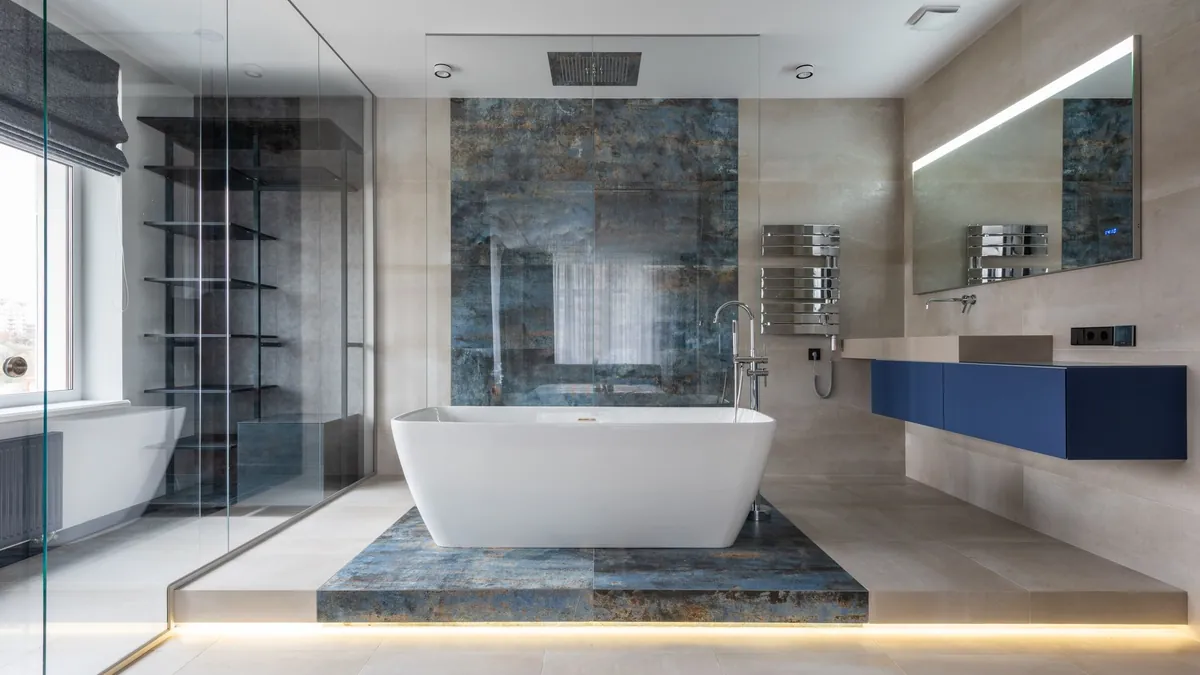
The olive is one of the few plants that looks better against modern buildings than traditional ones. Its organic, twisted form fights the straight lines of concrete, glass, and steel. That contrast is the point. Place a mature olive against a flat white wall or beside a black-framed window. Keep the ground plain with large-format pavers or pale gravel. The tree softens the architecture, and the architecture makes the tree look older and more sculptural. Less is more here. One tree, one wall, and nothing else competing for attention.
What Should You Plant Around an Olive Tree?
Choosing olive tree companion plants makes or breaks an olive design. The right neighbours share the olive’s needs: full sun, sharp drainage, and little water once established. They also share its colour family, which is the heart of Mediterranean garden design. The wrong neighbours, such as thirsty lawn grass or shade-loving ferns, will struggle and look out of place.
| Companion | Why it works | Where to use it |
|---|---|---|
| Lavender | Silver foliage, purple flowers, fragrance, same dry soil | Under and around the trunk, in drifts |
| Rosemary | Evergreen, aromatic, similar grey-green tones | Low hedging, bed edges, paths |
| Santolina | Soft silver mounds that echo the olive leaves | Edging, gravel beds, underplanting |
| Sage and thyme | Low, fragrant, drought tolerant | Groundcover, between pavers, pot edges |
| Agave and yucca | Bold sculptural shapes contrast with fine olive leaves | As accents, a few feet from the trunk |
| Ornamental grasses | Movement and softness against the rigid trunk | Blue fescue or Mexican feather grass in drifts |
| Fig tree | A true Mediterranean partner, similar sun and soil needs | As a second tree, well spaced from the olive |
| Citrus | Glossy green leaves and fruit add a second note | Nearby in a pot or bed, not crowding the olive |
| Boxwood | Clipped green structure, formal contrast | Low hedging around a courtyard olive |
| Creeping thyme | Fragrant, flat, handles light foot traffic | Between stepping stones, gravel joints |
Planting lavender under olive tree canopies deserves a special mention. It is the classic olive companion for a reason. The purple flowers peak as the silver leaves shine, and the scent carries on warm air. Plant lavender in drifts of seven or more, not in single plants. A drift reads as a river of colour, while a single plant reads as an accident.
What should you avoid? Thirsty plants are the main problem. A lawn ring around the trunk will need far more water than the olive wants, and wet soil invites root rot. Heavy shade plants will sulk in the full sun the olive demands. Bright bedding flowers, such as red geraniums or orange marigolds, clash with the silver palette. Keep the planting quiet, and the tree stays the star.
Which Materials Make an Olive Tree Look Its Best?
Materials do half the design work. In drought tolerant landscape design, the ground surface matters as much as the planting. The right ground surface makes the tree look intentional, while the wrong one makes it look like an afterthought.
Pale gravel is the safest choice. White or cream gravel brightens the base, reflects light into the canopy, and needs almost no care. Decomposed granite gives a similar effect with a softer, more natural feel. Both drain well, which olives need. Large-format stone pavers in limestone or sandstone add structure for patios and paths. Their warm tones sit well with silver leaves.
Terracotta brings warmth. Use it for pots, edging, or a low wall. Its orange-brown colour is the natural complement to silver-green. Corten steel, with its rusted orange patina, does a similar job in modern gardens. It works well as edging, planters, or a backdrop panel. White rendered walls are the classic Mediterranean backdrop. They bounce light onto the tree and make the trunk stand out.
Wood can work too, though it needs care. A hardwood deck beside an olive feels warm and natural. Keep the deck clear of the trunk so the tree has room to grow. Avoid dark mulch near the trunk. It holds moisture against the bark and looks heavy next to pale leaves. Gravel is the better mulch for olives.
How Do You Light an Olive Tree at Night?
Olive tree lighting is the cheapest way to double the value of your design. A tree you only see by day is half a feature, but one lit at night becomes the garden’s centrepiece after sunset.
Start with one warm-white uplight at the base. Aim it up the trunk so the light catches the twists and the underside of the canopy. Warm white, around 2700K, suits the silver leaves. Cool white looks harsh and clinical. For a large specimen, add a second light on the opposite side. Cross-lighting removes hard shadows and shows the full shape.
Downlights in the canopy are a second option. A small fixture tucked into a branch throws dappled light onto the ground below, like moonlight. This works well over a dining table or a bench. Keep the fixtures hidden. Visible hardware ruins the illusion.
String lights are the casual option. A loose swag of warm fairy lights through the lower branches turns a patio olive into a party tree. Use them for gatherings rather than every night, or they lose their charm. Whatever you choose, put the lights on a timer. A tree lit all night wastes power and disturbs wildlife.
How Much Care Does a Designed Olive Tree Need?
Fruitless olive tree landscape design and care are linked. A neglected tree will not hold its shape, and a badly pruned one will lose the sculptural form you designed around. The good news is that a Majestic Beauty fruitless olive is a low-care tree once it is established.
In brief: give it full sun and well-drained soil. Water deeply while it settles in, then cut back. Olives hate wet feet. Prune in late winter, removing dead wood and crossing branches, and keep suckers off the base. Feed lightly, if at all. That is the whole routine in one paragraph.
For the full details, including planting steps, watering schedules, pruning technique, pest control, and costs, read our Majestic Beauty fruitless olive planting and care guide. Design the garden first, then use that guide to keep the tree looking the way you designed it.
What Design Mistakes Should You Avoid?
Most olive designs fail for the same five reasons. Avoid them, and you are most of the way there.
Mistake one: planting too close to the house. A Majestic Beauty olive can reach 25 to 30 feet wide. Planted two feet from a wall, it will outgrow the space and start to look cramped. Give it at least 10 feet from walls and 15 feet from other large trees. Measure the mature size, not the size in the nursery pot.
Mistake two: crowding the base. A ring of dense shrubs around the trunk hides the very thing that makes the tree beautiful. The trunk is the sculpture. Keep the base open with gravel and low planting only. If you cannot see the trunk from ten feet away, you have planted too much.
Mistake three: too many colours. Bright flower beds next to an olive create visual noise. The silver leaves need quiet neighbours. Stick to greens, greys, whites, and the purple of lavender. One accent colour is enough. Three is a mess.
Mistake four: the wrong ground. A thirsty lawn under an olive is a conflict. The grass wants water every week, while the olive wants to dry out between waterings. One of them will lose. Gravel, decomposed granite, or stone solves the conflict at once.
Mistake five: forgetting the view from inside. You will see the tree from your windows far more often than from the garden. Check the sightline from the kitchen, the living room, and the bedroom. If the tree sits behind a shed or a fence from those angles, move it. Design for the view you actually live with.
Frequently Asked Questions
Can a Majestic Beauty fruitless olive grow in a pot?
Yes, it grows well in a large container as long as the pot drains freely and the tree gets full sun. Choose a pot at least 24 inches wide, use a free-draining mix, and water when the top few inches of soil dry out. Container trees stay smaller than ground-planted ones, which suits patios and balconies. Repot every few years as the roots fill the container.
How fast does a Majestic Beauty olive grow in a garden design?
Slowly, which is part of its design value. Expect roughly 12 to 24 inches of growth a year in good conditions. A young tree will take several years to reach its full shape. That slow pace means the layout you plan today will still look right in five years, and the tree will not outgrow its space overnight.
What grows well under a fruitless olive tree?
Lavender is the classic choice, along with rosemary, santolina, sage, and thyme. All share the olive’s love of sun and dry soil. Low grasses such as blue fescue add movement. Avoid thirsty plants and dense shrubs that would hide the trunk. Keep the planting low so the sculptural trunk stays visible.
Is a fruitless olive tree good for a small garden?
Yes, it is one of the best trees for a small garden. A single young tree in a large pot gives height and structure without taking much ground space. Its slow growth keeps it manageable, and its evergreen canopy provides year-round interest. Keep everything else in the garden low, and let the olive be the only tall element.
Does a Majestic Beauty olive drop leaves on patios and pools?
It drops very little. As an evergreen, it sheds old leaves gradually rather than all at once, and it produces little to no fruit. That is why designers use it over patios and near pools. A light sweep now and then is enough. Planting it a few feet back from the pool edge keeps even that small amount of leaf fall out of the water.
Can I plant a Majestic Beauty olive near a driveway?
Yes, and it is one of the best uses for the tree. A row of olives along a driveway creates an elegant entrance, and the fruitless variety means no olives will stain the paving or the cars. Space the trees 15 to 20 feet apart, keep the ground beneath them in gravel, and add small uplights at the base of each trunk for a striking effect at night.
Sources: Homedit, “15 Olive Tree Landscaping Ideas That Make Outdoor Spaces Feel Mediterranean”; Gardenista, “Genius Garden Ideas: 10 Landscapes with Olive Trees”; Homes & Gardens, “Landscaping with olive trees: 9 expert ideas”; Gardenia, “Mediterranean Gardens: Design Rules, Plant Lists, Ideas & Care”; Plant Insights, “How to Design a Modern Olive Tree Landscape”; The Norfolk Olive Tree Company, “Striking Plant Combinations for Olive Trees”; DIY Garden, “15 Stunning Olive Tree Landscaping Ideas”; David Domoney, “Ideas for designing a Mediterranean garden.”