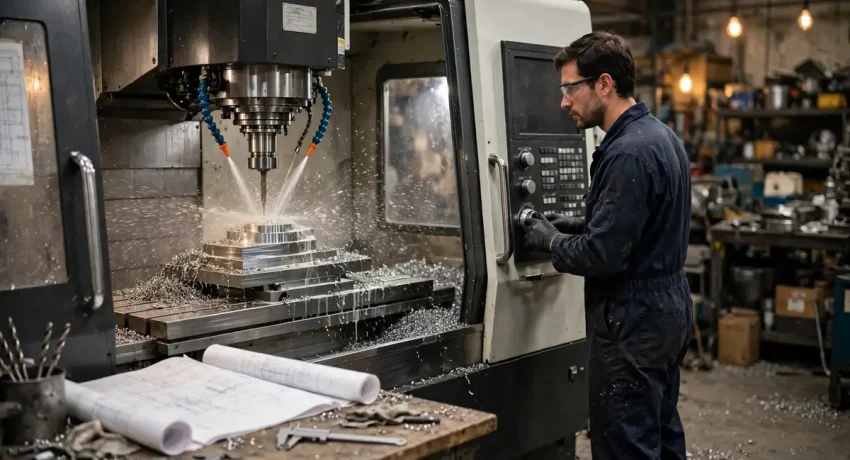

Some machinists spend their whole career at one shop, on one machine, in one town. Others pack a bag every few weeks and go where the work is. A traveling CNC machinist belongs to the second group. The job mixes skilled trade work with real travel, and the pay can beat a stationary shop role by a wide margin.
But the road life is not for everyone. Long hours, hotel rooms, and weeks away from home are part of the deal. This guide explains what traveling CNC machinist jobs actually involve, what they pay in 2026, and how to get into the work.
What Is a Traveling CNC Machinist?
A traveling CNC machinist is a machinist who works away from home for most of the year. Instead of reporting to the same shop every morning, you move from site to site. Each assignment lasts a few weeks or a few months, then you move on.
The work falls into three main types. Field machinists travel to a client’s plant and machine parts in place. They use portable machine tools on equipment that is too big, too heavy, or too urgent to ship to a shop. Contract machinists work through a staffing firm that places them at shops across the country. These jobs usually run two to three months or more, and the firm pays a per diem on top of the hourly rate. Outage machinists work on plant shutdowns, when a refinery, power station, or nuclear plant stops for maintenance. The work is intense, the hours are long, and the pay reflects that.
Some traveling machinists are CNC programmers who fly in to set up a job, write the program, prove it out, and leave. Others are setup specialists who get a shop’s new machine running and train the local crew. The common thread is movement. Your skill travels with you.
How Much Do Traveling CNC Machinists Make in 2026?
Pay depends on the type of traveling work. A shop-based CNC machinist earns a solid wage. Traveling machinists earn more, because the employer is paying for the inconvenience of life on the road. Here is how the numbers stack up in 2026.
| Role | Typical pay in 2026 | Source |
|---|---|---|
| Entry-level CNC machinist | $38,000 – $50,000 a year | SalarySolver |
| Mid-level CNC machinist (3–5 years) | $50,000 – $65,000 a year | SalarySolver |
| Average CNC machinist, all levels | $49,183 a year ($23.65 an hour) | ZipRecruiter, October 2026 |
| Senior machinist or lead | $65,000 – $85,000+ a year | SalarySolver |
| CNC machinist and programmer | $64,389 a year on average | ZipRecruiter, October 2026 |
| Field machinist II (traveling) | $100,000+ a year, plus per diem | In-Place Machining job listing |
The gap between a shop machinist and a field machinist is large. ZipRecruiter puts the average CNC machinist at $49,183 a year as of October 2026, with most earning between $41,000 and $56,000. Top earners reach $63,500. By contrast, a current field machinist listing from In-Place Machining Company advertises $100,000 or more a year, plus travel per diems and overtime.
Why the difference? Three things push traveling pay higher. Overtime is routine on the road, and many assignments run 60 hours a week. Per diem adds hundreds of dollars a week on top of wages. And some jobs carry a field differential, a pay bump of 25 to 50 percent over the shop rate, according to machinists posting on the Practical Machinist forum.
The Bureau of Labor Statistics puts the median annual wage for machinists at $58,750 as of May 2025. That figure covers all machinists, not just travelers. It also shows how much room there is to grow. A machinist who learns programming can move into the $64,389 average that ZipRecruiter reports for CNC machinist-programmers, with top earners at $85,000.
How Does Per Diem Work?
Per diem is the daily allowance your employer pays to cover meals and lodging while you travel. It is the part of traveling pay that newcomers often misunderstand, so it is worth explaining clearly.
In most traveling machinist jobs, the employer pays for the hotel directly or reimburses it, and the per diem covers food and small daily costs. The amounts vary by employer and project. In contract listings and forum posts, per diem for machinists commonly runs from about $75 to $110 a day. One staffing firm, MADICORP, advertised $110 a day in per diem on top of $30 an hour for contract CNC machinist work. A field service firm, TEAM, lists full travel and per diem paid as part of its field machinist roles.
Per diem is usually paid for every day you are on assignment, including weekends, as long as you stay near the job site. Some employers pay it seven days a week. Others pay it only on work days. Ask before you accept a job, because the difference adds up to hundreds of dollars a week.
Travel pay is separate. Most employers cover flights or mileage to and from the job site, and they pay for travel days. A few pay a flat travel allowance instead. Again, the details are in the offer, so read it before you sign.
What Does a Traveling CNC Machinist Do All Day?
A typical day starts early. Field machinists often begin around 6:30 in the morning, and the day can run 10 to 12 hours. You will spend the day setting up machines, cutting parts, checking measurements, and documenting the work.
Field machining is different from shop machining. In a shop, the machine is fixed and the part comes to you. Out in the field, you bring the machine to the part. Portable lathes, mills, and boring bars get bolted onto the equipment itself. You might machine a flange face on a refinery pipe, bore a bearing housing on a turbine, or cut and bevel pipe ends at a power plant. Parts can weigh 10 tons or more, and the work has to be right the first time.
Tolerances in the field are just as tight as in the shop. One field machinist listing asks for work held to plus or minus 0.010 inches under difficult conditions. You will measure with micrometers, dial indicators, and bore gauges, and you will record everything. Clients in power, aerospace, and refining expect paperwork to match the work.
Contract shop machinists have a different rhythm. You work in a host shop for a few months, running their machines to their programs. The work is more like a regular shop job, except the shop changes every few months. Some contract machinists stay in one region. Others cross the country several times a year.
Where Is the Work?
Traveling machinists work wherever big machines need attention. The main industries are power generation, refining and petrochemicals, aerospace, defense, and nuclear power. Agriculture equipment makers and food processors also use traveling machinists for on-site work.
Nuclear outages are a world of their own. When a nuclear plant shuts down for refueling and maintenance, hundreds of contract workers arrive for a few weeks. Machinists are a small part of that crew. One forum post from an outage veteran notes that a typical outage brings in more than 150 valve technicians and only about five machinists. The machinists who do get those jobs earn prevailing-wage rates, which can be very high.
Shutdowns in refineries and chemical plants follow the same pattern. The plant stops, the work has to be done fast, and the pay reflects the urgency. These jobs are not steady, but they pay well when they come.
Geography matters too. The Midwest has a steady stream of contract CNC work for agricultural equipment suppliers catching up on production backlogs. Gulf Coast refineries and petrochemical plants offer plenty of field work too. The Southeast has field machining firms based around Savannah, Georgia, and the Pacific Northwest has work in paper, power, and aerospace.
How Do You Become a Traveling CNC Machinist?
You do not start as a traveling machinist. Start as a machinist, build skill, and then take the skill on the road. Here is the path most people follow.
What training do you need first?
Most CNC machinist programs take 12 to 18 months, according to Hardhat Careers. You can train at a trade school, a community college, or through a registered apprenticeship. Apprenticeships pay while you learn, typically $18 to $32 an hour, and they combine classroom work with shop time. A high school diploma or GED is the usual starting point, along with decent math skills.
You can learn programming basics at home. Free tools like Fusion 360 teach CAD and CAM concepts, and G-code is a language you can study on your own. But real machine experience only comes from shop time. No employer will send a beginner to a client site alone.
Which certifications help?
The best-known credential is from NIMS, the National Institute for Metalworking Skills. NIMS certifications cover CNC milling, turning, and measurement, and employers across the country recognize them. A NIMS credential will not get you a traveling job by itself, but it proves your skills to a hiring manager who has never seen you work.
Some employers want a journeyperson certificate or a Red Seal endorsement, especially in Canada. In the United States, the credential that matters most is a record of tight-tolerance work and a clean safety history.
How much experience do you need before traveling?
Most traveling roles ask for at least three to five years of shop experience. Field machinist listings from In-Place Machining ask for five or more years of manual or field machining experience. Contract shop roles are more open, and some take machinists with two or three years of solid work.
The reason is simple. On the road, there is nobody to check your setup. You have to read the print, choose the tooling, set the machine, and prove the first part yourself. Shops that hire travelers are buying judgment, not just hands.
What does the career ladder look like?
The ladder runs from operator to setup machinist to programmer to lead. Operators load parts and run proven programs. Setup machinists choose tooling, set work offsets, and prove out new jobs. Programmers write the G-code and CAM programs. Leads run the cell or the crew.
Each step up pays more. Entry-level machinists earn $38,000 to $50,000, according to SalarySolver. Mid-level machinists earn $50,000 to $65,000. Senior machinists and leads earn $65,000 to $85,000 or more, and programmers can reach $75,000 to $100,000. Traveling work adds per diem and overtime on top of those base rates.
Which Skills Pay the Most?
Not all machining skills pay the same. The highest-paid traveling machinists share a few abilities that shops struggle to find.
Multi-axis machining tops the list. Five-axis work and mill-turn centers are common in aerospace and medical parts, and machinists who can set up and program them earn a premium. CAM programming is close behind. Shops pay well for people who can take a solid model and turn it into a working program without hand-holding.
Tight-tolerance work is another money skill. Aerospace and medical parts often carry tolerances in the thousandths of an inch, and the machinists who can hold them reliably are worth more. Experience with common control systems, especially Fanuc and Siemens, also helps, because a traveling machinist has to walk up to an unfamiliar machine and get it running.
Manual machining still matters in the field. Portable machine tools are often manual, and a field machinist who can run a manual lathe or mill by feel is in demand. The best traveling machinists are comfortable on both CNC and manual equipment.
What Are the Downsides?
Traveling work pays well for a reason. The lifestyle is hard, and it is honest to say so before you sign up.
Time away from home is the biggest cost. Assignments can run for weeks or months, and you will miss birthdays, school events, and ordinary evenings at home. Some machinists love the freedom. Others find the hotel life lonely, especially when they work alone on a remote site.
Hours are long. Sixty-hour weeks are common on contract jobs, and outage work can run even longer. The overtime pays well, but it wears on the body. You will stand for most of the day, work in heat or cold, and climb ladders and platforms in industrial plants.
Work is not always steady. Contract jobs end, and the next one may take a week or two to find. Direct-hire field machinists have steadier work, but even they have slow stretches between projects. A cash cushion matters in this career.
Safety is a real concern too. Refineries, power plants, and nuclear sites have strict safety rules for good reason. You will take site safety training, wear protective gear, and follow procedures that leave no room for shortcuts.
Should You Go Contract or Direct Hire?
Traveling machinists usually work in one of two ways. Each has trade-offs.
Direct hire means you work for one company, such as a field service firm, and they send you to jobs. You get benefits, paid time off, and a steadier schedule. In-Place Machining, for example, offers paid time off, 11 paid holidays, and a full benefits package with its field machinist roles. TEAM offers excellent benefits, a 401(k) match, and paid vacation. The pay is strong, and the work is more predictable.
Contract work means a staffing firm places you at a shop or site for a set period. You earn an hourly rate plus per diem, and the hours are often longer. One staffing firm, MADICORP, guarantees 60 hours a week on its contract machinist jobs, at $30 an hour plus $110 a day in per diem. That works out to roughly $2,570 a week before taxes. The trade-off is no benefits and no guarantee of what comes next.
Some machinists work as independent contractors. That can pay the most, but you carry your own insurance, pay your own taxes, and find your own work. It suits experienced machinists with a strong network, not beginners.
What Is the Job Outlook for CNC Machinists in 2026?
The outlook is steady rather than booming. Federal projections put openings at about 30,400 a year for machinists and tool and die makers through 2035. Most of those openings come from workers retiring or leaving the trade, not from new jobs. Total employment is expected to stay roughly flat, with machinists alone growing about 1 percent over the decade.
That flat headline hides a real shortage. About 31 percent of machinists are 55 or older, according to Bureau of Labor Statistics survey data reported by Apollo Technical. As those workers retire, shops will need replacements. Employers already report that they cannot find enough skilled machinists, and that shortage is part of why traveling pay stays high.
Technology is changing the trade, but it is not replacing it. Automation handles simple, repetitive work. The work that remains needs judgment: setting up a new job, holding a tight tolerance, and fixing a problem on a machine you have never seen before. Those are exactly the skills a traveling machinist sells.
How Do You Find Traveling CNC Machinist Jobs?
Start with the staffing firms that specialize in skilled trades. Firms like MADICORP place contract machinists across the United States, and they list current pay rates and per diem openly. General job boards also carry traveling machinist postings, but the specialist firms know the market better.
Apply directly to field service companies too. In-Place Machining Company, TEAM Industrial Services, and similar firms hire field machinists full time. Their listings spell out the travel, the per diem, and the benefits. If you have five years of experience and a clean record, you are the candidate they want.
For outage work, watch the nuclear and power industries. The Nuclear Company posts traveling machinist roles for outage and project work across nuclear, power generation, and industrial facilities. These postings usually cover multiple sites at once, so one application can reach several projects.
Your resume should lead with the things traveling employers care about. List the machines you have run, the controls you know, the tolerances you have held, and the industries you have worked in. Mention safety training and any NIMS certifications. A short, specific resume beats a long, vague one.
Frequently Asked Questions
Do traveling CNC machinists make $100,000 a year?
Some do. Field machinist listings from In-Place Machining advertise $100,000 or more a year, plus per diem and overtime. That level usually needs five or more years of experience and the willingness to travel most of the year. A typical shop-based CNC machinist earns far less, around $49,183 a year on average, according to ZipRecruiter.
How much is per diem for a traveling machinist?
In the listings and reports we found, per diem commonly runs from about $75 to $110 a day. It covers meals and daily costs while you are on assignment. Hotels are usually paid separately by the employer. Always confirm whether per diem is paid seven days a week or only on work days.
How long does it take to become a CNC machinist?
Most training programs take 12 to 18 months. Apprenticeships take longer but pay while you learn. You will need another two to three years of shop experience before most traveling roles will consider you.
Do you need a degree to become a CNC machinist?
No. A high school diploma or GED is enough to start. Trade school, community college, or an apprenticeship provides the training. A four-year degree is not required, and most employers care far more about what you can machine than what you studied.
Is CNC machining a good career in 2026?
Yes, for the right person. The pay is solid, the training is short, and the work is in demand. About 30,400 openings a year are projected through 2035, and a third of current machinists are near retirement age. The trade rewards skill and experience, and traveling work adds a real pay premium for those who want it.
What is the hardest part of traveling machinist work?
Time away from home is the hardest part for most people. Long hours, hotel living, and unpredictable schedules wear on you. The work itself is rewarding, but the lifestyle is not for everyone. Try a short contract first before committing to a full year on the road.
Sources: U.S. Bureau of Labor Statistics, Occupational Outlook Handbook (machinists and tool and die makers, May 2025 wages and 2025–35 projections); ZipRecruiter CNC Machinist Salary and CNC Machinist and Programmer Salary pages (October 2026); SalarySolver CNC Machinist Salary in 2026; Hardhat Careers, How to Become a CNC Machinist in 2026; In-Place Machining Company field machinist listings; TEAM Industrial Services field machinist listing; MADICORP contract machinist listings; Apollo Technical, Skilled Trades Shortage Statistics 2026.