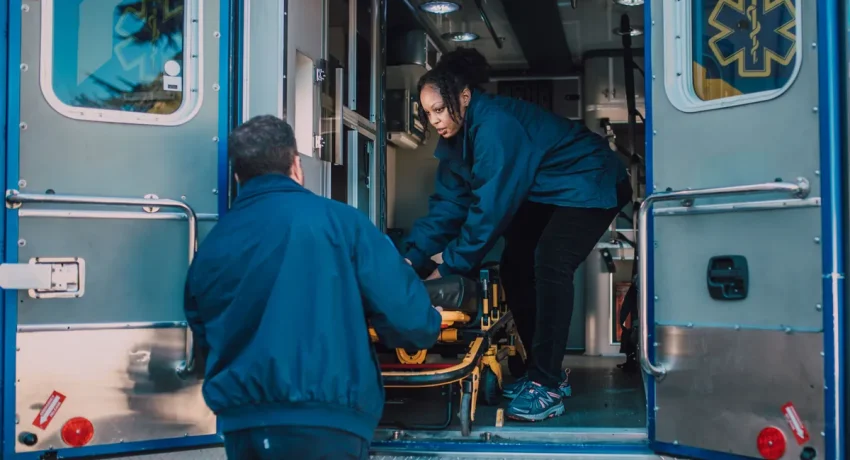

How Ambulance Services Work: Callouts, Crews and Emergency Care Explained?
An ambulance rushes past with lights flashing. Inside, a crew works on a patient while the driver finds the fastest safe route to hospital. Most people only see that moment. Behind it sits a whole service: control rooms, stations, crews, vehicles and hospitals working as one chain. This guide explains how that chain works.
Firstly, you will learn what an ambulance service is and what it covers. Secondly, you will follow a call from the phone to the hospital doors. Finally, you will meet the crews, the vehicles and the equipment, and learn when the service itself treats a call as an emergency. As a result, the next siren you hear will make more sense.
What Is an Ambulance Service?
An emergency ambulance explained in one line: it is a mobile emergency room that comes to the patient, treats them at the scene, and carries them to hospital when needed. In short, the service runs the vehicles, the crews and the control rooms that answer emergency calls. It is the link between a medical emergency and the hospital.
Emergency medical services cover more than the ambulance itself. The term includes the control room, the first responders, the paramedics, the air ambulance and the hospital’s emergency department. Together they form a system. A call to the emergency number starts the system. Finally, the hospital finishes it. The ambulance is the moving middle of that chain.
Emergency care explained in simple terms is care given in the first minutes and hours of a sudden illness or injury. It starts with the caller’s first aid, continues with the crew’s treatment at the scene, and ends with the hospital’s doctors and nurses. Each stage matters, because early care often decides the outcome. The ambulance service owns the middle stages.
Most ambulance services are public, run by a health authority or a regional body. Some areas use charities or private firms under contract. Health departments plan emergency cover for their counties, deciding how many stations and crews an area needs. However, the model stays the same everywhere: a public number, a control room, crews on standby, and hospitals at the end of the road.
How Does an Ambulance Call Work?
How ambulances work starts with a call. A person dials the emergency number and describes the problem. A call handler asks where, what and who is involved. In addition, the handler types the answers into a dispatch system, which grades the call by urgency. Then the nearest suitable crew is sent, and the handler stays on the line giving first aid advice until the crew arrives.
Ambulance dispatch explained step by step: the system looks at the location, the problem and the crews available. A life-threatening call gets the fastest response, often with two crews or an air ambulance as well. A less urgent call gets the next free crew. In addition, the dispatcher can send a solo rapid responder, a motorbike or a community first responder to start care early.
Meanwhile, control rooms work around the clock, handling many calls at once. Call handlers follow set questions, because the answers decide the priority. They also give instructions: how to stop bleeding, how to do chest compressions, or how to keep an airway open. Indeed, those instructions save lives before the crew arrives. In addition, the handler can call back if the situation changes.
Response starts the moment the crew is alerted. Firstly, the crew checks the address, picks the route and drives with lights and sirens when the call is urgent. The control room passes updates by radio, such as a gate code or a change in the patient’s state. Meanwhile, the crew prepares the equipment they expect to need. Consequently, a well-run dispatch means the crew arrives ready, not guessing.
Who Works in an Ambulance Crew?
Ambulance crews explained as a team, not a single role. A typical crew has two people: a paramedic and an emergency medical technician, or two paramedics. For example, one drives while the other treats, and they swap roles as needed. Larger incidents bring more crews, a supervisor and specialist teams. Each person knows their role before the doors open.
Paramedics explained in plain terms: they are trained clinicians who assess, treat and decide. They can give drugs, manage airways, read heart traces and decide which hospital suits the patient. Their training takes years, mixing classroom study with practice on real calls. A paramedic’s decisions at the scene shape the patient’s whole hospital stay.
Emergency medical technicians support the paramedic. They drive, lift, prepare equipment and give basic care. They also assess patients and pass information to the paramedic. In some systems, they are called ambulance technicians or emergency care assistants. The name changes, but the job holds: a skilled partner who keeps the crew moving.
Ambulance vs paramedic is a common confusion. An ambulance is the vehicle. A paramedic is the clinician inside it. The public says “call an ambulance” and means the whole service, but the treatment comes from the people, not the van. A crew with a paramedic can do far more at the scene than a crew without one, which is why staffing matters so much.
Other roles support the crews. Control room staff take the calls. Mechanics keep the vehicles ready. Trainers teach new skills. Managers plan the rotas. Volunteers, such as community first responders, attend calls in their own neighbourhoods before the ambulance arrives. Each role keeps the chain unbroken.
What Equipment Does an Ambulance Carry?
Ambulance equipment fills every corner of the vehicle. The stretcher carries the patient. The monitor reads heart rate, blood pressure and oxygen. The defibrillator restarts a stopped heart. Oxygen, drugs, bandages, splints and airway tools fill the cupboards. A suction unit clears an airway. Each item has a place. As a result, the crew can find it in the dark, in the rain, under pressure.
The ambulance carries a technology package of monitors, radios and navigation, and the crew trains on it constantly. Radios link the crew to the control room and the hospital. Navigation finds the fastest route. The monitor sends the patient’s heart trace to the hospital ahead, so doctors can prepare. That link between ambulance and hospital saves minutes that matter.
Different calls need different kits. A trauma bag holds bandages, splints and tourniquets. A maternity kit holds the tools for a birth. A paediatric kit holds small sizes for children. The crew picks the kit from the call details, then checks it on arrival. Preparation is the quiet half of the job, and it happens before the emergency, not during it.
Cleaning and restocking happen after every call. The crew wipes surfaces, replaces used items and checks the drug stocks. The vehicle is then ready for the next call. A crew that skips this step risks arriving at the next emergency without the item that matters most. Therefore, the ten minutes after a call are as important as the call itself.
What Types of Ambulances Are There?
Types of ambulances vary by job. The standard emergency ambulance is a large van with a treatment area, a stretcher and full equipment. A rapid response vehicle is a car with one paramedic, sent to start treatment fast. A motorbike ambulance weaves through traffic to reach patients in crowded streets. Each type answers a different problem.
The air ambulance explained in one line: it is a helicopter or plane that carries a medical team to patients far from a hospital, or to scenes a road vehicle cannot reach. The air ambulance brings the hospital’s skills to the scene, with a doctor or a critical care paramedic on board. It lands in fields, on roads and on rooftops, then flies the patient to the right hospital. However, weather and daylight limit its use. When it flies, it saves time no road vehicle can match.
Patient transport services move people who need a stretcher or medical support but are not in an emergency. A patient going to a planned hospital appointment, to dialysis or to a care home may travel by patient transport. The crew checks the patient, monitors them on the journey and hands them over at the other end. This work frees emergency ambulances for emergencies.
Specialist ambulances cover special needs. A neonatal ambulance carries tiny babies with incubators and specialist staff. A bariatric ambulance carries larger patients with wider stretchers and lifting gear. A major incident unit carries equipment for many casualties at once. Each specialist vehicle exists because one size cannot fit every patient.
How Fast Do Ambulances Arrive?
Ambulance response times are measured from the call to the crew’s arrival. The target time depends on the urgency. Life-threatening calls have the fastest target, often measured in minutes. Less urgent calls have longer targets. The service publishes its performance. As a result, the public can see how often the target is met.
Several factors shape the time. Distance matters most: a rural crew travels further than a city crew. Traffic, weather and roadworks add minutes. The number of calls matters too: a busy hour stretches every crew. Therefore, response times vary by place and by hour, and a single slow arrival does not mean the system failed.
Services plan their cover to meet the targets. Stations sit where the calls are. Crews start shifts before the busy hours. Rapid responders fill gaps. Hospitals share data so the control room knows which emergency department has space. Each measure shaves minutes, and minutes matter in the calls where the target is tightest.
When the wait is long, the control room stays in touch. The handler may call back, ask for updates and repeat first aid advice. A community first responder may arrive first and start care. The system does not go quiet while the ambulance travels. It keeps working, by phone and by neighbour, until the crew arrives.
When Should Someone Call an Ambulance?
When to call an ambulance is a question the service itself answers with a list. The service treats chest pain, breathing difficulty, signs of a stroke, heavy bleeding, a serious injury, a seizure, a severe allergic reaction and an overdose as emergencies. These are the calls where minutes matter and where the crew’s treatment changes the outcome.
Chest pain and breathing difficulty top the list, because they can signal a heart attack or a blocked airway. A face that droops, an arm that will not lift, or speech that slurs can signal a stroke. Heavy bleeding that will not stop needs pressure and a crew. A person who is unconscious or not breathing needs help at once. The call handler will ask the questions that sort these cases fast.
Some situations do not need an ambulance. A minor cut, a mild fever, a repeat prescription or a lift to a routine appointment are not emergencies. The service asks the public to use other routes for those: a pharmacist, a family doctor, an urgent care centre or patient transport. That advice protects the emergency crews for the calls that need them.
Calling early is better than calling late. People often wait, hoping the problem will pass. The service would rather attend a false alarm than arrive too late. A caller who is unsure can describe the symptoms and let the handler decide. The handler’s questions are designed to sort the urgent from the routine, and the caller does not need to diagnose the problem themselves.
How Did Ambulance Services Begin?
Ambulance history starts on the battlefield. In the late 1700s, a French army surgeon set up horse-drawn wagons to carry wounded soldiers from the field. Cities followed, with hand-pushed stretchers and then horse ambulances. Hospitals ran their own wagons, and the public called them by messenger or by phone.
Motor ambulances arrived in the early 1900s, and the service grew with the telephone. A call could summon a vehicle in minutes rather than hours. The Second World War brought organisation, with services covering whole cities. Then, in the 1960s and 1970s, paramedics appeared, and the ambulance changed from a taxi to a treatment room.
Modern services blend all of that history. The control room descends from the telephone exchange. The paramedic descends from the battlefield surgeon. The air ambulance descends from wartime helicopter rescue. Each layer added skill to the same job: reach the patient fast, treat them well, and carry them to the right hospital.
What Happens After the Ambulance Arrives at Hospital?
Handover is the moment the ambulance crew passes the patient to the hospital team. The paramedic gives a short report: what happened, what they found, what they did and what changed. The hospital team takes over, and the crew leaves. A good handover is short, clear and complete, because the hospital’s decisions rest on it.
The patient then travels to hospital, and the journey continues inside. Doctors assess, scan and treat. Some patients go home the same day. Others stay for days or weeks. Some patients need home health care after discharge, with nurses visiting to check wounds, give medicines and support recovery. The ambulance ride is one link in a longer chain of care.
Non-medical home care services support recovery at home too, helping with washing, dressing and meals while a person regains strength. These services are not ambulances, and they do not treat emergencies. They sit at the other end of the journey, where the emergency has passed and ordinary life resumes.
In some systems, health insurance covers the ambulance ride, while in others the service is free at the point of use. The funding model varies by country, and the bill, where there is one, arrives later. The crew never asks about payment at the scene. Their job is the patient, not the paperwork.
How Do Ambulance Crews Cope With the Job?
Ambulance work is demanding. Crews face trauma, death, violence and long shifts. Hard decisions come with little information. Heavy patients must be carried up narrow stairs. Nights, weekends and holidays are all working days. The job asks a lot, and the service must give support in return.
Crews also respond to mental health emergencies, where calm words matter as much as equipment. A person in crisis needs patience, listening and a safe journey to help. Paramedics train for these calls, learning how to de-escalate and how to keep everyone safe. The work is clinical and human at once.
Support for crews includes debriefs after hard calls, peer support and professional help. Many services run wellbeing programmes, and crews look out for each other. A crew that has just attended a difficult call may take a short break before the next one. That pause is part of the job, not a break from it.
Recruitment stays a challenge, because the job is hard and the training is long. Services run campaigns, cadet schemes and apprenticeships to bring new people in. Each new paramedic adds a crew to the rota, and each crew shortens someone’s wait. The chain grows one recruit at a time.
Why Does the Ambulance Service Matter?
The ambulance service matters because it brings care to the patient, rather than waiting for the patient to reach care. A heart attack at home, a crash on a country road, a birth in a flat: in each case, the crew arrives with skills and equipment that the scene does not have. That arrival changes what happens next.
The service also connects the parts of emergency care. The caller, the handler, the crew, the hospital and the recovery services all depend on each other. A break in any link weakens the whole chain. The ambulance service holds the middle links, and it holds them every hour of every day.
The next time you hear a siren, picture the chain. A call, a dispatch, a crew, a treatment, a handover, a hospital. Six links, one patient, and a service that exists for the moment when minutes matter most. That is how ambulance services work.