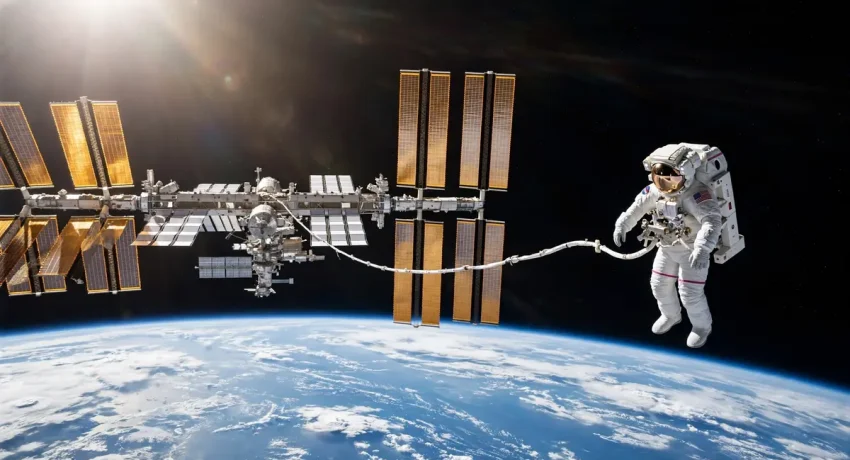

Picture this. You float outside a spacecraft, 400 kilometres above Earth. The planet curves below you in blue and white. Between you and the vacuum of space, there is only a spacesuit. That is a spacewalk.
Spacewalks look calm in photos. In reality, they are some of the hardest and most dangerous jobs in spaceflight. Every minute is planned, and every tool is tied down. And every astronaut who goes outside has trained for years to do it. How do spacewalks work? This guide explains the whole job, from the first one in 1965 to the solar array work of 2026 and the Moon walks coming next.
What Is a Spacewalk?
A spacewalk happens any time an astronaut leaves a spacecraft while in space. NASA calls it an EVA, short for extravehicular activity. That phrase simply means work outside the vehicle.
The name is a little misleading. Astronauts do not really walk. They float, climb hand over hand, and use their hands far more than their feet. There is no ground to walk on. Still, the name has stuck for more than 60 years.
Most spacewalks today happen outside the International Space Station. Astronauts go out to fix things, install new parts, and run science experiments. They work in pairs. Two astronauts go outside together, while the rest of the crew supports them from inside.
A Short History of Spacewalks
Spacewalking began in the middle of the Space Race. It has grown from a 10-minute gamble into routine maintenance work. These are the moments that shaped it.
| Year | Moment |
|---|---|
| 1965 | Alexei Leonov makes the first spacewalk from Voskhod 2 |
| 1965 | Ed White makes the first US spacewalk from Gemini 4 |
| 1984 | Bruce McCandless makes the first untethered spacewalk |
| 1993 | Five spacewalks repair the Hubble Space Telescope |
| 2019 | Christina Koch and Jessica Meir complete the first all-women spacewalk |
| 2026 | US spacewalk 100 installs a new solar array on the ISS |
Alexei Leonov stepped outside the Soviet Voskhod 2 capsule on March 18, 1965. He spent about 12 minutes floating in space. The trip nearly ended in disaster. His suit swelled up in the vacuum. It grew so stiff that he could not squeeze back through the airlock. Leonov had to let some oxygen out of his suit, a risky move, before he could get inside. He made it back, sweating and exhausted.
Less than three months later, Ed White became the first American to spacewalk. He floated outside Gemini 4 on June 3, 1965, for about 23 minutes. White used a small handheld oxygen gun to move himself around. The contrast with Leonov was sharp. White’s walk looked smooth and easy. It was not. Both men were testing ideas that nobody had tried before.
By the 1980s, spacewalks had become a tool, not a stunt. In 1984, Bruce McCandless flew free of any tether with a jet-powered backpack called the manned maneuvering unit. It was the first untethered spacewalk. Photos from that flight are still famous today.
The Hubble Space Telescope gave spacewalks their greatest rescue job. Hubble launched in 1990 with flawed optics. Its mirror could not focus light properly. In December 1993, seven astronauts flew up on the shuttle Endeavour. They carried out five spacewalks in five days, fitting corrective optics and saving the telescope. Hubble went on to change astronomy. None of that would have happened without hands-on work in orbit.
Spacewalks also built the International Space Station. Piece by piece, crews assembled the station in orbit over many years. By late 2026, astronauts had carried out nearly 286 spacewalks in support of the ISS. The station exists because people were willing to work outside it.
Why Do Astronauts Go on Spacewalks?
A NASA spacewalk is never done for fun. Each one has a clear job. The work falls into a few groups.
- Repairs. Pumps, antennas, and cooling lines break. A spacewalker can fix them in place instead of bringing them back to Earth.
- Installation. New solar arrays, cameras, and docking adapters go on the outside of the station. Someone has to bolt them down.
- Science. Some experiments must sit outside the station. Astronauts place them there and collect them later.
- Testing. New tools, suits, and equipment get their first real trial during a spacewalk.
- Servicing. Telescopes and satellites in orbit can be repaired and upgraded by hand, as Hubble proved.
Robots do much of the outside work now. The station’s Canadarm2 robotic arm moves heavy parts into place. But some jobs still need human hands, eyes, and judgment. When a bolt will not turn or a cable will not fit, a person goes out to deal with it.
What Do Astronauts Wear on a Spacewalk?
The suit is called the Extravehicular Mobility Unit, or EMU. Astronauts call it their own little spacecraft. An astronaut spacesuit is not clothing but a machine built around a person. It does far more than cover the body — it keeps the person inside alive.
| System | What It Does |
|---|---|
| Oxygen supply | Provides pure oxygen to breathe and flushes out carbon dioxide |
| Pressure | Holds the suit at about 4.3 psi so the body can function |
| Cooling garment | Circulates water through underwear to control body temperature |
| Drink bag | Lets the astronaut sip water during long spacewalks |
| Radio | Keeps the spacewalker in touch with the crew and Mission Control |
| Outer layers | Shield against micrometeoroids, radiation, and extreme temperatures |
| Life-support backpack | Carries oxygen, power, and cooling in one unit on the back |
Inside the suit, astronauts breathe pure oxygen. The suit holds about one third of normal air pressure. That sounds low, and it is. The low pressure is what lets astronauts bend their arms and legs. A suit at full pressure would be as stiff as a blown-up balloon.
Temperature is another problem. In sunlight, surfaces can get very hot. Shaded surfaces turn freezing cold. The suit handles both extremes. Its layers block heat, cold, radiation, and tiny particles flying at high speed.
The suit also carries a drink bag. Spacewalks last for hours. Astronauts sip water through a straw inside the helmet. There is no lunch break outside the station.
How Do Astronauts Get Ready for a Spacewalk?
Preparation starts the night before. It is slow, careful work. Rushing it would put the crew at risk.
First comes the pressure problem. The space station holds air at 14.7 psi, about the same as sea level on Earth, while the suit holds only 4.3 psi. Switch too fast, and nitrogen bubbles can form in the blood. That is decompression sickness. Divers call it the bends. It can cause pain in the shoulders, elbows, wrists, and knees.
To prevent it, astronauts breathe pure oxygen for hours before the spacewalk. They also eat a low-nitrogen diet the day before and take it easy. Some crews sleep in the airlock overnight, already in their suits. The slow change lets nitrogen leave the body safely.
Putting the suit on takes several hours. Every seal, valve, and connection gets checked. The crew runs through the task list one more time. Only then do the two spacewalkers enter the airlock and close the inner hatch behind them.
What Happens During a Spacewalk, Step by Step?
How do spacewalks work in practice? Once the plan is set, the spacewalk follows the same basic pattern every time. Here is how it runs.
- Suit up and check. The astronauts put on their suits hours before the spacewalk. They test oxygen, cooling, radios, and every seal.
- Enter the airlock. The two spacewalkers move into the airlock, a small room with two doors, and close the inner door behind them. On the ISS, the spacewalk airlock is the Quest module.
- Depressurize. Air is pumped out of the airlock. The pressure drops to match the vacuum outside. This takes time.
- Open the outer hatch. The spacewalkers open the second door. Nothing rushes out, because the air is already gone.
- Move to the worksite. The crew clips safety tethers to the station. They move along handrails or ride on the Canadarm2 robotic arm.
- Do the work. The astronauts follow a task list, step by step, in constant contact with Mission Control. Helmet cameras record everything.
- Come back inside. The pair returns through the airlock. Then the room is repressurized, and the suits come off, an action called doffing.
A typical spacewalk lasts five to eight hours. Most run about six and a half hours. The work is physical. Hands get tired inside stiff gloves. Focus has to hold for the whole day. When oxygen runs low or the crew gets tired, the spacewalk ends.
How Do Astronauts Train for Spacewalks?
There is no way to copy weightlessness on Earth. The closest match is water. That is why astronaut training for spacewalks happens in a giant swimming pool.
The Neutral Buoyancy Laboratory sits at NASA’s Johnson Space Center in Houston. It holds 6.2 million gallons of water. Full-size models of the space station sit on the pool floor. Astronauts put on spacesuits and practice their tasks underwater. The water makes them float, much like space does.
Training loads are heavy. For every hour an astronaut will spend outside, they train for about seven hours underwater. Practice runs often cover the full length of the real spacewalk. That builds the stamina the job needs.
Water is not a perfect copy of space. It drags on the body. There is no vacuum. And nobody floats away in a pool. Still, it is the best tool available. Crews also rehearse each task on dry land, step by step, until the moves feel automatic.
Some training goes further. At the Aquarius Reef Base off Florida, NASA runs NEEMO missions. Crews live underwater for days. They practice working under pressure, with limited help and high demands. It trains the mind as much as the hands.
How Do Astronauts Stay Safe Outside?
Safety on a spacewalk comes in layers. No single system carries the whole job. Each one backs up the others.
The first layer is the tether. Spacewalkers clip themselves to the station with strong cables. Their tools are tethered too. Nothing is allowed to float free. The tether is the rule that never gets broken.
Next comes SAFER, which stands for Simplified Aid for EVA Rescue. It is a small backpack with tiny jet thrusters. If an astronaut came loose, they could steer back to the station with a joystick. It has never been needed in a real emergency, but it is there just in case.
The station itself helps. Handrails run along the outside. Foot restraints hold astronauts steady while they work. The Canadarm2 robotic arm can carry a spacewalker to the worksite. Helmet cameras let Mission Control see what the crew sees.
So far, the system has worked every time. No spacewalker has ever drifted away and been lost. That record comes from planning, training, and backup on top of backup.
How Long Does a Spacewalk Last?
Most spacewalks last five to eight hours. A typical one runs about six and a half hours, though a few have gone longer when the job demanded it.
Several things set the limit. Oxygen runs down. Drinking water runs out. The suit’s system for removing carbon dioxide fills up. Batteries drain. And the astronaut gets tired. Gloves are the hardest part. Squeezing stiff gloves for hours wears out the hands.
Mission Control watches all of it. The team on the ground tracks oxygen, water, and power through the whole spacewalk. If any number gets low, the crew heads back inside. The schedule always leaves room to get home safely.
What Is Happening With Spacewalks in 2026?
Spacewalks are still a regular part of ISS life in 2026. The big job this year is power. NASA is finishing a years-long upgrade of the station’s solar arrays.
The headline event is US spacewalk 100. On October 29, 2026, NASA astronaut Anil Menon and Canadian Space Agency astronaut Joshua Kutryk were scheduled to leave the station through the Quest airlock. Their job was to install the seventh roll-out solar array, known as an IROSA, on the station’s 2A power channel. It was the 285th spacewalk carried out in support of the ISS.
Menon came into the spacewalk with experience. He had already carried out three spacewalks in August 2026. The October outing was his fourth. Kutryk was making his first spacewalk. He became the fifth Canadian to spacewalk, and the first since David Saint-Jacques in 2019.
A second spacewalk was planned for November 5, 2026. Menon and Kutryk were set to install the eighth and final IROSA on the 3B power channel. That would be US spacewalk 101 and the 286th ISS spacewalk overall.
Together, the eight arrays raise the station’s available power by up to 30 percent. Generating capacity rises from about 160 kilowatts to roughly 215 kilowatts. The extra power matters for the station’s final years. NASA plans to retire the ISS around 2030 with a safe, controlled deorbit. The upgraded arrays help the station run well until then.
Earlier in 2026, the station saw steady spacewalk activity. NASA astronaut Jessica Meir and ESA astronaut Sophie Adenot went outside on September 1. Meir had also spacewalked with Chris Williams on March 18. Four spacewalks took place between August and early September. The pace shows that, even near the end of its life, the station still needs hands-on work.
What Comes Next? Moonwalks and the Artemis Program
The next big step for spacewalks is the Moon. NASA’s Artemis program plans to return astronauts to the lunar surface. Spacewalks will be central to that work.
The plan shifted in February 2026. Artemis III became an Earth-orbit test flight for 2027. It will include tests of the new spacewalk suits. The first crewed landing moved to Artemis IV, planned for 2028, near the lunar south pole.
Axiom Space builds the new suit under NASA’s contract. It is called the AxEMU, short for Axiom Extravehicular Mobility Unit. The fashion house Prada designed the white outer layer. Oakley designed the visor system.
The AxEMU is built for a harder job than the EMU. It fits astronauts from the 1st to the 99th percentile of body size. Spacewalks in the suit can last at least eight hours. The suit can also survive at least two hours inside permanently shadowed craters, where temperatures fall below minus 230 degrees Celsius.
Testing is already far along. By early 2026, the suit had logged more than 850 hours of pressurized testing with people inside. NASA has tested it in the Neutral Buoyancy Laboratory, weighted to feel like lunar gravity. An in-space demonstration aboard the ISS is planned for 2027.
Moonwalks will be tougher than ISS spacewalks. Astronauts will climb slopes, collect rock samples, and work in dust. Gravity is one sixth of Earth’s. Light is harsh, shadows are long, and the ground is uneven. The new suit is built for all of that.
Quick Answers to Common Questions
What happens if a tether breaks? The astronaut still has SAFER, the small jet backpack. It can fly them back to the station. The crew also works in pairs, so help is close by.
How many spacewalks has the ISS had? The November 5, 2026 spacewalk was set to be the 286th carried out in support of the station. That count covers assembly, maintenance, and upgrades since 1998.
Do spacewalkers ever work alone? No. Spacewalks are team jobs. Two astronauts usually go outside together, while crewmates inside track their air, power, and progress.
Why do spacewalks take so long to plan? Every move is mapped out in advance. Crews rehearse the full job underwater, sometimes for months. The planning is what makes a dangerous job routine.
More than sixty years after Leonov’s 12 minutes outside Voskhod 2, spacewalks are routine work and still extraordinary. They built the space station, saved Hubble, and keep the ISS powered in 2026. Soon, they will carry astronauts across the grey dust of the Moon. The view may be the best part of the job, but the work is the reason it exists.