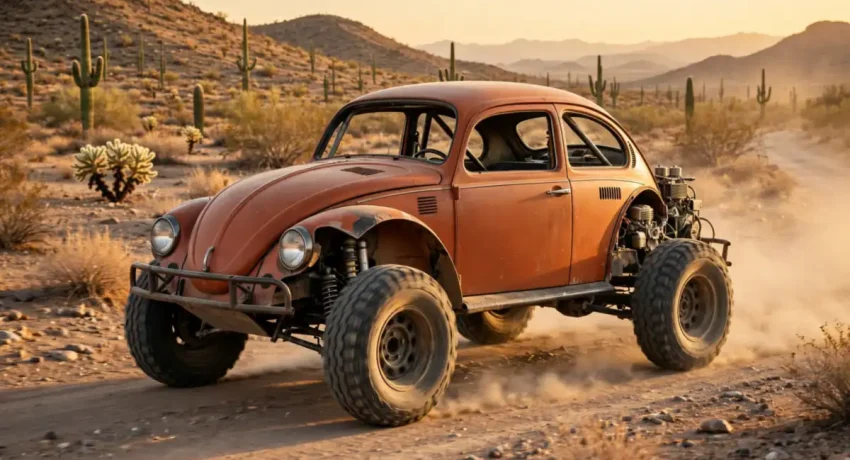

A Baja Bug looks like pure fun. It is a classic Volkswagen Beetle with the fenders cut away, the suspension lifted, and big knobby tires ready for sand and dirt. The shape is cheerful, the engine note is loud, and the whole car seems to promise a weekend in the desert. Then comes the real question. Can you drive it on a public road?
The short answer is that it depends. A Baja Bug street legal build is possible in many states, but it is never automatic. Lights, mirrors, and a horn do not make a buggy legal by themselves. Road use depends on state law, the way the vehicle is classified, the title history, the emissions rules, the safety equipment, and whether you can get insurance. This guide walks through all of it, step by step, so you can find out where your build stands before you spend money on parts.
One warning matters from the start. Rules change from state to state, and they change over time. Nothing here is legal advice for your own car. Treat this guide as general information, then check the rules with your own state motor vehicle department before you buy, build, or drive.
What Is a Baja Bug?
A Baja Bug is an original Volkswagen Beetle that has been modified to run off road, on open desert, sand dunes, and beaches. Other air-cooled Volkswagens are sometimes modified the same way, but the classic Beetle is the usual starting point. The name comes from Baja California, the desert peninsula in Mexico where these cars first proved themselves in long off-road races. Baja Bug history is really a story about cheap speed.
The story starts in Southern California in the late 1960s. VW Beetle dune buggy designs were already popular, and the best known was the Meyers Manx, a fiberglass-bodied buggy built on a Beetle floorpan. Buggies were fun, but they were not cheap. Builders wanted a lower-cost way into the same sport, so they started cutting up ordinary Beetles instead.
Credit for the first Baja Bug usually goes to Gary Emory, who built one around 1968 while working at a Volkswagen dealership in Newport Beach, California. The first Baja Bug in racing is credited to Dave Deal, a cartoonist from California, who drove one in the Mexican 1000 race of 1968. Early builders had no fiberglass parts to buy, so they cut away the metal fenders, front apron, and rear deck by hand to gain ground clearance and suspension travel.
The first fiberglass Baja kit arrived in 1969, when the Miller-Havens company sold the Bugeye kit. The kit replaced the cut metal with light fiberglass panels, including the famous round headlight pods that gave the car its wide-eyed look. Later kits added longer rear fenders and a longer engine cowl. The Beetle itself was a strong base for the job. Its rear-mounted air-cooled engine, flat floorpan, and tough torsion bar suspension already worked well on rough ground.
Today the Baja Bug is a familiar sight at desert races such as the Baja 1000. Racing versions run in classes such as Class 5 and Class 5/1600. Street versions are a different story. A race car and a road car follow different rules, and the gap between them is what this guide is about.
Are Baja Bugs Street Legal?
Yes, a Baja Bug can be street legal, but only when it meets the rules of the state where it is registered. There is no single federal stamp that makes a modified Beetle legal everywhere. That is why a Baja Bug street legal question has no single answer. Each state decides how it classifies the vehicle, what equipment it must carry, and what paperwork it needs.
Three things decide the answer for any single car. The first is classification. A car that keeps its original Beetle title follows a different path from a car built from parts and registered as a specially constructed vehicle. The second is equipment. The car must carry the safety gear the state requires for road use. The third is paperwork. The title, the vehicle identification number, the inspection, the emissions test, and the insurance must all line up.
Some states are friendly to these cars. Arizona, for example, has a clear path for registering off-highway vehicles for street use. Utah updated its street-legal all-terrain vehicle law in 2026. Other states are strict. California classifies dune buggies as off-highway vehicles and warns that adding equipment alone does not turn one into a highway-legal car. A few states will not register a dune buggy for road use at all unless it meets federal motor vehicle safety standards.
The lesson is simple. Never assume a Baja Bug is street legal because the seller says so, or because it has lights and a license plate. Check the title, check the classification, and check the state rules first.
Why Does Classification Decide Everything?
Before any state talks about lights or mirrors, it asks what the vehicle is. The answer shapes every step that follows. Most Baja Bugs fall into one of three groups.
The first group is a modified Beetle that keeps its original title. The car started life as a Volkswagen Beetle, and the title still shows the Beetle year and the original vehicle identification number. Keeping that Volkswagen Beetle title is the simplest path in many states. In many states this is the easiest path. The car is treated as the year it was built, and the owner registers it like any other car of that year, as long as the safety equipment and emissions rules for that year are met.
The second group is a specially constructed vehicle, sometimes called a kit car or assembled vehicle. This covers cars built from a kit or from a mix of new and used parts, where the original identity of the car no longer applies. These vehicles get a new title, often with the year the application was filed rather than a model year. They usually face a special inspection, and in some states they must meet the safety or emissions standards of the year they were built.
The third group is an off-highway vehicle. Many states define dune buggies as off-highway vehicles, which are meant for trails and private land, not public roads. A car in this group may only get an off-highway identification plate. In California, for example, the motor vehicle department states that a noncomplying off-highway vehicle cannot be converted to ordinary highway registration simply by adding equipment.
Age can help. A Baja Bug built on a pre-1969 Volkswagen platform may be registered on the original title and year in some states, because older cars face fewer equipment and emissions rules. A newer build has no such advantage. That is one reason buyers often prefer an older donor Beetle with a clean title.
What Equipment Does a Street-Legal Baja Bug Need?
Equipment rules vary by state, but the core list is much the same everywhere. The car must look and work like a road vehicle, not a trail toy. Here is the usual checklist.
| Equipment | What it means |
|---|---|
| Headlights | Working high and low beams, marked as DOT approved. |
| Taillights and brake lights | Working rear lights that show when you brake. |
| Turn signals | Front and rear signals, or hand signals where the state allows them. |
| Horn | A working horn that can be heard at a set distance. |
| Mirrors | At least one rear-view mirror, and side mirrors in most states. |
| Windshield and wipers | A proper windshield with wipers, or a helmet in states that allow it. |
| Seat belts | Working belts for every seat. |
| Speedometer | A working speedometer the driver can read. |
| Brakes | Working brakes plus a parking brake that holds the car. |
| Tires | DOT approved street tires, not sand-only tires. |
| License plate light | A light that makes the rear plate readable at night. |
| Exhaust | A working exhaust system that meets noise and emissions rules. |
Two items catch new owners by surprise. The first is tires. The big knobby tires that work so well on sand are usually not DOT approved for highway use. A street-legal Baja Bug needs highway-rated tires, which changes how the car looks and drives. The second is the windshield. Some states allow a helmet instead of a windshield, but many do not. A car with no windshield and no wipers will fail inspection in those states.
Roll cages need care too. A cage is a good idea for safety, but bare steel tubes near the driver can be a problem at inspection. Padding on the tubes is often required. Fenders, bumpers, and tire coverage matter as well. Several states limit how far tires may stick out past the fenders, and they set limits on bumper height and suspension lift. Check those limits before you buy oversized wheels.
How Do You Register a Baja Bug for the Street?
Registration follows the same rough path in most states, though the forms and offices differ. Knowing the steps in advance saves weeks of back-and-forth.
First, gather the paperwork. You need proof of ownership, the original title if the car has one, and receipts for major parts. Photos of the build help, especially for a specially constructed vehicle. Keep every receipt. Inspectors ask for them.
Second, run a VIN verification. The number on the frame must match the number on the title. If the frame number is missing, damaged, or does not match, the process stops until it is sorted out. Some states assign a new number after an inspection, but that takes time and extra paperwork.
Third, fit the equipment. Complete the safety gear in the table above before you book an inspection. Inspectors check every item, and a single missing light can mean a failed visit.
Fourth, book the inspection. Many states send modified or specially constructed vehicles to a special inspection station rather than a normal test center. The inspector checks the equipment, the frame number, and the build quality. Some states also require a separate emissions test.
Fifth, buy insurance. A street-legal Baja Bug needs at least the minimum liability cover your state requires. Tell the insurer exactly what the car is. A policy written for a stock Beetle may not cover a modified car, and a claim can be refused if the car was not described honestly.
Sixth, file the registration. Take the passed inspection, the title, the proof of insurance, and the fees to the motor vehicle department. If everything checks out, you get plates. A missing paper sends you back to the start of the queue.
What About Emissions and Smog Checks?
Emissions rules are where many Baja Bug projects stall. The engine is the problem, not the body. A swapped engine brings its own emissions rules with it, and the state will judge the car by the engine year, the body year, or both.
California shows how complex this gets. The state exempts vehicles built before the 1976 model year from its smog check program. That is one reason a 1960s donor Beetle is so attractive to builders. Newer engines face stricter tests, and a car registered as a specially constructed vehicle must go to a Bureau of Automotive Repair referee station for its first inspection.
California also runs a program called Senate Bill 100, known as SB100. It allows the first 500 specially constructed vehicles each year to receive a 1960 model year designation after a referee inspection. The owner can choose whether the inspection is based on the year of the body or the year of the engine. Those 500 slots are claimed fast, often early in the year, so builders who want one need to plan ahead.
Without a Senate Bill 100 number, the rule is different. The car must carry the emissions equipment that was required when its engine was first made. A 1968 engine needs the gear from 1968. A 1991 engine needs the gear from 1991. An engine built before 1966 needs no exhaust emissions controls at all under the program, and one built before 1961 needs no crankcase ventilation system either.
Other states are simpler, but none can be ignored. Some states have no emissions testing at all. Others test only in certain counties or cities. A car that passes in a rural county may still fail in a city with a testing program. Ask your local motor vehicle department which program covers your address before you build.
How Do the Rules Change From State to State?
No two states treat a Baja Bug the same way. The table below gives a snapshot of five states that builders ask about most. It is a starting point, not a substitute for the official rules.
| State | What to know in 2026 |
|---|---|
| California | Dune buggies are classed as off-highway vehicles. Adding equipment does not convert one to highway use. Pre-1976 cars are smog exempt. Senate Bill 100 covers the first 500 specially constructed vehicles each year. |
| Arizona | An Arizona OHV registration lets off-highway vehicles drive on public roads with an OHV decal, insurance, and highway equipment. Owners choose between a mainly off-road registration and a full on-road registration. Emissions testing may apply. |
| Utah | The Utah street legal rules allow all-terrain vehicles on many roads under state law, updated in 2026. Interstates are off limits, and some high-speed roads in large counties are excluded. Registration, insurance, and motorcycle-style equipment rules apply. |
| Florida | The Florida dune buggy rules sit in Florida Statute Chapter 316, and they cover lights, brakes, exhaust, horn, seat belts, mirrors, and a windshield with wipers. They must be licensed and registered like other vehicles. |
| Alabama | A dune buggy is defined as an open-chassis off-road vehicle. It cannot be titled or registered unless it meets federal motor vehicle safety standards, shown by a manufacturer certificate or a federal compliance label. |
The pattern is clear. Western states with large desert areas tend to have a path for these vehicles. States with big cities tend to be stricter. A car that is legal in Arizona may not be legal in California, and a car that is legal in Utah may not be legal in Alabama. Moving house can mean re-registering from scratch, and a car that passed in one state may fail in the next.
Local rules add another layer. Some counties and cities ban off-road vehicles on certain roads even when the state allows them. A street-legal plate does not give you the right to drive on every road in town. Check city and county rules as well as state rules.
What Kind of Insurance Do You Need?
Insurance is a legal requirement, not an optional extra. Every state that allows a Baja Bug on the road requires at least minimum liability cover. Driving without it can mean fines, a suspended license, and personal liability if you cause a crash.
Getting dune buggy insurance takes more effort than insuring a normal car. Many standard insurers will not cover a home-built or heavily modified vehicle. Specialist insurers and classic car insurers are often a better fit. They understand modified vehicles and can write agreed-value cover, which pays a set amount if the car is written off, rather than a book value that ignores your build costs.
Be honest on the application. List the modifications, the engine, and the real value of the car. If you describe a Baja Bug as a stock Beetle, the insurer can refuse a claim when the truth comes out. Keep photos of the build and receipts for parts. They help the insurer set the value, and they help you if you ever need to claim.
Ask about the details before you pay. Does the policy cover off-road use, or only road use? Will it cover the car while it is on a trailer? What is the excess if you make a claim? The answers shape the real cost of owning the car.
How Much Does a Street-Legal Baja Bug Cost?
Costs vary widely, because no two Baja Bugs are the same. A rough guide helps you set a budget before you start.
A titled Volkswagen-based buggy often costs between 6,000 and 30,000 dollars, depending on condition, build quality, and how complete the paperwork is. A car with a clean title, a passed inspection, and current plates sits at the top of that range. A project car with no title and no plates sits at the bottom, and it may cost more to fix than it is worth.
Building one yourself can cost less in parts and more in time. A donor Beetle, a fiberglass kit, suspension parts, tires, lights, and a roll cage add up fast. A realistic build budget runs into thousands of dollars before you count your own hours. Registration, inspection, and insurance add more on top.
The cheapest car is rarely the cheapest deal. A car with no title can be almost impossible to register in some states. A mismatched vehicle identification number can lead to the car being seized. An inspection failure can mean hundreds of dollars in new parts. Pay more for clean paperwork and a car that has already passed inspection in your state.
What Should You Check Before You Buy One?
Buying a Baja Bug is exciting, and that excitement is exactly why buyers skip checks they would never skip on a normal car. A Baja Bug street legal project starts with the title, not the tires. Use this list on every car you view.
Check the title first. Is it clean, or does it say salvage, rebuilt, or off-road only? A title marked for off-road use only is a warning sign. Some states will not convert it to road use.
Check the vehicle identification number next. Does the number on the frame match the number on the title? Is that same number on any receipts? A mismatch is a serious problem, not a small detail.
Check the classification. How is the car registered now? Is it registered as a Beetle, as a specially constructed vehicle, or as an off-highway vehicle? The answer tells you what you will face at your own motor vehicle department.
Check the equipment. Does the car have every item in the equipment table? Test the lights, the horn, the wipers, and the brakes yourself. Do not take the seller’s word for it.
Check the emissions status. Has the car passed a smog test? What year is the engine, and what emissions gear does it carry? In California, ask whether the car holds a Senate Bill 100 number. That number is valuable, and it stays with the car.
Check the insurance. Can you get cover for this car at a price you accept? Get a quote before you pay for the car, not after.
Check the rust. Beetle floorpans rust, and a Baja Bug hides rust under fiberglass panels and fresh paint. Look underneath, lift the carpets, and check the frame head and the rear torsion housing. Rust repair on a Beetle pan is slow and costly.
Check the suspension and steering. Lifted Beetles wear parts faster, and a car that has been jumped hard may have bent arms or a cracked frame. A short test drive on a rough road tells you more than a long look in a driveway.
What Mistakes Do First-Time Owners Make?
The same mistakes appear again and again, and most of them are avoidable. Here are the ones to watch for.
The first mistake is buying the car before checking the rules. A buyer finds a cheap buggy online, pays for it, and then learns that the home state will not register it. The car becomes a garden ornament. Check the rules first, then buy.
The second mistake is trusting a plate. A car can carry plates from another state and still be illegal in yours. Plates prove that the car was registered somewhere, not that it can be registered where you live.
The third mistake is fitting sand tires for the road. Sand tires look right on a Baja Bug, but they are not DOT approved for highway use. They wear fast, grip poorly on wet roads, and fail inspection. Buy a set of street tires for road use and keep the sand tires for the dunes.
The fourth mistake is skipping insurance. A Baja Bug feels like a toy, but the law treats it like a car. An uninsured crash can cost you far more than the car is worth.
The fifth mistake is forgetting the off-road rules. A street-legal plate lets you drive on public roads. It does not let you drive anywhere off road. Trails, dunes, and beaches have their own rules, permits, and closed areas. Riding in a closed area can mean a fine and a towed car.
Does Street Legal Mean You Can Drive Anywhere?
No, it does not. Street legality and trail access are two different things. A car can be fully legal on the road and still be banned from a trail, a dune area, or a beach.
Off-road areas have their own managers and rules. National forests, state parks, and desert areas set their own limits on where vehicles may go. Some areas need a permit or an off-highway vehicle sticker in addition to a road plate. Others close during fire season or wildlife breeding season. A few beaches ban vehicles entirely.
Interstates are a special case. Even in states that allow street-legal all-terrain vehicles, interstates are usually off limits. Utah law, for example, bars street-legal all-terrain vehicles from interstate highways. A Baja Bug registered as a normal car can use an interstate, but a car registered as an off-highway vehicle or an all-terrain vehicle often cannot. Know which group your car falls into before you plan a long trip.
Noise rules matter too. Many trails and towns set limits on exhaust noise. A loud straight-pipe exhaust that passes a rural inspection may still earn you a ticket in a town or a national park. A working muffler is cheap insurance against fines and complaints.
Frequently Asked Questions
Can you drive a Baja Bug on the highway?
It depends on the state and the registration. A Baja Bug registered as a normal car can use highways in most states. A car registered as an off-highway vehicle or an all-terrain vehicle usually cannot use interstates, and some states limit it to local roads. Check your registration type before you plan a highway trip.
Do you need a windshield on a Baja Bug?
Most states require a windshield with wipers for road use. A few states allow a helmet instead, but that is the exception. If your car has no windshield, check your state rule before you drive it on the road.
Can a dune buggy be registered in California?
California classifies dune buggies as off-highway vehicles, and it warns that adding equipment alone does not make one highway legal. A car built on an older Beetle title may still be registered as that Beetle, and a specially constructed vehicle may qualify under the Senate Bill 100 program. The details matter, so ask the California motor vehicle department before you buy.
What is the cheapest way to get a street-legal Baja Bug?
Buy a car that is already titled, inspected, and plated in your own state. It costs more up front than a project car, but it saves the cost and risk of sorting out the title, the inspection, and the emissions test yourself.
Do Baja Bugs need a smog check?
It depends on the state, the engine year, and the registration type. California exempts cars built before the 1976 model year, and its Senate Bill 100 program gives 500 specially constructed vehicles a year a 1960 designation. Other states test only in certain areas, or not at all. Check the rule for your address.
Are Baja Bugs good daily drivers?
They can be fun for short trips in good weather, but they are not ideal daily cars. The ride is loud, the car offers little weather protection, and it lacks the safety features of a modern car. Most owners keep a normal car for daily use and save the Baja Bug for weekends and desert trips.
Sources: Wikipedia on the Baja Bug, the AutoMadeSimply guide to Baja Bugs, EngineerFix on driving a dune buggy on the road, and ThePricer on dune buggy costs. Other sources include World Population Review on states where ATVs are street legal, Offroad-Ed on Arizona off-highway vehicle registration, It Still Runs on Florida street buggy rules, Utah Code section 41-6a-1509, and Alabama Department of Revenue rule 810-5-1-.238. California Senate Bill 100 and the Bureau of Automotive Repair policy on specially constructed vehicles were also used. This article is general information only. It is not legal advice. Check the rules with your state motor vehicle department before you buy, build, or drive a Baja Bug.