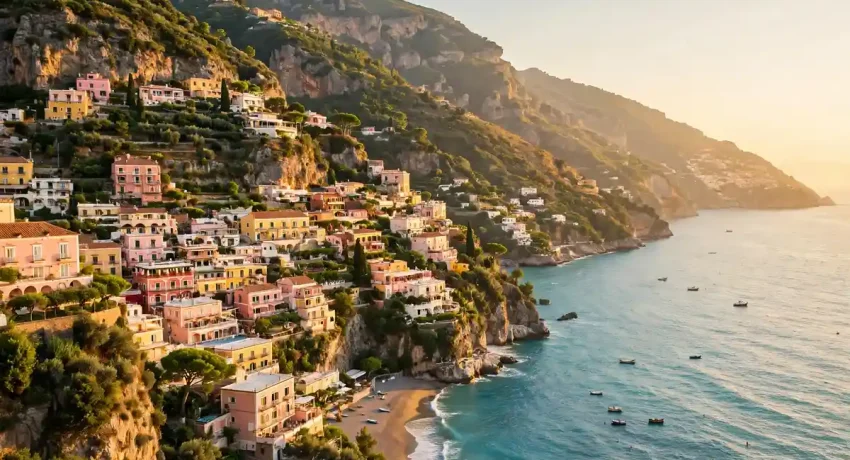

Positano does not ease you in. You come around a bend on the coast road. Or you step off a ferry. Suddenly the whole village is there. Pink, yellow and terracotta houses stack down a cliff to a small beach. The sea glitters below. It is the view every Amalfi Coast postcard promises. The good news is that the real thing is better than the postcard. The bad news is that everyone else knows it too.
That is why the best places on the Amalfi Coast to visit are not only the famous names. This coast rewards people who pick their base well. Use the ferries. Walk one great trail. And leave time for the small towns between the big ones. This guide covers the best places on the Amalfi Coast to visit. It gives verified 2026 prices. Bus and ferry timetables are explained in plain terms. The driving rule that catches visitors out is covered too. And it offers a five-day plan that does not try to do everything at once.
Where Is the Amalfi Coast, Exactly?
The Amalfi Coast is a roughly 50-kilometre stretch of cliff coastline. It runs through Campania in southern Italy, on the southern edge of the Sorrentine Peninsula. Thirteen towns are strung along it between Sorrento in the west and Vietri sul Mare in the east. The best places on the Amalfi Coast to visit sit along this short stretch. UNESCO listed the coast as a World Heritage Site in 1997. It has been one of Italy’s most visited regions ever since.
There is no train line along the coast itself. Most visitors arrive through Naples, Salerno or Sorrento. Then they switch to a bus, a ferry or a car for the final stretch. There is no station in Positano or Amalfi. That single fact shapes every plan on this coast. So the transport sections below matter as much as the places themselves.
Capri is not technically part of the Amalfi Coast at all. The island sits at the mouth of the Gulf of Naples, about 45 minutes by ferry from Positano or Sorrento. It appears in this guide because nearly every coast trip includes it. The crossing is one of the great arrivals in Italy.
When Is the Best Time to Visit the Amalfi Coast?
May, June and September offer the best combination of warm weather and manageable crowds. Guides agree on the Amalfi Coast best time to visit: May, June and September. That is the short answer, and it is the one most 2026 guides agree on. July and August bring the most reliable beach weather but also the heaviest crowds and the highest prices. November through March is quiet and affordable, yet many smaller hotels and all coastal ferries shut down entirely.
The sea is warmest in September, which makes that month the sweet spot for swimmers. Spring brings wildflowers on the clifftops and the lemon groves in full scent. October can be lovely too. The ferry season ends around the end of the month, though, and the sea gets rougher.
| Month | Weather and crowds | What to expect |
|---|---|---|
| April | Mild, 17–20°C, light crowds | Trails open, ferries start late March, some hotels still closed |
| May–June | Warm, 22–27°C, moderate crowds | Best all-round months; book hotels early |
| July–August | Hot, 28–31°C, very crowded | Peak prices; driving restrictions daily in August |
| September | Warm, 24–27°C, easing crowds | Warmest sea; best month for swimming |
| October | Mild, 19–23°C, quiet | Ferries end late October; rough seas possible |
| November–March | Cool, 10–16°C, very quiet | Buses still run; ferries stop; many hotels closed |
One more honest note: the coast in high summer is genuinely crowded. The Path of the Gods at midday in August is a queue, not a walk. If your dates are fixed in July or August, start early. Book ferries and hotels months ahead. And plan one slow day on purpose.
What Makes Positano the Postcard of the Coast?
Positano Amalfi Coast is the image everyone carries in their head before they arrive. It tops every list of the best places on the Amalfi Coast to visit. The village earns it. Pastel houses cascade down a near-vertical cliff to Spiaggia Grande, the main beach. Above the sand rises the dome of the Church of Santa Maria Assunta. The 13th-century church is tiled in majolica. There is no flat ground here. Everything is stairs, lanes and viewpoints, and that is half the charm.
Start at Spiaggia Grande in the morning, before the day boats arrive. The beach is pebbly rather than sandy. Beach clubs charge for sunbeds, so check prices before you sit down. They are famously steep in July and August. Then climb through the lanes above the beach. The shops sell linen, sandals and ceramics. The lanes themselves are the attraction: bougainvillea, laundry lines, sudden sea views between buildings.
For the classic photo, walk up to the viewpoint above the beach at sunset. That is when the village lights flick on above you. For a quieter swim, walk 10 minutes west to Fornillo, a smaller beach with a slower pace. Positano was a quiet fishing village until artists and writers “discovered” it in the 1950s. John Steinbeck wrote about it in 1953. It has been famous ever since.
Where should you stay? Positano suits travellers who want to stay put in one picturesque spot rather than day-trip everywhere. Just know that its steep, vertical layout means serious walking and stairs. Summer hotel prices here are the highest on the coast. Sorrento and Amalfi town work better as bases if you plan to move around every day.
Is Amalfi Town Worth More Than a Ferry Stop?
Yes. Amalfi town belongs on any list of the best places on the Amalfi Coast to visit. Most visitors give it too little time. Amalfi town was once a powerful maritime republic. It was one of the four great Italian maritime republics, alongside Venice, Genoa and Pisa. Its cathedral square still feels like the centre of a small empire. The Amalfi town Duomo is the Cathedral of Sant’Andrea. It rises at the top of a dramatic 62-step staircase above the main piazza. Inside, the Cloister of Paradise and the crypt are worth the small entry fee.
Amalfi is also the practical hinge of the whole coast. Ferries and both main bus routes meet here. So it makes the best base if you want to move every day without a car. The town is flatter than Positano and cheaper to sleep in. Behind the tourist front it has a real working-town feel. There is a paper museum, the Museo della Carta, in a former paper mill. The old Arsenale, where the republic’s ships were built, is still standing. And lemon groves climb the valley behind the town.
Paper matters here. Amalfi has made paper since the 13th century. It learned the craft through Arab trade. The museum still shows the old water-powered process. The lemons matter too. The local sfusato amalfitano lemon holds protected IGP status. It turns up everywhere: in granita, in pasta, in the delizia al limone cake, and in limoncello.
Give Amalfi a full morning at least. Climb to the Duomo. Walk the lanes behind the piazza. Then take the short walk through the tunnel to Atrani, the tiny town next door. Use the afternoon for Ravello, which sits in the hills directly above.
Why Is Ravello the Coast’s Quiet Masterpiece?
Ravello Italy sits 350 metres above the sea on a hillside above Amalfi, and it feels like a different world. There is no beach, no ferry dock, no traffic roar. Just gardens, villas and a view that drops straight to the Gulf of Salerno. If Positano is the postcard, Ravello is the place you remember when you get home.
Villa Rufolo comes first. The 13th-century villa and its gardens sit right off Piazza Duomo. The composer Richard Wagner was so struck by them in 1880. He used the garden as the model for the enchanted garden in his opera Parsifal. Entry is about €8 in 2026, and the villa is open daily from 9:00 to 20:00 in summer. The Ravello Festival still stages concerts on the villa’s terrace. The 74th edition runs from 4 July to 5 September 2026, with concert tickets from about €20.
Then walk 15 minutes through the village to Villa Cimbrone. The villa is now a luxury hotel, but its gardens are open to the public. The Terrace of Infinity at the far end is widely called the most spectacular single viewpoint on the coast. Marble busts line a terrace that seems to hang over the sea, with the coastline falling away on both sides. Entry is about €10 in summer and €7 from 1 November to 31 March. In summer it is open daily from 9:00 to 19:30. Budget a full hour inside.
Between the two villas, stop at the Duomo di Ravello. Entry is free, though it closes at midday. The free panoramic terrace on the walk between them is worth a pause too. The whole village takes two and a half to three hours including both villa gardens. Go early, before the day-trip crowds arrive on the bus from Amalfi.
Should You Take the Ferry to Capri?
Yes — but go with a plan, because Capri rewards early starters and punishes wanderers. Capri is one of the best places on the Amalfi Coast to visit by boat. The Capri Blue Grotto is the island’s famous sight. It works like this: you take a boat from Marina Grande to the cave mouth. Then you transfer to a small official rowboat. The entrance is barely a metre high. You lie flat while the boatman pulls a chain to guide you through. Inside, sunlight entering through an underwater fissure turns the water an electric blue. The visit lasts about five minutes.
The cost in 2026 is about €18 per person for the rowboat and entrance. You pay in cash on the spot. That covers the €6 state entrance ticket plus the rowboat fare. It is not included in any boat tour price. The boat transfer from Marina Grande costs about €25 more. An island boat tour with Motoscafisti Capri runs about €24 per person. The brightest blue shows between 11:00 and 14:00. Go early in the day too. When the queue at the cave passes 45 minutes, boats can turn back. Rough seas close the grotto entirely, and winter hours run 9:00 to 14:00.
After the grotto, circle the island by boat to see the Faraglioni. These are the three sea stacks off the south coast. The Green and White Grottos are on the same route. Many visitors say they enjoyed them even more than the Blue Grotto. Then take the funicular or bus up to Capri town. Walk the Piazzetta. Then ride the chairlift from Anacapri to Monte Solaro, the island’s highest point at 589 metres. The view from the top covers the whole Gulf of Naples.
A day trip from Sorrento is entirely sufficient to see Capri’s highlights without paying the island’s high overnight hotel prices. Ferries from Sorrento take about 45 minutes. From Naples Molo Beverello to Positano and Amalfi, they run from 1 April to 3 November 2026. One warning: Capri charges a landing fee of about €10 per person, payable on the spot, so carry cash.
How Hard Is the Path of the Gods, Really?
The Path of the Gods hike — the Sentiero degli Dei — is the best walk on the Amalfi Coast. It is easier than its name suggests. The classic route runs from Bomerano, in the hill town of Agerola, to Nocelle, a hamlet above Positano. It is about 7.5 kilometres. Walking takes two and a half to three hours. It is rated easy to moderate. The trail is free and waymarked with red-and-white CAI markers. It follows ancient mule tracks along a limestone ridge 400 to 700 metres above the sea.
Start in Bomerano, not Positano. The direction matters. From Bomerano the route is mostly flat or gently downhill. The coast is in front of you the whole way. Starting from Positano means a steep climb up roughly 1,500 stone steps first. Get to Bomerano by SITA bus from Amalfi, and allow a full morning including the bus rides.
From Nocelle, you have two choices. The stepped path down to Positano takes about 45 minutes. The path covers roughly 1,500 steps. It is hard on the knees, so take it slowly. Or catch the local bus from Nocelle down to Positano. Either way, finish in Positano with a swim and a long lunch. You will have earned both.
Go in April, May, September or October if you can. The trail is exposed, with little shade, and August heat makes it a much harder walk. Carry at least a litre of water per person. Wear proper walking shoes: the footing is rocky in places. And check the weather the night before. There is no fee, no booking system and no visitor cap in 2026.
What About Sorrento — Base or Day Trip?
Sorrento Amalfi Coast is the practical answer to almost every planning question. It sits at the western end of the coast, on a cliff above the Bay of Naples. Vesuvius rises across the water. It has a train station, a ferry port and flat streets in the old town. There are far more hotels here at far lower prices than Positano.
Getting there is simple. The Circumvesuviana train from Naples Garibaldi takes about 70 minutes and costs around €5, running every 30 minutes. The Campania Express is faster — about 50 minutes, with fewer stops — and costs more. From Sorrento, the ferry to Positano takes 35 to 40 minutes and costs around €20. To Amalfi it takes about 65 minutes and costs around €20 to €22. The bus is cheaper, at about €2.60, but can take over an hour in summer traffic.
As a base, Sorrento suits travellers who want day trips. Capri and Pompeii are both easy from here. The rail link to Naples makes arrival and departure painless. As a place in itself, it is calmer than Positano. There is a handsome old town and a small fishing harbour at Marina Grande. Lemon groves and views cost nothing. The one thing it is not is the Amalfi Coast proper. If the cliff villages are the point of your trip, sleep in Amalfi town or Positano instead. Visit Sorrento for a day.
Where Are the Coast’s Best Beaches?
Amalfi Coast beaches are small and pebbly. Most are reached by steps. This is a cliff coast, not a sand coast. That is part of the charm, but it is worth knowing before you pack. Here are the best places on the Amalfi Coast to visit for a swim, from west to east.
Spiaggia Grande in Positano is the famous one. It is a broad pebble beach below the village, with beach clubs, restaurants and a view of the houses above. No other beach on the coast is busier, or pricier. Fornillo, ten minutes west on foot, is smaller, quieter and cheaper. In Praiano, Marina di Praia is a tiny pebble cove at the foot of a cliff. You reach it by steps from the road. There is a good seafood restaurant on the sand.
Atrani has a small beach right in the village, popular with locals and far calmer than Positano. Maiori has the longest sandy beach on the coast. It is the only proper stretch of sand. Minori, next door, has a smaller sandy beach with a pretty promenade. The Fiordo di Furore is the most photographed beach of all. It is a tiny strip of sand inside a fjord, under a road bridge, reached by steep steps. Go early or late, because the fjord is small and the steps are many.
Two practical notes. First, most beaches are pebble or coarse sand, so bring water shoes if you have sensitive feet. Second, the free public sections of beach are small. The rest belongs to beach clubs that charge for sunbeds and umbrellas. Arrive before 10:00 in summer if you want a free spot.
What Are Praiano, Atrani and the Small Towns Hiding?
The best places on the Amalfi Coast to visit are not all famous. The small towns between the big names are where the coast still feels like a place people live. They are also where your money goes further.
Praiano Amalfi Coast sits between Positano and Amalfi, and it is the coast’s best sunset town. The village faces west, so the evening light falls straight onto the sea. The church of San Gennaro has one of the prettiest tiled floors on the coast. Praiano is quieter and cheaper than its neighbours, with good restaurants and the Marina di Praia cove below. It makes a calm base for walkers. The Path of the Gods passes above it. The steps down to the sea are a workout in themselves.
Atrani Italy is the smallest town in southern Italy. It is ten minutes from Amalfi on foot through a tunnel. Its main square, Piazza Umberto I, is a small, shaded, local-feeling place. It has cafés and a beach at the end of the street. Atrani appears in films and postcards, yet it stays quiet. Almost nobody sleeps here. Most visitors pass through without stopping.
East of Amalfi, Minori is known as the city of taste. There are lemon groves and a first-century Roman villa open to visitors. The Path of the Lemons is a stepped trail through the groves to Maiori. Maiori has the long sandy beach and a relaxed resort feel. Cetara, further east, is a working fishing village. It is famous for anchovies and colatura di alici, the anchovy sauce that is the coast’s great condiment. Vietri sul Mare, at the eastern end, is the ceramics town. It is the gateway to the coast from Salerno. Buy the painted tiles you will see on every church dome here.
How Do Ferries and Buses Actually Work?
An Amalfi Coast ferry is the best way to move between towns whenever it runs. The SITA bus is the backup that runs all year. Understand both and the coast opens up. Ignore them and you will spend your holiday in traffic.
Ferries are seasonal, roughly late March to October, and they run in daylight only. Travelmar is the main operator, linking Salerno, Amalfi, Positano, Maiori, Minori, Cetara and Vietri sul Mare. Useful fares in 2026: Positano to Amalfi takes 25 to 30 minutes and costs around €10 to €12. Sorrento to Positano takes 35 to 40 minutes and costs around €20. Amalfi to Salerno takes about 42 minutes and costs around €10. Buy tickets online a day ahead in summer. Keep the bus as a backup. Rough seas cancel sailings at short notice, sometimes on the morning itself.
The Amalfi Coast SITA bus network is the year-round backbone. Three routes matter most. Line 5070 runs Sorrento to Positano to Praiano to Amalfi. The 5120 runs Amalfi to Minori to Maiori to Cetara to Vietri to Salerno. Line 5110 runs Amalfi to Ravello to Scala in about 25 minutes, costing roughly €1.80. There is no ferry to Ravello, so the 5110 is the only public way up. Single tickets cost about €1.80 to €2.60 depending on the zone. The COSTIERASITA 24-hour pass costs €10 for unlimited SITA travel across the coastal towns. It costs €12 including the local Positano bus. Buy tickets before boarding: at a tabacchi, a bar or through the UnicoCampania app. Validate them when you board. Tickets cannot reliably be bought on the bus.
One warning: summer buses fill up. At Positano in particular, buses can pass full stops without stopping. Leave margin for traffic and full buses, especially around Positano. Take the earliest bus of the day when it matters.
Should You Drive the Amalfi Coast Road?
Probably not, and the Amalfi Coast driving restrictions are the reason. The coast has one road, the SS163. It is a narrow, winding cliff road. The road runs about 40 kilometres from Vietri sul Mare to Positano. The system runs on alternating number plates — the targhe alterne — between 10:00 and 18:00. On an odd date, cars whose plate ends in an odd digit may not use the road. Even dates work the other way: plates ending in an even digit may not.
In 2026 the rule applies daily from 30 March to 6 April and from 24 April to 2 May. It applies on weekends and public holidays from 1 June to 31 July. From 1 August to 30 September it applies daily, and on weekends again in October. The rule does not apply from 1 November. Rental cars are not exempt — the only thing that matters is the last digit of the plate. Motorcycles and scooters are exempt. Residents and hotel guests are exempt too. But only for the journeys needed to arrive and depart. Day trips along the coast are not covered once you are there.
Even without the plate rule, driving here is hard work. The road is narrow and the buses are wide. Parking is scarce and expensive. The town centres are permit-only zones, with camera enforcement and fines of €83 to €332. If you do drive, use the car to arrive and leave, then park it and use ferries and buses. Or skip the car entirely. The ferry from Naples, the train to Sorrento and the SITA buses cover the whole coast without a steering wheel.
How Much Does an Amalfi Coast Trip Cost in 2026?
Amalfi Coast costs are high, and honest planning means saying so. This is one of the most expensive coastlines in Italy, and July and August are the worst of it. The figures below are labelled ranges from 2026 guides, per person per day, excluding flights. Check current prices before you book — they move with the season.
| Budget level | Daily range | What it buys |
|---|---|---|
| Budget | €80–€120 | Hostel or basic B&B in Sorrento or Salerno, SITA bus pass, street food and trattorias, free beaches |
| Mid-range | €180–€280 | Three-star hotel, ferries, one paid sight a day, restaurant dinners, a boat trip |
| Luxury | €400 and up | Cliffside hotel in Positano, private boat, fine dining, beach club days |
For a seven-day mid-range trip, one 2026 itinerary guide budgets about €2,300 to €3,700 per person. That includes accommodation, food, transport and activities. The biggest single lever is where you sleep. Amalfi Coast hotels in Positano cost the most, and Sorrento and Salerno cost far less. A room in Positano in July can cost two or three times the same standard in Sorrento or Salerno. The second lever is when you go: May and September hotels run 20 to 35 percent below August peak.
Small costs add up too. Budget about €10 for a ferry hop and €10 for a 24-hour bus pass. Allow €7 to €10 for each villa garden and €18 for the Blue Grotto rowboat. Add a few euros a day for water and coffee. A boat day around Capri or along the coast runs about €100 to €150 per person on a shared tour. A private boat costs far more.
What Does a 5-Day Amalfi Coast Itinerary Look Like?
An Amalfi Coast itinerary works best when it has one base, one big day, one slow day and one walk. This five-day plan covers the best places on the Amalfi Coast to visit without rushing. Amalfi town is the base for this five-day plan. It is central, flat and cheap, with ferries and buses in every direction.
Day one: arrive in Naples, take the train to Sorrento, then the ferry or bus to Amalfi. Settle in, walk the Duomo square, and eat your first lemon granita. Day two: Positano by ferry in the morning, beach and lanes, then the ferry back at sunset. The third day is for the Path of the Gods. Bus to Bomerano, walk to Nocelle, descend to Positano for a late lunch, bus back to Amalfi.
The fourth day belongs to Capri. Early ferry from Amalfi or Sorrento. Blue Grotto first, then the island boat tour, Anacapri and the Monte Solaro chairlift. Then the last ferry home. The fifth day starts in Ravello. Villa Rufolo, then Villa Cimbrone and the Terrace of Infinity. Atrani and the paper museum follow in the afternoon, before departure.
With seven days, add a Sorrento day and a Pompeii day trip. Add one genuinely slow day with no plan at all. The coast rewards slowness: a long lunch, a swim, a terrace at sunset. Trying to see everything is the one mistake that guarantees you enjoy nothing.
What Should You Eat and Drink on the Coast?
The coast’s food is simple, and that is the point. The lemons are the headline. The sfusato amalfitano is the long, knobbly local lemon. It appears in granita, in pasta and in the delizia al limone cake. Limoncello, the sweet lemon liqueur served ice-cold after dinner, is made from it too. In Minori, the lemon groves climb the hills in terraces held up by dry stone walls. The Path of the Lemons walks straight through them.
Order scialatielli ai frutti di mare, the local fresh pasta with seafood, and grilled fish with lemon and olive oil. In Cetara, try pasta with colatura di alici. It is the anchovy sauce made by pressing salted anchovies. A few drops transform a plate of spaghetti. In Sorrento, the gnocchi alla sorrentina — potato dumplings baked with tomato and mozzarella — is the local classic.
For a drink, the local white wines from the terraced vineyards above the coast are worth seeking out. The espresso is taken standing at the bar, the way Italians do it. One rule of thumb: eat where the menu is short, handwritten and in Italian first. The restaurants with picture menus and touts outside are the ones to walk past.
What Mistakes Do First-Timers Make?
Five mistakes cover most ruined Amalfi Coast trips, and all five are avoidable. First, trying to drive everywhere: the plate rule, the traffic and the parking will eat your days. Second, staying in Positano and day-tripping everywhere else. The stairs and the prices wear you down. The buses leave full. Third, skipping the ferries: the coast was made to be seen from the water, and the road hides the views.
Fourth, planning the Path of the Gods for midday in August. Start at 8:00, carry water, and wear real shoes. Fifth, booking nothing in advance. In May to September, the good hotels, the Capri boat tours and the Ravello Festival concerts all sell out. Book hotels three to six months ahead for summer, and the Capri boat and the festival before you land.
One more, smaller than the rest but worth saying. Do not trust the first price you see for a sunbed, a boat or a taxi. Ask the price before you sit down, before you board, before you ride. The coast is honest about its beauty and its prices — it just expects you to ask.
What Does an Amalfi Coast Day Trip from Naples Look Like?
An Amalfi Coast day trip from Naples is possible, and many people do it, but it is a long day. The honest version: take the early Circumvesuviana or Campania Express train from Naples Garibaldi to Sorrento. Then take the ferry to Positano or Amalfi. That puts you on the coast by late morning. You will have time for one town, a swim and a long lunch before the ferry back.
Do not try to see Positano, Amalfi and Ravello in one day from Naples. You will spend the day on buses and see the coast through a window. Pick one town — Positano for the view, Amalfi for the history — and enjoy it properly. Or take a private day tour from Sorrento or Naples. It runs about €344 per person in 2026 listings. The tour covers the coast by car, with a driver who knows the road. If you can, stay one night. The coast at 7:00 in the morning is a different place from the coast at noon. That is before the day boats arrive.
Frequently Asked Questions
How many days do you need on the Amalfi Coast?
Three to four days is the comfortable minimum to see two or three towns without rushing. Five to seven days lets you add the Path of the Gods and a Capri day. You can add Ravello and at least one slow afternoon too. Ten days lets you add Pompeii, Paestum and the Cilento coast beyond Salerno.
Is the Amalfi Coast expensive?
Yes. Mid-range travellers should budget roughly €180 to €280 per person per day in 2026. Positano hotels in July and August can cost two or three times the same standard in Sorrento or Salerno. May and September are 20 to 35 percent cheaper than August peak.
Can you visit the Amalfi Coast without a car?
Yes, and most 2026 guides recommend it. Ferries link the main towns from late March to October. SITA buses run all year. The train from Naples reaches Sorrento. The driving plate rule, scarce parking and permit-only town centres make a car more trouble than help.
Is the Blue Grotto worth it?
It depends on the queue. The glow is real. The five minutes inside are memorable. But a wait of over an hour in the sun is not. Go early, go on a calm-sea day, and have a backup plan. The Faraglioni boat tour and the Green Grotto are excellent even if the Blue Grotto is closed.
What is the number one attraction on the Amalfi Coast?
The best places on the Amalfi Coast to visit include Positano as an experience. The Duomo di Amalfi is the single great monument. The Terrace of Infinity in Ravello is the viewpoint. But the boat trip along the coast is the activity most visitors say was the highlight of their whole trip.
Is Ravello worth visiting?
Yes. The two villa gardens and the Terrace of Infinity give the best views on the coast. The village is calm even in high summer. Budget two and a half to three hours including both villas, and go early.
Where should you stay on the Amalfi Coast?
Amalfi town for the best base: central, flat, cheaper than Positano, with ferries and buses everywhere. Sorrento for the most practical base with a train station and the best day trips. Positano for one picturesque stay in the village itself. Praiano or Minori for a quieter, cheaper stay.