
Uttar Pradesh is not a state you tick off in a weekend. It is the state where the Taj Mahal rises out of morning mist. Varanasi has lit its lamps on the Ganges for thousands of years. Ayodhya has become the most talked-about pilgrimage city in India. One journey here can carry you from Mughal marble to Buddhist ruins, from Nawabi kitchens to Krishna’s childhood streets. This guide covers the best places to visit in Uttar Pradesh in 2026. It uses honest, checked facts and practical advice for planning your trip.
Most lists of Uttar Pradesh tourism stop at three names: Agra, Varanasi and Lucknow. Those three matter, but they are only the start. This guide goes further. It covers the Ram Mandir in Ayodhya as it stands today. It also covers the Buddhist trail at Sarnath and Kushinagar. It covers the forts of Jhansi and the wild side of the state at Dudhwa National Park. It also tells you what things cost and when to go. It shows how to move between cities without wasting days in transit.
What Makes Uttar Pradesh India’s Greatest Travel State?
Start with scale. Uttar Pradesh is India’s most populous state, home to more than 240 million people. It stretches across the Gangetic plain, from the Yamuna in the west to the Nepal border in the north. Few places on earth pack so much history into one state. Three of its monuments carry UNESCO World Heritage status. Two of Hinduism’s holiest cities stand here. Buddhism began its public teaching here. The 1857 revolt was fought here.
What surprises first-time visitors is the variety. Agra is Mughal and monumental. Varanasi is ancient and spiritual. Lucknow is courtly and slow. Ayodhya is newly transformed. Mathura and Vrindavan are joyful and loud. Prayagraj is calm until a festival fills it with millions. You can build a trip around temples, around history, around food, or around all three at once. The best places to visit in Uttar Pradesh reward travellers who slow down. Stay a night or two in each city instead of rushing through on a day trip.
One more thing sets the state apart. It is not a museum. The rituals you see on the ghats are not staged for tourists. The aarti at Dashashwamedh Ghat happens every evening, whether you are there or not. The temples of Vrindavan fill with real devotees, not actors. That living quality is what makes Uttar Pradesh tourism feel different from a heritage tour anywhere else.
Where Should You Start — Agra and the Taj Mahal?
Agra is the obvious first stop, and it earns that place. No list of the best places to visit in Uttar Pradesh is complete without it. The Taj Mahal is the most famous building in India, and no photograph prepares you for the real thing. It sits on the south bank of the Yamuna. This white marble mausoleum was built by the Mughal emperor Shah Jahan for his wife Mumtaz Mahal. Work began in 1632 and took about two decades. UNESCO listed it as a World Heritage Site in 1983. In 2007 it was voted one of the New Seven Wonders of the World.
Arrive at sunrise if you can. The Taj Mahal Agra complex opens at sunrise, and the first hour is the quietest part of the day. The marble shifts colour as the sun rises, from soft pink to bright white. By mid-morning the crowds thicken, and by noon the heat in summer is punishing. The Taj Mahal is closed every Friday, so never plan your Agra day for a Friday. Check the official site before you travel, because timings and rules can change.
How Much Does the Taj Mahal Cost in 2026?
The Taj Mahal ticket price depends on your nationality, and the table below lays it out clearly. Entry fees are set by the Archaeological Survey of India. They are the same figures the official Taj Mahal website listed in October 2026. Indian visitors pay ₹50 for entry. Citizens of SAARC and BIMSTEC countries pay ₹540. Foreign tourists pay ₹1,100. Children under 15 enter free, whatever their nationality. Entering the main mausoleum chamber costs an extra ₹200 per person in every category. That means the full visit costs ₹250 for an Indian visitor. SAARC and BIMSTEC visitors pay ₹740, and foreign visitors pay ₹1,300. Booking online saves a small amount: ₹5 on an Indian ticket and ₹50 on a foreign ticket.
Night viewing is a separate experience. It runs on five nights around the full moon each month. Visitors enter in eight batches of at most 50 people, each lasting 30 minutes. Tickets cost ₹510 for an Indian adult and ₹750 for a foreign adult. Children aged 3 to 15 pay ₹500. Booking opens seven days before each night through the ASI ticketing portal. Treat all of these figures as a guide. Confirm them on the official site close to your visit, because the ASI revises fees from time to time.
| Visitor | Day entry | Main mausoleum | Total |
|---|---|---|---|
| Indian citizen | ₹50 | + ₹200 | ₹250 |
| SAARC / BIMSTEC citizen | ₹540 | + ₹200 | ₹740 |
| Foreign tourist | ₹1,100 | + ₹200 | ₹1,300 |
| Child under 15 | Free | — | Free |
One warning matters more than any price. Only buy tickets from the official ASI portal or the counters at the site. Touts around the gates sell overpriced “guides” and fake fast-track entry. A licensed guide is worth hiring, but agree the fee before you start, and check the guide’s licence card.
What Else Is Worth Seeing in Agra?
Beyond the monument itself, the places to visit in Agra include a great fort, an abandoned capital and two quiet gardens. Agra Fort is the city’s second great monument, and it deserves half a day of its own. This red sandstone fortress was the main residence of the Mughal emperors until the capital moved to Delhi in 1638. Shah Jahan spent his last years imprisoned here, looking across the river at the Taj Mahal he had built. UNESCO listed the fort in 1983. Walk through the Jahangir Palace, the Khas Mahal and the Musamman Burj, where that view of the Taj is at its most poignant.
Fatehpur Sikri sits about 40 kilometres west of Agra, and it is one of the strangest places in India. Emperor Akbar built it as his capital in 1571 and abandoned it roughly fifteen years later, most likely because the water supply failed. The red sandstone city survives almost whole: the Buland Darwaza, one of the largest gateways in the world, the Jama Masjid, and the white marble tomb of the Sufi saint Salim Chishti. It became a UNESCO World Heritage Site in 1986. Go early, because the site is open and shadeless, and the midday sun is fierce.
Two quieter stops round out Agra. Mehtab Bagh, the garden across the river, gives the best sunset view of the Taj Mahal without the crowds. Itimad-ud-Daulah’s Tomb, often called the Baby Taj, is a jewel-box marble tomb that shows the style the Taj Mahal later perfected. Both are worth an hour each, and both are calm after the intensity of the main monument.
Why Is Varanasi Unlike Any City on Earth?
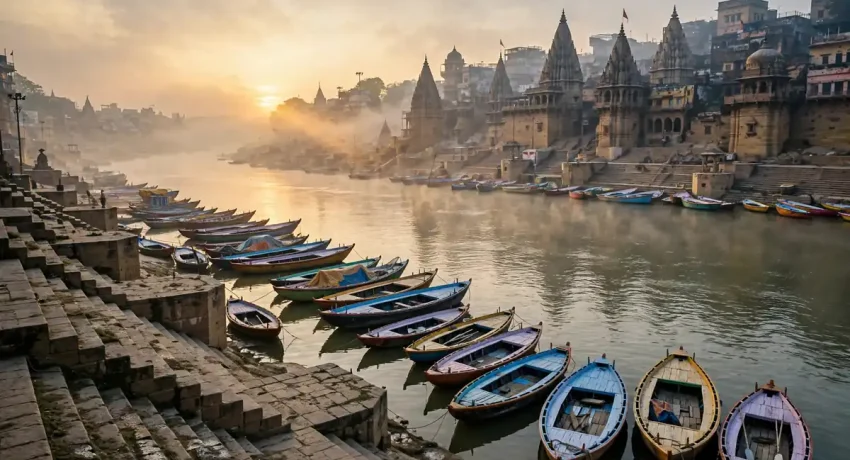
Varanasi is one of the oldest continuously inhabited cities in the world. It is also called Kashi, the City of Life, and Benaras. Varanasi tops every list of the best places to visit in Uttar Pradesh for spiritual travellers. Hindu tradition holds it as the city of Lord Shiva, and it is one of the seven holy cities of Hinduism. The old city is a maze of narrow lanes, silk shops, sweet stalls and temples, all tumbling down to the ghats, the stone steps that line the western bank of the Ganges.
The ghats are the heart of the city. There are more than eighty of them, each with its own character. Dashashwamedh Ghat is the main ghat, where the evening aarti takes place. Assi Ghat, at the southern end, is calmer and popular for morning yoga and the sunrise aarti. Manikarnika Ghat is the main cremation ground, and visitors should treat it with quiet respect and not photograph the ceremonies. A dawn boat ride is the single best experience in Varanasi. Boats leave before sunrise, and from the river you see the whole city wake up: bathers, priests, temple bells and the first light on the palaces.
What Happens at the Ganga Aarti?
The Varanasi Ganga Aarti is the most famous evening ritual in India. Every evening at sunset, seven priests perform the Ganga Aarti at Dashashwamedh Ghat. They move in perfect unison, raising tiered brass lamps, ringing bells and chanting, while hundreds of small oil lamps float down the river. The ceremony lasts about 45 minutes. The best way to watch is from a boat on the river, where you see the lamps and the crowd together. Arrive at least an hour early for a good spot on the steps, because the ghat fills fast. Assi Ghat hosts its own smaller morning aarti at sunrise, called Subah-e-Banaras, which is quieter and easier to enjoy.
Things to do in Varanasi go beyond the ghats. The Shri Kashi Vishwanath Temple, dedicated to Lord Shiva, is the city’s most important temple. The Kashi Vishwanath Corridor, opened in December 2021, rebuilt the approach to the temple with a wide walkway from the ghats, and it has transformed the visit. Security is tight, phones and cameras are not allowed inside, and queues can be long on festival days. The Bharat Mata Temple, the Banaras Hindu University campus, and the silk-weaving lanes of the old city are all worth half a day. Food matters too: try the kachori-sabzi breakfast, the lassi in earthen cups, and the paan that Varanasi is famous for.
What Should You Do at Dawn in Varanasi?
Set an alarm for 5 a.m. Walk to Assi Ghat or Dashashwamedh Ghat in the dark. Hire a rowing boat, not a motorboat, because the rowing boats are quieter and can drift close to the steps. Watch the sun rise over the river as the city lights its lamps. Then walk back through the lanes as the sweet shops open and the temples begin their morning prayers. The whole experience costs little and stays with you longer than any monument in the city.
What Changed in Ayodhya After the Ram Mandir?
Ayodhya is the biggest change in Uttar Pradesh tourism in a generation. The city is revered as the birthplace of Lord Rama, and for decades it was a quiet pilgrimage town. That changed on 22 January 2024, when the Shri Ram Janmabhoomi Mandir was consecrated in a ceremony led by Prime Minister Narendra Modi. The temple stands on the Ram Janmabhoomi site, following a Supreme Court verdict in 2019 and a foundation stone ceremony in August 2020. Ayodhya is now one of the best places to visit in Uttar Pradesh for pilgrims.
It is built in the traditional Nagara style of architecture. It measures 380 feet long, 250 feet wide and 161 feet high. It is still officially under construction in parts of the wider complex, but the main temple is consecrated and open to devotees. Entry for standard darshan is free. Darshan runs in two sessions, roughly 7:00 a.m. to 11:30 a.m. and 2:00 p.m. to 7:00 p.m., with a midday break. Free Sugam Darshan e-passes are available from the Trust, and they are released about 15 days ahead. Carry government-issued ID, because security checks it at the entrance.
The numbers tell the story of the change. The Shri Ram Janmabhoomi Teerth Kshetra Trust reported in June 2026 that more than 15 crore devotees had visited the temple since the consecration, with donations crossing ₹500 crore. The city around the temple has been rebuilt too. The Rampath, the main boulevard to the temple, is now a wide stone-paved pilgrim corridor. The Saryu riverfront has new ghats and an evening aarti. Maharshi Valmiki International Airport opened in December 2023 and now connects Ayodhya directly to Delhi, Mumbai and other major cities.
Beyond the Ram Mandir, Ayodhya rewards a full day. Hanuman Garhi is the fort-like temple of Lord Hanuman, reached by climbing 76 steps, and tradition says you should visit it before the Ram Mandir. Kanak Bhawan is a beautiful palace-temple said to have been gifted to Sita. The ghats on the Saryu, especially Ram ki Paidi, are the place to sit at sunset. Deepotsav, the festival of lights held around Diwali, turns the riverfront into a sea of lamps and is now one of India’s biggest religious events. Visit on a weekday if you can, because weekends and festival days bring very large crowds.
How Do Mathura and Vrindavan Celebrate Krishna?
Mathura and Vrindavan are twin cities of Krishna devotion, about 11 kilometres apart and an hour’s drive from Agra. The Mathura Vrindavan temples draw millions of pilgrims every year, and they are busiest during festivals. Mathura is traditionally held to be the birthplace of Lord Krishna. Vrindavan is where he spent his childhood, and the town is packed with temples, ashrams and narrow lanes full of chanting and flower sellers. Together they are among the most visited pilgrimage places in India.
In Mathura, start at the Shri Krishna Janmabhoomi Temple complex, built on the site traditionally believed to be Krishna’s birthplace. Vishram Ghat, on the Yamuna, is where tradition says Krishna rested after defeating the tyrant Kansa, and its evening aarti is smaller and calmer than Varanasi’s. In Vrindavan, the Banke Bihari Temple is the most famous shrine, known for its unusual darshan: the curtain before the deity opens and closes every few moments, so devotees catch only brief glimpses. The Prem Mandir, opened in 2012, is a white marble temple with elaborate carvings and a musical fountain show in the evening. The ISKCON temple, Nidhivan, and the Govardhan hill circuit complete the picture.
Holi in Mathura and Vrindavan is unlike Holi anywhere else. The celebrations stretch over a week, with the famous Lathmar Holi in nearby Barsana and Nandgaon, where women playfully beat men with sticks, and the Phoolon Wali Holi, played with flowers, at the Banke Bihari Temple. If you come for Holi, book months ahead, expect enormous crowds, and protect your phone and camera from colour and water. The rest of the year, the towns are busy but manageable, and the best time to visit is October to March, like the rest of the state.
What Makes Lucknow the City of Nawabs?
Lucknow is the capital of Uttar Pradesh, and it moves at a different pace from the pilgrimage cities. These Lucknow tourist places cover history, food and shopping in a single day. It was the seat of the Nawabs of Awadh, and their courtly culture still shapes the city: refined manners, Urdu poetry, chikankari embroidery, and some of the best food in India. The old city, around Chowk and Aminabad, is a maze of markets and kebab shops. The newer city has wide avenues, parks and malls. Both are worth your time.
The Bara Imambara is Lucknow’s great monument. Built in 1784 by Nawab Asaf-ud-Daula, it is a vast hall with no beams supporting its roof, and its upper floor holds the Bhool Bhulaiya, a famous labyrinth of passages that is easy to enter and hard to leave without a guide. The Rumi Darwaza, built in the same year, is a 60-foot gateway modelled on a gate in Istanbul, and it has become the symbol of the city. The Chota Imambara, with its chandeliers and gold dome, and the British Residency, the ruined compound besieged during the revolt of 1857, complete the historic core. The Residency’s bullet-marked walls and its small museum tell the story of the siege without any varnish.
Food is half the reason to visit Lucknow. The city invented the Tunday Kababi, whose melt-in-the-mouth galouti kebabs are made from a recipe said to use more than a hundred spices. Try them with sheermal bread. The biryani here is Awadhi style: fragrant, subtle and layered, very different from the fiery Hyderabadi version. Old Lucknow’s street food — basket chaat, kulfi falooda, and the sweets of Chowk — deserves a whole evening. For shopping, chikankari kurtas and embroidered fabrics are the classic buy, and the best pieces still come from small family workshops rather than big stores.
Why Visit Prayagraj When There Is No Kumbh?
Prayagraj, long known as Allahabad, is famous for one event: the Kumbh Mela at the Triveni Sangam, where the Ganga, the Yamuna and the unseen Saraswati are said to meet. The Prayagraj Sangam is that meeting point. The Kumbh Mela Prayagraj gathering is the largest religious festival on earth. The most recent Maha Kumbh ran from 13 January to 26 February 2025, and official estimates put attendance at roughly 660 million people over its 45 days, making it one of the largest gatherings in human history. The next full Kumbh at Prayagraj is scheduled for 2037, with an Ardh Kumbh, or half Kumbh, in 2031. A smaller Magh Mela takes place every January. So the honest answer is this: there is no Kumbh in 2026, and anyone selling you a “Kumbh experience” this year is selling you something else.
That does not mean Prayagraj is empty. The Sangam itself is worth visiting at any time of year. Boats take you to the exact point where the two visible rivers meet — you can see the greenish Yamuna and the muddy Ganga running side by side before they blend. The Allahabad Fort, built by Akbar in 1583, stands at the confluence, though much of it is under army control and only parts are open. Anand Bhavan, the ancestral home of the Nehru family, is now a museum of India’s freedom movement. Khusro Bagh, a walled garden with the tombs of the Mughal prince Khusro, is quiet and beautiful. Come for a day between Varanasi and Lucknow, take the boat at sunrise, and you will understand why millions travel here.
Which Hidden Gems Deserve a Day?
The famous cities get the crowds, but some of the best places to visit in Uttar Pradesh are the quieter ones. They are easy to reach, they are rarely crowded, and they add depth to a trip that the big names cannot.
Sarnath sits just 10 kilometres from Varanasi, and it is one of the most important Buddhist sites in the world. This Sarnath Buddhist site is where the Buddha delivered his first sermon after his enlightenment, setting the wheel of dharma in motion. The Dhamek Stupa, a massive brick tower from the 5th century, marks the spot. The ruins of monasteries, the Ashoka Pillar, and the Archaeological Museum, which holds the Lion Capital that became India’s national emblem, are all within walking distance. A half day from Varanasi is enough, and it is one of the calmest mornings you will spend in India.
Kushinagar, near the Nepal border, is where the Buddha attained Mahaparinirvana, his final passing. The Mahaparinirvana Temple holds a famous reclining statue of the Buddha, and the Ramabhar Stupa marks the cremation site. It is quieter than Sarnath and further from the main circuit, but Buddhist pilgrims from Thailand, Japan, Sri Lanka and Tibet have built beautiful temples here, and the town has a peaceful, international feel.
Jhansi is the city of Rani Lakshmibai, the queen who fought the British in 1857 and became one of India’s great folk heroes. Jhansi Fort stands on a rocky hill above the city, and its museum and ramparts tell her story. The fort is the main reason to stop, but the city also makes a good base for Orchha, the temple town just across the border in Madhya Pradesh. Kanpur, the state’s largest industrial city, is not a classic tourist stop, but Bithoor, on the Ganges just outside the city, is a sacred town tied to the Ramayana, and the JK Temple and the Ganga Barrage are worth a short visit if you pass through.
Chitrakoot, on the border with Madhya Pradesh, is where Rama, Sita and Lakshmana are said to have spent eleven years of their exile. The Mandakini river, the Kamadgiri hill, and the Ram Ghat are the focus of pilgrimage here, and the town is far quieter than Ayodhya. Dudhwa National Park, in the Terai near the Nepal border, is the state’s wild side: tigers, one-horned rhinos, swamp deer and more than 400 bird species. It is far less visited than the famous parks of central India, and that is part of its charm. The park is open from mid-November to mid-June, and the best wildlife months are February to April.
When Is the Best Time to Visit Uttar Pradesh?
October to March is the best time to visit Uttar Pradesh, and there is no real debate about it. The best places to visit in Uttar Pradesh are at their best from October to March. Winter days are cool and dry, with daytime temperatures roughly 15 to 28 degrees Celsius. The mornings can be foggy, especially in December and January, which sometimes delays trains and flights. Even so, winter is when the state is at its best: the Taj Mahal at sunrise, the ghats without the heat, and the festivals in full swing.
April to June is brutally hot. Temperatures in Agra, Lucknow and Varanasi regularly cross 40 degrees, and sightseeing in the middle of the day becomes miserable. If you must travel in summer, start at dawn, rest in the afternoon, and go out again after 4 p.m. July to September brings the monsoon. The rain cools the air and turns the countryside green, but the ghats can flood, boat rides stop when the river runs high, and the humidity is heavy. Festivals give winter another edge: Diwali lights up Varanasi and Ayodhya, Dev Deepawali fills the Varanasi ghats with lamps, and Holi transforms Mathura and Vrindavan in February or March.
How Do You Travel Between Cities in Uttar Pradesh?
Trains are the backbone of travel in Uttar Pradesh. The Vande Bharat Express links Delhi, Agra, Lucknow, Varanasi and Ayodhya on fast, comfortable services, and ordinary express trains cover the same routes for less money. Book through the official IRCTC website or app, and book early, because the best trains sell out days ahead in winter. Second AC and Chair Car are the sweet spot for most travellers: comfortable, air-conditioned and affordable.
Roads have improved enormously in recent years. The Yamuna Expressway connects Delhi to Agra in about three hours. The Agra–Lucknow Expressway links the two cities in roughly the same time. The Purvanchal Expressway runs from Lucknow towards the east of the state. Hiring a car with a driver is the easiest way to cover a route like Agra–Mathura–Vrindavan in a day, or Lucknow–Ayodhya as a round trip. Agree the full price before you set off, including tolls and the driver’s night halt if you stay overnight.
Flying is useful for the long jumps. Lucknow, Varanasi, Agra, Ayodhya, Prayagraj, Kanpur and Gorakhpur all have airports with domestic flights. Ayodhya’s Maharshi Valmiki International Airport opened in December 2023 and now has direct flights from Delhi, Mumbai and other major cities. For most trips, though, the train is cheaper, simpler and more reliable than flying between cities that are only a few hours apart.
| Route | Distance | Best option |
|---|---|---|
| Delhi – Agra | ~230 km | Yamuna Expressway or Vande Bharat |
| Agra – Mathura | ~60 km | Car or local train |
| Agra – Lucknow | ~330 km | Agra–Lucknow Expressway or train |
| Lucknow – Ayodhya | ~140 km | Expressway, train or Vande Bharat |
| Varanasi – Sarnath | ~10 km | Auto-rickshaw or taxi |
| Varanasi – Prayagraj | ~120 km | Train or road |
| Lucknow – Varanasi | ~320 km | Vande Bharat or overnight train |
What Does a 7-Day Uttar Pradesh Itinerary Look Like?
Seven days is the minimum for a proper trip. This Uttar Pradesh tour itinerary covers the best places to visit in Uttar Pradesh in seven days. It gives you two days in Agra, two in Varanasi, and a day each in Ayodhya, Lucknow and the Mathura–Vrindavan pair. Shorter trips force painful choices. Longer trips let you add Prayagraj, Sarnath and Jhansi without rushing. Here is a route that works, moving west to east so you never backtrack.
| Day | Where | What to do |
|---|---|---|
| 1 | Agra | Arrive from Delhi; Mehtab Bagh at sunset |
| 2 | Agra | Taj Mahal at sunrise; Agra Fort; Itimad-ud-Daulah |
| 3 | Mathura–Vrindavan | Krishna Janmabhoomi; Banke Bihari; Prem Mandir in the evening |
| 4 | Lucknow | Bara Imambara and Bhool Bhulaiya; Rumi Darwaza; kebabs in the evening |
| 5 | Ayodhya | Ram Mandir darshan; Hanuman Garhi; Saryu ghats at sunset |
| 6 | Varanasi | Morning boat ride; Kashi Vishwanath Corridor; Ganga Aarti at Dashashwamedh Ghat |
| 7 | Varanasi / Sarnath | Sarnath in the morning; old-city lanes and silk shops before departure |
This route can stretch in either direction. Add Prayagraj between Ayodhya and Varanasi for the Sangam. Add Jhansi and Orchha after Agra if you love forts. Add Dudhwa National Park after Lucknow if you want wildlife. The shape stays the same: move steadily east, sleep in each city, and keep one day free for the place that surprises you most.
What Should You Know Before You Go?
A few honest tips will save you money and frustration. First, the crowds are real. The Taj Mahal, the Ram Mandir and the Kashi Vishwanath Temple all draw huge numbers on weekends and festival days. Visit on a weekday when you can, arrive early, and carry patience. Second, the heat is real too. From April to June, plan your sightseeing for the morning and evening, drink water constantly, and wear a hat. Third, the touts are real. Around the Taj Mahal, the ghats and the big temples, people will offer guides, boats, blessings and photographs at inflated prices. A polite no works. Agree every price before you accept a service.
Dress modestly at temples and mosques, and remove your shoes where asked. Photography is banned inside most temple sanctums, and at cremation ghats it is disrespectful, so keep the camera away. Carry cash in small notes, because small shops and boatmen often do not take cards. Keep your passport or Aadhaar card with you, because the Ram Mandir and some other sites check ID at security. Drink bottled water, eat at busy stalls where the food turns over fast, and wash your hands often. None of this is complicated. It is simply the difference between a good trip and a frustrating one.
Money deserves a straight answer. Uttar Pradesh is one of the cheapest states in India to travel in. Budget travellers can manage on modest daily spending, mid-range travellers will find good hotels in every big city, and luxury travellers can stay in palace hotels in Agra and heritage hotels in Lucknow. The honest advice is to spend on the experiences, not the room: a sunrise boat in Varanasi, a licensed guide at the Taj Mahal, and a good meal in old Lucknow are worth more than a fancier hotel.
Which Uttar Pradesh Trip Suits You Best?
Not every traveller wants the same trip, so pick the shape that fits you. First-time visitors should follow the classic route: Agra, Varanasi and Lucknow, with Ayodhya added if time allows. Pilgrims should centre the trip on Varanasi, Ayodhya and Mathura–Vrindavan, with Sarnath and Kushinagar for the Buddhist trail. History lovers should spend longer in Agra, Fatehpur Sikri, Lucknow and Jhansi, where the monuments and the 1857 story come alive. Food lovers should give Lucknow two days and Varanasi two mornings, and eat their way through both old cities. Families with children will find Agra and Lucknow the easiest cities, with shorter walks and better hotels.
Whatever shape you choose, the best places to visit in Uttar Pradesh share one quality: they are alive. The Taj Mahal is a monument, but Varanasi is a living city, Ayodhya is a city remaking itself, and Vrindavan is a town that sings. Come with an open schedule, leave room for the unexpected, and let the state set the pace. That is how Uttar Pradesh is best travelled, and it is why travellers keep coming back.
What Else Should You Ask Before You Go?
What is the best time to visit Uttar Pradesh?
October to March is the best time, with cool, dry weather across the state. December and January can be foggy in the mornings, which sometimes delays trains. April to June is extremely hot, and July to September brings monsoon rain.
How many days do you need for Uttar Pradesh?
Seven days covers the highlights: Agra, Mathura–Vrindavan, Lucknow, Ayodhya and Varanasi. Ten to twelve days lets you add Prayagraj, Sarnath, Jhansi and Dudhwa National Park without rushing.
Is the Taj Mahal closed on any day?
Yes, the Taj Mahal is closed every Friday. It is also closed on some public holidays, so check the official site before your visit. Night viewing runs on five nights around the full moon each month.
Is the Ram Mandir in Ayodhya open to visitors?
Yes. The Ram Mandir was consecrated on 22 January 2024 and is open to devotees. Entry for standard darshan is free, and free Sugam Darshan e-passes are available from the Trust about 15 days ahead. Carry government-issued ID for the security check.
When is the next Kumbh Mela in Prayagraj?
The Maha Kumbh of 2025 ended on 26 February 2025. The next full Kumbh at Prayagraj is scheduled for 2037, with an Ardh Kumbh in 2031. A smaller Magh Mela takes place every January.
What is the best way to travel between cities in Uttar Pradesh?
Trains are the best option for most routes, especially the Vande Bharat Express between Delhi, Agra, Lucknow, Varanasi and Ayodhya. The expressways are excellent for car travel, and hiring a car with a driver works well for short hops like Agra to Mathura.
Is Uttar Pradesh safe for tourists?
Millions of tourists, including large numbers of foreign visitors, travel through Uttar Pradesh every year. The usual precautions apply: use licensed guides, agree prices in advance, avoid isolated areas at night, and keep valuables secure in crowds.
What food should you try in Uttar Pradesh?
Lucknow’s Tunday kebabs and Awadhi biryani, Varanasi’s kachori-sabzi and lassi, Agra’s petha, Mathura’s peda, and the chaat of old Lucknow are the essential tastes. Eat at busy, popular places where the food is freshly made.