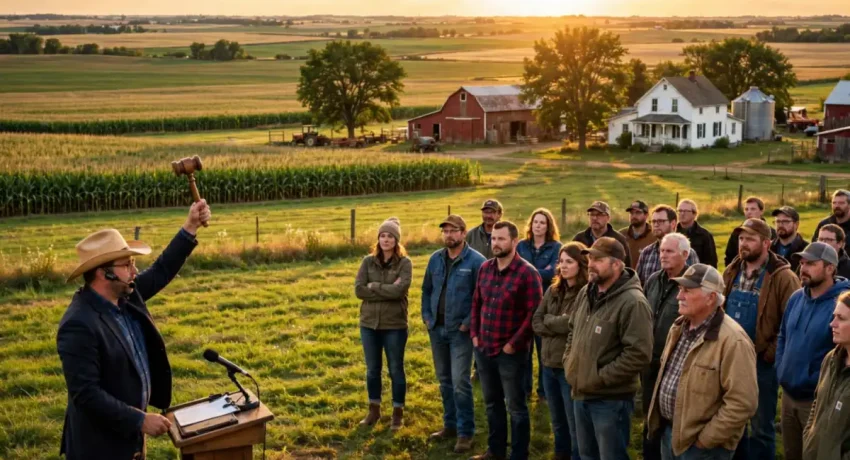

A gavel falls in a Minnesota field. In that instant, a farm changes hands. No weeks of back-and-forth offers, and no inspection contingency. Just one bid, one buyer, and a deal done.
That is the world of Kerkhoff Auction & Real Estate. This family-run company from Redwood Falls, Minnesota, sells farmland, machinery, and homes at auction. Some buyers walk away with a bargain. Others walk away with a lesson. This guide explains how its sales work, what Minnesota land costs in 2026, and how to bid without regret.
Who Is Kerkhoff Auction & Real Estate?
Kerkhoff Auction & Real Estate is a licensed auction company based in Redwood Falls, Minnesota. Doug Kerkhoff owns the firm and works as its auctioneer. His son Zac Kerkhoff also works as an auctioneer. The company describes itself as family oriented, and its goal is simple: run auctions and real estate sales that beat what sellers and bidders expect.
The firm operates from the Kerkhoff Auction Center at 1500 East Bridge Street in Redwood Falls, Minnesota. Online bidding runs through its own website, kerkhoffauction.com. A case study by NextLot, the bidding platform provider, notes that Kerkhoff moved from a shared auction marketplace to its own branded online bidding site. Its first sale on the new platform drew more than 300 unique bidders in three weeks of promotion. That beat every previous Kerkhoff auction held on a marketplace. The same sale reached a 69 percent online bid-on rate.
| Detail | What We Verified |
|---|---|
| Company | Kerkhoff Auction & Real Estate |
| Location | 1500 E. Bridge Street, Redwood Falls, MN 56283 |
| Phone | 507-644-8433 |
| Owner and auctioneer | Doug Kerkhoff |
| Also on the team | Zac Kerkhoff, auctioneer |
| Online bidding | kerkhoffauction.com |
| First branded-platform sale | 300+ unique bidders, 69% bid-on rate |
What Does Kerkhoff Sell at Auction?
Farmland leads the list. Kerkhoff regularly auctions tillable acres, pasture, and recreational ground across southern and central Minnesota. Parcels often sell in pieces, so a 367-acre farm might go out as five separate tracts. Each tract gets its own bidding, and buyers can chase one parcel or several.
Farm machinery fills much of the calendar too. Tractors, combines, planters, and tillage tools change hands at the auction center and online. Construction equipment appears as well, along with trucks and other vehicles. The firm also handles firearms, coins, antiques, and collectibles, which draw a different crowd than the land sales do.
Real estate beyond farmland rounds out the catalog. Homes, building sites, and small commercial properties show up from time to time. A recent example is a 40-acre parcel in Home Township, Minnesota, listed through NorthstarMLS at $476,000. That listing carried 39.66 acres of mostly level, gently rolling ground.
How Does a Kerkhoff Land Auction Work?
Most Kerkhoff land sales run as online-only auctions. Bidding opens days ahead of the close, and it ends at a set time, often 10 a.m. on the sale date. Bidders register on the company website first. Staff help by phone when a bidder needs it.
Each listing spells out its terms in plain language. Here is what a real Kerkhoff farmland auction looked like in 2024. A 75.7-acre parcel went up for online-only bidding. The successful bidder had to sign a purchase agreement the same day and pay a $40,000 non-refundable down payment. The balance was due in certified funds at closing, about a month later. Possession followed once the 2024 crop came off the field.
A larger sale the same year tells the same story. A 367.15-acre farm in Camp Township went out in five parcels. Every parcel carried the same $40,000 non-refundable down payment, due on auction day. Closing landed about five weeks later, with the balance in certified funds. The pattern is clear: Kerkhoff land sales move fast, and the deposit is real money at risk.
- Register on kerkhoffauction.com and read the full terms for the parcel you want.
- Study the survey, soil data, CRP acres, and easements listed for that parcel.
- Set your maximum bid before the sale starts, and include the deposit in your math.
- Bid online until the clock stops, or watch the live event if one is held.
- Sign the purchase agreement the same day and pay the non-refundable deposit.
- Close with certified funds on the stated date, usually within 30 to 45 days.
What Does Minnesota Farmland Cost in 2026?
Land prices set the stakes at every Kerkhoff sale. The U.S. Department of Agriculture put Minnesota cropland at $7,300 per acre in its 2026 report. Nationally, cropland averaged $6,020 per acre, up 3.3 percent from the year before. Minnesota runs well above the national average, and the best ground runs far above the state average.
County-level sales show the spread. Compeer Financial tracked farmland deals across southeastern Minnesota in 2026. Le Sueur County averaged close to $13,500 per tillable acre. Dodge County pushed toward $14,500. Most other counties in the region sat near $11,000 to $11,500 per tillable acre. Values rose about 5 percent from 2025 levels, even though the number of sales fell sharply.
Recent auction results confirm those ranges. A 232-acre farm in Sibley County sold at auction in three parcels for $3.3 million, or about $14,224 per acre. In Faribault County, a 164-acre farm sold in two tracts for $1.6 million, or about $10,167 per acre. One tract in that sale reached $11,110 per acre. Soil quality drives the gap: a parcel with a productivity index near 97 can fetch close to $15,000 per acre, while weaker ground in the far north has traded near $5,120.
| Measure | 2026 Figure | Source |
|---|---|---|
| Minnesota cropland average | $7,300 per acre | USDA Land Values Summary |
| U.S. cropland average | $6,020 per acre, up 3.3% | USDA Land Values Summary |
| Southeastern Minnesota, typical | $11,000–$11,500 per tillable acre | Compeer Financial |
| Le Sueur County average | About $13,500 per tillable acre | Compeer Financial |
| Dodge County average | About $14,500 per tillable acre | Compeer Financial |
| Sibley County auction, 232 acres | $14,224 per acre average | DTN Landwatch |
| Faribault County auction, 164 acres | $10,167 per acre average | DTN Landwatch |
| Recreational land, southeastern MN | $5,000–$7,000 per acre | Compeer Financial |
One warning matters here. Compeer notes that only 55 farmland sales qualified for its southeastern Minnesota analysis in 2026, down from 101 in 2025. A few strong sales can lift an average when the sample is small. Treat these numbers as a guide, not a promise.
Who Buys Property at Auction?
Neighboring farmers buy the most Kerkhoff land. They know the soil, the drainage, and the rental history. An extra 80 acres next door can spread equipment costs and add scale. For them, an auction is a rare chance to buy ground that almost never changes hands.
Investors come second. Farmland has held its value through a rough stretch for crop prices, and that steadiness attracts outside money. Some investors rent the ground back to a local operator. Others hold it for years and wait for values to climb. Recreational buyers form a third group. They want hunting ground, a cabin site, or a piece of river valley, and they pay $5,000 to $7,000 per acre for it in southeastern Minnesota.
First-time buyers show up too, and they face the steepest learning curve. An auction gives no second chance to ask questions after the gavel falls. That is why the preparation steps below matter more than the bidding itself.
How Do You Prepare Before You Bid?
Start with the listing packet. Kerkhoff publishes acreage, soil data, CRP acres and payments, easements, and possession terms for each parcel. Read every line. A 5.88-acre CRP parcel paying $1,515 a year until 2036, for example, changes what the land earns and what you can do with it.
Walk the ground if you can. Soil maps tell you the productivity index, but boots on the ground show you wet spots, access problems, and fence lines. Talk to the tenant farmer when one exists. Ask about yields, drainage work, and any weed or tile issues.
Line up the money early. Kerkhoff land deals close in about 30 to 45 days, and the deposit is non-refundable from day one. Most buyers pay with cash, a farm operating loan, or a land loan arranged in advance. A lender who has never financed an auction purchase may move too slowly, so confirm the timeline in writing before you bid.
Check the title and the easements. One Kerkhoff parcel carried a 20-foot ingress and egress easement along its west line so a neighbor could reach their land. That kind of detail is easy to miss and hard to undo. A title search and a survey, when one exists, are worth the cost on any purchase this size.
Finally, set a hard ceiling. Take the per-acre price you can justify, multiply it by the acres, and add the deposit. Write the number down. Auctions reward discipline and punish excitement in equal measure.
What Are the Risks of Buying at Auction?
The deposit is the first risk. Kerkhoff asks for $40,000 per parcel, non-refundable, on auction day. If your financing falls apart, that money is gone. Compare that with a normal home purchase, where earnest money usually runs 1 to 3 percent of the price and often comes back if a contingency fails.
The second risk is the lack of contingencies. Auction sales are non-contingent. There is no inspection clause to hide behind and no appraisal clause to save you. If the well is dry or the soil is worse than you thought, the deal still closes.
The third risk is speed. Closing lands 30 to 45 days after the sale, with the balance due in certified funds. A buyer who counts on selling another property first, or on a slow lender, can run out of time. Some auction houses add a buyer premium on top of the hammer price, often around 4 percent in published examples. Always ask whether a premium applies before you bid, because it changes your true cost.
The fourth risk is the property itself. Auction parcels sell as-is, where-is, with no warranties. Farm machinery sells the same way. That is normal for auctions, but it means your homework has to happen before the sale, not after.
Is Auction Buying Cheaper Than a Normal Sale?
Sometimes it is, and sometimes it is not. The discount depends on the property type. Foreclosure auctions can sell well below retail value, often 20 to 40 percent below, according to industry data cited by AmeriSave. Kerkhoff farmland sales are a different story. Good tillable ground in southern Minnesota is scarce, and neighbors bid hard for it. A 232-acre farm that fetched $14,224 per acre at auction was not a bargain. It was the market price, set in public.
Foreclosure volume is rising, which may create more auction supply. ATTOM reported 39,906 U.S. properties with a foreclosure filing in July 2026, up 10 percent from the same month a year earlier. More filings mean more auction lots, and more lots mean more chances for a careful buyer. They also mean more competition from investors who buy at auction every week.
Speed is the real advantage of an auction. A normal real estate deal takes 30 to 60 days from offer to closing, and it can drag on longer. An auction compresses the whole process into a few weeks. Sellers like the certainty. Buyers who are ready like the clarity. Nobody likes the risk, but the risk is the price of the speed.
What Happens After the Hammer Falls?
The winner signs a purchase agreement immediately. At Kerkhoff land sales, that happens on auction day, along with the $40,000 non-refundable deposit per parcel. The agreement is non-contingent, so the usual escape clauses do not apply.
Next comes the closing window. Kerkhoff typically sets closing 30 to 45 days after the sale. The buyer pays the balance with certified funds. The seller delivers the deed, and possession follows the terms in the listing. On farmland, possession often waits until the current crop is harvested. Machinery and personal property follow a different rule: the buyer picks items up during a set load-out window, often a single day from 9 a.m. to 3 p.m.
Miss the deadline and the deposit is at risk. That is why serious bidders arrive with financing approved, not merely pre-qualified. A lender who needs six weeks will not fit a four-week closing.
Should You Bid in a Kerkhoff Auction?
Bid if you know the ground, the price, and your limit. Kerkhoff is a real, licensed, family-run firm with a verifiable record in Redwood Falls. Its online platform drew more than 300 bidders to a single sale. The terms are published in advance, and every parcel carries real soil and survey data. That is a solid foundation for a buyer who does the work.
Skip the sale if you need contingencies, a slow lender, or time to think. An auction gives you none of those. Watch one first instead. Register, follow the bidding, and see how a parcel you studied actually closes. The next sale will come, and you will bid with eyes open.
Frequently Asked Questions
Where is Kerkhoff Auction & Real Estate located?
The company works from the Kerkhoff Auction Center at 1500 East Bridge Street, Redwood Falls, Minnesota 56283. Its phone number is 507-644-8433, and online bidding runs at kerkhoffauction.com.
What does Kerkhoff Auction sell?
Farmland and other real estate lead the catalog. Farm machinery, construction equipment, vehicles, firearms, coins, antiques, and collectibles also sell through the firm, both at the auction center and online.
How much is the down payment at a Kerkhoff land auction?
Recent Kerkhoff farmland listings required a $40,000 non-refundable down payment per parcel, paid on auction day. The balance was due in certified funds at closing, about 30 to 45 days later. Terms vary by sale, so always read the listing packet.
Can I bid online in a Kerkhoff auction?
Yes. Most Kerkhoff land sales run as online-only auctions, and bidding happens on kerkhoffauction.com. Staff help bidders by phone when needed. The firm’s first sale on its own branded platform drew more than 300 unique bidders.
Is buying farmland at auction risky?
It can be. The deposit is non-refundable, the sale is non-contingent, and closing comes fast. The risk drops sharply when you walk the ground, check the title, arrange financing in advance, and set a firm maximum bid before the sale starts.
What is Minnesota farmland worth in 2026?
The USDA put Minnesota cropland at $7,300 per acre in 2026. County-level sales in southeastern Minnesota ranged from about $11,000 to $14,500 per tillable acre, while recreational land fetched $5,000 to $7,000 per acre. Soil quality and location drive the spread.