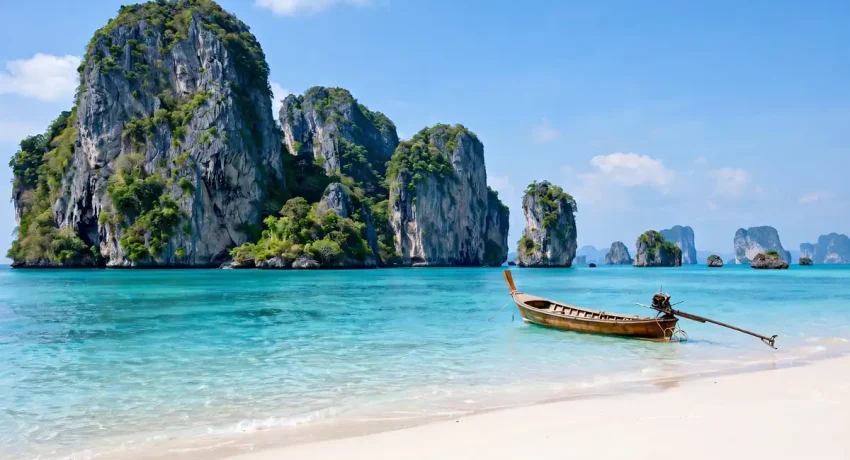

Thailand has more than 3,000 kilometres of coastline. It also has two seas. That single fact shapes every beach trip in the country. The best places to visit in Thailand for beaches are not all good at the same time. Choose the wrong coast for your month, and you get grey seas and cancelled boats. Pick the right one, and you get the turquoise water from the postcards.
This guide covers the beaches that are actually worth your time in 2026. It names the best sand on each coast. This guide gives you real prices, honest rules, and the mistakes to avoid. Every fact here comes from a published source. Where a price varies, you will see a range. Rule changes from 2026 are flagged as you read.
What Makes Thailand’s Beaches So Different From Anywhere Else?
Most beach countries have one coastline and one season. Thailand has two. The Andaman Sea washes the west coast. The Gulf of Thailand washes the east. Their monsoons run in opposite directions. So the country is never fully in beach season, and never fully out of it. There is almost always a good beach somewhere in Thailand. The trick is knowing which coast to pick for your dates.
The range is also unusual. You can find a party beach with a hundred bars. There is a beach with no road at all. Some coves ban boats from anchoring on the sand. One island is built entirely around diving. Few countries pack that much variety into one flight.
That variety is why this guide is organised by coast first, then by island. The beach you choose matters less than the month you choose it in. Get the month right, and almost any of the beaches below will deliver. Choose badly, and even the most famous beach in the country will disappoint you.
Which Coast Should You Choose — Andaman or Gulf?
This is the most important decision in the whole guide. The best places to visit in Thailand for beaches sit on two coasts with opposite weather. The same week can be flat calm on one side and closed to ferries on the other. So fix your dates first, then pick your coast.
The Andaman coast covers Phuket, Krabi, the Phi Phi islands, Koh Lanta and Koh Lipe. Its dry season runs from November to April. December to March gives you the calmest sea and the most reliable island hopping. From May to October, the southwest monsoon brings rougher water and ferry cancellations. Several marine national parks close entirely during this period.
That is the Thailand beach season in one paragraph: two coasts, two calendars. The Gulf coast covers Koh Samui, Koh Phangan and Koh Tao. It runs on a different rainfall calendar. Its wettest stretch is roughly September to December, with November usually the worst month. The Gulf islands tend to be at their best from January onward and through the middle of the year. So in December, head west. In June and July, head east.
| Coast | Islands and beaches | Best months | Months to avoid |
|---|---|---|---|
| Andaman (west) | Phuket, Krabi, Phi Phi, Koh Lanta, Koh Lipe | November to April | May to October (rough seas, some closures) |
| Gulf (east) | Koh Samui, Koh Phangan, Koh Tao | January to September | October to December (November wettest) |
| Eastern Gulf | Koh Chang, Koh Kood, Pattaya, Hua Hin | November to April | May to October (rain, rougher seas) |
What if your trip covers both coasts? You can do it, but one half will probably be wet. A better plan is to split the trip by season. Spend the dry months on the Andaman side. Use the summer months for the Gulf side. If your dates are fixed, choose the coast that matches them and stay there.
What Are the Best Beaches in Phuket?
Thailand’s biggest island is Phuket. Phuket beaches offer the most variety and the easiest access of any beach destination in the country. Several of the best places to visit in Thailand for beaches sit on this one island. You fly into Phuket International Airport, and you can be on the sand within an hour. That ease is also its weakness. The most famous beaches are crowded. The trick is knowing which beach fits your trip.
Is Patong Beach Worth Your Time?
Patong is loud, busy, and a little messy at times. It is also the most complete beach in Phuket. You get nightlife, water sports, shopping, and restaurants within a short walk of the sand. Bangla Road comes alive after 9pm, with drinks from about 150 THB. If that strip is the trip, stay in Patong. Otherwise, sleep elsewhere and visit for one evening.
The beach itself is a long curve of sand with jet skis, parasailing, and sun loungers. It is not the prettiest beach on the island. But it is the most convenient one. Families often prefer to stay south in Kata or Karon and come to Patong for a night out.
Why Do Families Choose Kata and Karon?
Kata and Karon sit just south of Patong. They are the family beaches of Phuket. The sand is walkable, the water is calm in the dry season, and restaurants sit right on the beach. Karon offers the best balance of beach quality, local atmosphere, and amenities for most travellers. Kata is more artistic and scenic, and it is the island’s surf beach in the wet season.
From May to October, Kata comes alive for surfers. Board hire from the beach shacks costs around 300 to 500 THB an hour. Lessons run about 600 to 1,000 THB an hour. The same swell that makes surfing possible also makes swimming risky. Red flags fly on the west coast more days than not in these months. Take them seriously.
How Do You Reach Freedom Beach?
Freedom Beach is a 300-metre strip of soft white sand tucked between Patong and Karon. Many guides call it the most beautiful hidden beach in Phuket. There is no road to it. You reach it by longtail boat from the southern end of Patong Beach, or by a steep trail from the land.
A round-trip longtail boat usually costs between 1,200 and 1,500 THB per boat, so sharing with a group makes it much more affordable. The private land trail costs around 100 to 200 THB per person to cross. A free public trail also exists, but the hike back up is steep. The best time to visit is December to April, when the sea is flat and the water is clear for snorkelling.
One honest warning. In August 2026, the environment minister ordered Freedom Beach closed after its third drowning since May 2025. No reopening date was given at the time of writing. Check the current status before you build a day around it. The sea here can turn dangerous fast in the monsoon, and longtail boats often stop running entirely from May to October.
Where Is Phuket at Its Quietest?
Nai Harn Beach, at the southern tip of the island, has clear water and far fewer crowds than Patong. Kamala and Surin are the quieter west-coast coves north of Patong, with daybeds from about 2,000 THB in high season. Mai Khao, on the northern coast, is the longest and least crowded beach in Phuket. It is backed by a national park and has minimal development.
If you want a non-beach day, Old Phuket Town is worth a morning. Its Sino-Portuguese streets are a different Thailand from the beach strip. Rooms in the old town start from around 1,300 THB, about half the price of a comparable beach room.
Why Is Railay Beach in Krabi So Special?
Railay is the beach that makes people fall in love with Thailand. Krabi beaches are famous for limestone cliffs that rise straight out of turquoise water. There are no cars and no roads. You reach it only by longtail boat, about 15 minutes from Ao Nang, for around 150 THB. That single fact keeps the crowds down and the atmosphere calm.
Railay has four beaches in one small peninsula. West Railay is the sunset beach, wide and sandy. East Railay is a mangrove shore with bars and restaurants. Phra Nang, a short cliff walk away, is the showpiece. It has powder sand, turquoise water, and a limestone tower rising out of the sea. Many guides call it the best beach in Thailand. It is hard to argue with them.
Rock climbing is the other reason people come here. The cliffs hold hundreds of bolted routes, and schools run beginner sessions on the beach. Kayaking through the limestone caves is the quieter alternative. Stay overnight if you can. The day boats leave by late afternoon, and the peninsula turns peaceful.
Is Ao Nang a Good Base for Krabi?
The main town on the Krabi mainland is Ao Nang. Ao Nang beach itself is ordinary, but that is not the point. This town is the base for island hopping. Thailand island hopping starts here, with longtail boats leaving from its beach to Railay, to the Hong Islands, and to the Phi Phi islands. Restaurants, hotels, and tour offices line the main street. Book a boat in the morning. The sea is calmest then, and the best beaches are empty before the day boats arrive.
From Krabi, the Phi Phi islands are an easy day trip. Speedboats run in the morning, and the crossing takes about an hour. The national park fee for the Phi Phi area is 400 THB for foreign adults and 200 THB for children. Some cheap listings quote a fare and then collect the fee in cash at the jetty. Ask before you book whether the fee is included.
Can You Still Visit Maya Bay — and Can You Swim There?
Maya Bay is the most famous beach in Thailand, and one of the best places to visit in Thailand for beaches even though you cannot swim there. It starred in the film “The Beach” with Leonardo DiCaprio. Yet it is also the most misunderstood beach in the country. You cannot swim there. Nor can you stay all day. And for two months every year, you cannot visit at all.
The bay sits on Koh Phi Phi Leh, an uninhabited island in Krabi province. It closed for nearly four years to recover from overtourism, then reopened in 2022 with strict new rules. Those rules are still in force in 2026. Here is what they mean in practice.
| Rule | 2026 position |
|---|---|
| Open or closed | Open, except the annual closure from 1 August to 30 September |
| Hours | 7:00am to 6:00pm daily when open |
| Entry fee | 400 THB per foreign adult, 200 THB per foreign child |
| Swimming | Not allowed — wading to knee depth only |
| Boats | Dock at Loh Samah Bay, then a 5 to 10 minute boardwalk — no anchoring on the sand |
| Time on site | About one hour, with visitor numbers capped |
| Also banned | Standing on coral, taking shells, non-reef-safe sunscreen, drones, paddleboards in the park |
The bay reopened on 1 October 2026 after its annual conservation break. The two-month closure is now a fixed annual fixture. It runs every year from 1 August to 30 September, so the reef and marine life can recover during the monsoon. If you are planning a summer trip, check the dates before you build a day around it.
Why no swimming? The recovering reef and the blacktip reef sharks that use the shallows need the space. Rangers patrol the beach and will whistle anyone who goes deeper than their knees. That sounds strict, and it is. It is also why the bay looks the way it does now. The water is clear, the sand is clean, and the sharks have returned.
Most people reach Maya Bay as a day trip by speedboat from Phuket, about 45 kilometres and 45 to 60 minutes across the water. A Koh Phi Phi day trip usually starts early in the morning, when the sea is calmest. The national park fee is usually included in the tour price. Some cheap listings quote a fare and then collect 400 THB in cash at the jetty. Ask before you book. The best months to visit are November to April. February to March is the calm shoulder, with fewer crowds than December and January.
What Are the Best Beaches on Koh Samui?
Koh Samui is the Gulf coast’s main island. Some of the best places to visit in Thailand for beaches on the Gulf sit on this one island. It has its own airport, so you can fly in from Bangkok in about 70 minutes. A one-way flight in 2026 is often 1,800 to 4,500 THB before bags. The Donsak ferry plus a van from the mainland is the slower, cheaper path. Samui is built for comfort. It has villa resorts, quiet bays, and the best infrastructure of any Gulf island.
Koh Samui beaches range from busy Chaweng to quiet Maenam. Chaweng Beach is Samui’s busiest and most complete beach. It has hotels, nightlife, water sports, and a strong holiday infrastructure. Chaweng suits you if you want plenty happening around you. Lamai Beach, just south, runs at a slower pace. It has the same sand with fewer crowds and lower prices.
For something calmer, try Silver Beach, also called Thong Takian. It is a small cove with soft sand and clear water, good for swimming and snorkelling. Bophut, on the north coast, has a fisherman’s village feel, with restaurants along the sand and a Friday night market. Maenam, further west, is the quiet family beach, with long flat sand and shallow water.
Samui’s best season runs from January to September. October to December is the roughest stretch, when the northeast monsoon hits the Gulf. November is usually the wettest month on Samui, and ferries are sometimes cancelled when the sea is rough. December improves, especially in the second half, but it is a gamble. If your dates are fixed in November, choose the Andaman side instead.
Is Ang Thong Marine Park Worth a Day Trip?
Ang Thong is a group of 42 islands in a national marine park, reached only by day boat from Samui. There is no public ferry. The park fee is 300 THB, on top of the tour. Full-day tours run about 55 to 75 US dollars per person. The islands have hidden lagoons, limestone cliffs, and viewpoints that look like the inside of a postcard. It is the best day trip from Samui, and the one most people remember.
Is Koh Phangan Only About the Full Moon Party?
Koh Phangan is famous for one thing: the Koh Phangan Full Moon Party at Haad Rin. Every month, thousands of people gather on Haad Rin beach for an all-night party under the full moon. The ferry from Samui takes about 30 minutes on the Lomprayah catamaran, from around 250 THB. Book ahead around the party, because the Friday outbound fills two to three weeks in advance.
But Phangan is much more than one party. The island has quiet beaches, jungle waterfalls, and a growing wellness scene. Bottle Beach, on the north coast, is reached only by boat or a rough track, which is exactly why it stays empty. Thong Nai Pan, on the east coast, has two bays with soft sand and calm water. Than Sadet waterfall, on the east side, is the island’s best-known jungle walk.
If you want the party without the chaos, stay on the west or north coast and take a boat to Haad Rin for the night. For quiet, avoid the three days around the full moon entirely. The island changes completely once the party crowd leaves.
Why Do Divers Love Koh Tao So Much?
Koh Tao is not a beach destination with diving on the side. It is a diving island with small beaches. The experience only delivers if you arrive knowing that. The island has some of the cheapest dive courses in the world, and the reefs around it are full of turtles, reef sharks, and colourful fish. Koh Tao diving is among the cheapest in the world, which is why so many people learn here.
Sairee Beach is the main beach, a long curve of sand with dive schools, restaurants, and bars. It is the social heart of the island. For the best sand, take a boat to Koh Nang Yuan, a tiny island just off the north-west coast. It has a sandbar that joins three small islands, and it is one of the most photographed spots in Thailand. A day trip from Samui, including Koh Tao snorkelling and a stop at Koh Nang Yuan, costs about 60 to 90 US dollars per person.
The ferry from Koh Phangan to Koh Tao takes about 90 minutes on the Lomprayah catamaran. Book the afternoon before, not at the pier in a swell. The Gulf monsoon hits hardest from October to December, and afternoon sailings can shift by 30 to 60 minutes in November and December swell.
Where Are Thailand’s Quietest Beaches?
If the famous beaches sound too busy, Thailand still has quiet sand. You just have to go further, or accept a slower pace. The best places to visit in Thailand for beaches are not always the ones on the postcards. Sometimes the quiet ones are better.
The calmest island on the Andaman coast is Koh Lanta. Koh Lanta beaches are long, calm, and relaxed. It has long beaches, clear water, and a relaxed pace that suits families and slow travellers. Kantiang Bay, in the south, is the quietest sand on the island. Koh Lanta stays open year-round, but the dry season from November to April is still the best time to visit.
In the eastern Gulf near the Cambodian border sits Koh Chang, Thailand’s second-largest island. Koh Chang beaches mix white sand with jungle and waterfalls. It has white-sand beaches, waterfalls, and jungle, within reach of Bangkok by road and ferry. Koh Kood, just south of it, is quieter still. It has clear water, soft beaches, and a slower pace, with far fewer visitors than the famous islands.
The trade-off is real. Quiet beaches have fewer restaurants, fewer boats, and fewer options when the weather turns. That is the price of the quiet. For most people, it is worth paying.
What About Pattaya and Hua Hin — Are They Worth It?
Pattaya and Hua Hin are the easiest beach escapes from Bangkok. Both are reached by road in about two to three hours. Neither has the best sand in Thailand. Both are worth a visit for the right reasons.
Pattaya is a city beach, not a tropical island. The sand is narrow, the water is murky, and the nightlife dominates the main strip. But the islands just offshore, like Koh Larn, have clear water and white sand, reached by a 30-minute ferry. Pattaya works as a weekend break or a base for island day trips. It does not work as a pure beach holiday.
Hua Hin is the calmer alternative. It has a long, flat beach, a night market, and a royal palace. Thai families and older travellers love it here. The sand is firm and the water is shallow, which suits children. It is the best easy beach escape from Bangkok if you want quiet over drama.
How Much Do Thailand’s Best Beaches Cost?
The best places to visit in Thailand for beaches are still cheap by international standards. But prices vary sharply by island, by season, and by how you travel. The table below gives you real ranges for what Thailand beaches cost, from published 2026 sources. Use them to plan, not as promises. Prices change, and the cheapest listing is not always the honest one.
| What | Typical range (2026) | Notes |
|---|---|---|
| Budget day in Phuket | 800 to 1,500 THB | Guesthouse, street food, local transport |
| Mid-range day in Phuket | 2,000 to 4,000 THB | Hotel, restaurants, one tour |
| Luxury day in Phuket | 5,000 THB and up | Resort, spa, private boat |
| Rainy season hotel saving | 30 to 50 percent below peak | May to October on the Andaman coast |
| Phi Phi day boat from Phuket | 1,500 to 2,500 THB | Plus 400 THB national park fee |
| Phang Nga Bay day boat | 1,500 to 2,500 THB | Plus 300 THB national park fee |
| Snorkelling half-day | 800 to 1,200 THB | From Patong or Ao Nang |
| Surf board hire, Kata | 300 to 500 THB per hour | May to October only |
| Samui to Phangan ferry | About 250 THB | Lomprayah, 30 minutes |
| Koh Tao day trip from Samui | 60 to 90 US dollars | Speedboat, gear, lunch included |
| Ang Thong day tour | 55 to 75 US dollars | Plus 300 THB park fee |
| Longtail boat, Railay | About 150 THB | 15 minutes from Ao Nang |
| Longtail boat, Freedom Beach | 1,200 to 1,500 THB return | Per boat, so share with a group |
The biggest saving is the season. A mid-range Kata hotel asking 2,000 to 3,500 THB in the cool season is typically about a third off from May to September. Rooms in Old Phuket Town start from around 1,300 THB, about half a comparable beach room. The cheapest window on the Andaman coast is June to September. The most expensive is about 20 December to 3 January.
How Do You Get Between the Islands?
Thailand’s islands are connected by a ferry network that is easy to use once you understand it. The main operators are Lomprayah, Seatran, and Raja Ferry. Lomprayah runs the fast catamarans between Samui, Phangan, and Tao. Seatran runs the slower car ferries. Raja Ferry handles vehicles on the mainland routes.
Book the fast boats the afternoon before, not at the pier in a swell. High-season crossings in late December and around Songkran in mid-April fill earlier than the rest of the year. The morning sailing runs reliably year-round. Afternoon sailings can shift by 30 to 60 minutes in November and December swell.
For the Andaman coast, fly into Phuket or Krabi, then take a boat in the morning. The sea is calmest then. For the Gulf, fly into Koh Samui, then take the ferry south to Phangan and Tao. All Gulf itineraries begin and end on Samui. There is no shortcut around that.
How Should You Plan a 10-Day Beach Trip?
Ten days is the right length for a first Thailand beach trip. This plan covers the best places to visit in Thailand for beaches on the Andaman side, with an optional Gulf finish.
Days one to four: base yourself in Kata or Karon, Phuket. You get the beach, the food, and the day boats to Phi Phi and Phang Nga Bay. Take one boat day to the Phi Phi islands, with Maya Bay early in the morning. Keep one day for Freedom Beach or Nai Harn. Leave one day free for the weather.
Days five to seven: cross to Krabi and stay in Ao Nang. Take the longtail to Railay and Phra Nang. Walk the cliff path between the beaches. Stay one night on Railay if you can. The peninsula is a different place once the day boats leave.
Days eight to ten: fly or ferry to the Gulf, or stay on the Andaman side if your dates fall in the wet season. If you do cross to the Gulf, base yourself on Samui and take a day trip to Koh Tao and Koh Nang Yuan. End the trip with one slow day on the sand. You will need it.
If your dates fall between May and September, flip the plan. Start on the Gulf. Base yourself on Samui, Phangan, or Tao. The Andaman coast will be wet, and the boats will be rough. The Gulf islands are at their best in exactly those months.
What Should You Watch Out For?
Thailand’s beaches are safe for most people, most of the time. The risks are real, but they are easy to manage once you know them. Here are the ones that matter.
Red flags on the beach mean do not swim. Between 2024 and mid-2026, officials counted 56 drownings on Phuket’s beaches. Twenty of them were at Karon alone, and five each at Kata and Surin. May and August were the worst months. The sea is the problem, not the sky. If the flag is red, stay out of the water.
Box jellyfish pose a real risk on the Gulf coast, with the highest concentrations during the rainy season. Since 2002, around ten people have died from box jellyfish stings in Thailand, according to a 2016 study, with the majority in the waters around Koh Samui and Koh Phangan. Swim inside the nets where they are provided, and ask locally about current conditions.
National park fees catch people out. The Phi Phi area charges 400 THB for foreign adults and 200 THB for children. Phang Nga Bay charges 300 THB. Ang Thong charges 300 THB. Some operators include the fee in the tour price. Others collect it in cash at the jetty. Ask before you book, so the total does not move when you arrive.
Scams are usually small. The most common is the jet ski damage claim, where an operator demands money for a scratch that was already there. Photograph the jet ski before you ride it. The second is the cheap tour that hides the park fee. The third is the taxi or tuk-tuk with no meter. Agree the price before you get in.
Finally, respect the rules that protect the beaches. Use reef-safe sunscreen. Do not stand on coral. Leave the shells where they are. Drones need a permit, so do not fly one without it. The beaches that look the best in 2026 are the ones where these rules are enforced. Maya Bay is the proof.
Frequently Asked Questions
What is the best beach in Thailand?
For most travellers, it is Phra Nang in Krabi. It has powder sand, turquoise water, and a limestone tower rising out of the sea, all a short cliff walk from Railay. If you want quiet over drama, Bottle Beach on Koh Phangan or Kantiang Bay on Koh Lanta beat it on solitude.
Which Thai island has the best beaches?
Krabi, for Railay and Phra Nang, and Koh Lanta stand out on the Andaman coast for scenery and calm water. Phuket has the most variety and the easiest access. For clear-water diving, Koh Tao wins. Comfort and beauty together point to Koh Samui.
When is the best time to visit Thailand’s beaches?
The best time to visit Thailand beaches depends on the coast. The Andaman side, with Phuket, Krabi, Phi Phi, Lanta, and Lipe, is best from November to April. The Gulf side, with Koh Samui, Koh Phangan, and Koh Tao, is best from roughly January to September, with its wettest stretch in October to December.
Can you swim at Maya Bay?
No. Since the 2022 reopening, swimming is not allowed. You can wade into the water up to your knees only. The bay also closes every year from 1 August to 30 September for reef recovery, and reopened on 1 October 2026. The entry fee is 400 THB for foreign adults.
How many days do you need for Thailand’s beaches?
Ten days is the right length for a first trip. It gives you two islands and one slow day. Seven days works for one coast. Fewer than five days means you will spend most of the trip in transit. Add days, not islands, if you want a relaxed trip.
Are Thailand’s beaches expensive?
No, not by international standards. A budget day in Phuket runs about 800 to 1,500 THB. A mid-range day runs about 2,000 to 4,000 THB. The biggest saving is the season. Rooms on the Andaman coast drop 30 to 50 percent below peak from May to October, though the sea is rougher then.
The best places to visit in Thailand for beaches reward one simple habit: match the coast to the month. Do that, and the rest of the trip takes care of itself. The sand will be white, the water will be clear, and the boat will actually run. Get the month wrong, and no beach in the country can save the trip. So check the calendar first, then book the beach.