

Your team joins a video call and the picture freezes. A file takes ten minutes to reach the printer. The card machine drops offline at the till. Most of the time, the problem is not your internet plan. It is the network inside your building.
Business network technology is the hardware and software that connects everything in your office. It covers the fibre line coming in, the router and firewall, the switches, the Wi-Fi access points, and the rules that keep staff, guests, and devices apart. Get it right and nobody thinks about it. When it goes wrong, every working day has a small, expensive delay in it.
This guide explains what a modern business network needs in 2026. It covers Wi-Fi 7, multi-gigabit wiring, SD-WAN, SASE, and network security. You will also find real 2026 costs and a setup plan for offices of different sizes.
What Is Business Network Technology?
Business network technology is the set of tools that moves data around a company. It has four jobs. First, it connects devices to each other. Next, it connects the office to the internet. Then it protects data from intruders. And it keeps working when one part fails.
A home router does a rough version of this for a few phones and a laptop. By contrast, a business network does it for dozens or hundreds of devices. That includes staff laptops, phones, printers, tills, cameras, door locks, and sensors. The scale changes everything. A home setup can be one box. In a business, the setup is a small system.
The parts of that system are simple to name. First comes the internet line, which brings connectivity in. Then the gateway and business firewall, guarding the door. After that, the switch, which moves data between wired devices. Access points spread Wi-Fi through the building. A controller manages it all from one screen. And the backup line takes over if the main line fails.
None of these parts is new. What changed in 2026 is the speed and the price. Multi-gigabit hardware now costs almost the same as gigabit hardware. Wi-Fi 7 access points have dropped to small-business prices. And cloud-managed SD-WAN has put enterprise-grade branch networking within reach of a ten-person office.
What Happened to Guangzhou Baomei Network Technology?
You may have found this page looking for a company called Guangzhou Baomei Network Technology. Here is what we could verify. Guangzhou Baomei Network Technology Co., Ltd. is a real registered company in China. United States trademark records show it owns two brand names, KITCER and AIKICO. The KITCER filing, from September 2020, covers kitchen and household goods such as cups, dishes, and cooking utensils. A second filing, for AIKICO from June 2021, covers paper and stationery goods.
What we could not verify is any network technology business. The company has no official website we could find. It lists no network products, no services, and no clients. Nothing in the public record connects it to enterprise networking, Wi-Fi, or business internet.
So this article does not pretend the company is a networking vendor. Instead, it answers the question behind the search. If you are a business owner looking for network technology, here is what you actually need in 2026, what it costs, and how to choose it.
What Are the Building Blocks of a Modern Business Network?
A business network has seven building blocks. Each one does a different job. Skip one and the whole system has a weak point.
| Building block | What it does | Typical 2026 choice |
|---|---|---|
| Internet line | Brings connectivity into the building | Full-fibre business broadband, 500 Mbps to 1 Gbps |
| Gateway and firewall | Guards the door and inspects traffic | Managed security gateway with firewall |
| Switch | Connects wired devices at high speed | Managed PoE switch, 2.5G ports |
| Access points | Spread Wi-Fi through the building | Wi-Fi 7 or Wi-Fi 6E access points |
| Network segments | Keep staff, guests, and devices apart | VLANs for staff, guest, and IoT traffic |
| Backup line | Takes over if the main line fails | Second broadband line or 4G/5G failover |
| Management | Lets you see and control everything | Cloud controller or on-site controller |
The order matters. Start with the internet line and the gateway. Then add switching and Wi-Fi. After that, add segments and a backup line. The management layer sits on top of all of it.
Do You Need Wi-Fi 7 in 2026?
Wi-Fi 7 is the marketing name for the IEEE 802.11be standard. The Wi-Fi Alliance began certifying it in January 2024. By 2026, it is the standard spec on premium routers, laptops, and flagship phones.
The headline number is a theoretical maximum of 46 Gbps. That is about four times the 9.6 Gbps ceiling of Wi-Fi 6. Real-world speeds are much lower. No office will see 46 Gbps. But the improvement over older standards is still very noticeable in a busy office.
Three features do the real work. Multi-Link Operation lets a device use several bands at once, such as 5 GHz and 6 GHz together. That gives steadier latency. If one band gets congested, traffic keeps flowing on the others. Channels up to 320 MHz wide on the 6 GHz band double the room for data. And 4K-QAM packs about 20% more data into each signal than Wi-Fi 6.
Do you need it now? It depends on your devices. You need a Wi-Fi 7 access point and Wi-Fi 7 devices to see the full benefit. Recent flagships such as the Samsung Galaxy S24 and later, the Google Pixel 9 and later, and the iPhone 16 and later support it. Many 2025 and 2026 Windows laptops do too. Older devices still work fine on a Wi-Fi 7 network. They simply connect with their own older standard.
For most offices, Wi-Fi 7 for business is a “buy it when you replace the hardware” upgrade. If your current access points work well and your internet plan is under 500 Mbps, you can wait. When you are buying new access points anyway, Wi-Fi 7 is the sensible choice in 2026. Business Wi-Fi 7 access points now start at around $189, with models such as the UniFi U7 Pro at $189 and the U7 Pro Max at $279.
Why Does Your Wired Network Need Multi-Gigabit Speed?
Wi-Fi 7 can move data faster than a gigabit cable. That creates a bottleneck. Your wireless network is only as fast as the wired backbone behind it. This is why multi-gigabit networking matters in 2026.
Multi-gigabit means switch ports that run at 2.5 Gbps or 5 Gbps instead of 1 Gbps. The good news is that the upgrade is cheap. Under the IEEE 802.3bz standard, 2.5G and 5G run over existing Cat5e and Cat6 cabling. Most offices can upgrade without rewiring. And by the second quarter of 2026, the cost difference between gigabit and 2.5G hardware had dropped below 15%.
Industry data shows the shift is already happening. Around 70% of small business network upgrades in 2026 include multi-gigabit infrastructure. The reason is simple. Wi-Fi 7 access points, cloud applications, and local AI workloads all push more data through the wired network than gigabit ports can carry.
The rule is simple. If you are buying a new network switch for business use, buy one with 2.5G ports. A managed PoE switch with 2.5G ports powers your access points and cameras through the same cable that carries their data. Power over Ethernet, or PoE, means one cable per device instead of two. That keeps the install clean and the cost down.
How Should You Segment Your Network?
Segmentation means splitting one network into separate lanes. Each lane has its own rules. Staff devices use one lane. Guests use another. Cameras, printers, and smart devices use a third. The lanes cannot see each other unless you allow it.
What creates them is the VLAN, or virtual local area network. A managed switch creates VLANs in software. No extra hardware is needed. A typical small office runs three VLANs. One for staff, one for guests, and one for devices such as cameras and printers.
Why does this matter? Because a guest should never reach your file server. A camera should never reach the internet directly. And a single infected laptop should not be able to scan every device in the building. Segmentation limits the damage when something goes wrong.
Set up three simple rules. Staff can reach the servers, the printers, and the internet. Guests can reach the internet only. Devices can reach only the service they need. That is enough for most offices. Larger offices add a fourth VLAN for payment systems or for voice calls.
What Is SD-WAN and When Do You Need It?
SD-WAN stands for software-defined wide area networking. It connects your offices to each other and to the internet. The old way to do this was MPLS, a private circuit rented from a carrier. SD-WAN replaces that with software that runs over ordinary broadband lines.
The software watches every link in real time. It sends video calls over the fastest link. Bulk downloads go over the cheapest link instead. If a link fails, traffic shifts to another link in seconds. Nobody in the office notices.
SD-WAN also makes multi-site networking simple. Cloud-managed SD-WAN can connect a new branch office in a few clicks once the IP ranges are planned. Tools such as UniFi Site Magic do this without the manual IPsec tunnel work that used to need a network engineer on site.
When do you need it? You need SD-WAN when you have two or more locations. It also helps when your main site depends on cloud apps and cannot afford an outage. A single office with one internet line does not need SD-WAN. It needs a good firewall and a backup line.
How Much Does SD-WAN Cost in 2026?
SD-WAN pricing is famously opaque. Vendors rarely publish list prices. But 2026 market data gives a clear picture.
As a quick benchmark, SD-WAN typically costs between $100 and $500 per site per month. That depends on features, bandwidth, and the deployment model. Real quotes from recent requests for proposals show $95 to $272 per site per month at 200 Mbps, and $496 to $1,256 per site per month at 2 Gbps. The spread between the cheapest and most expensive option is nearly three times at the same speed.
Most of the saving comes from retiring MPLS. In practice, organisations save 30% to 50% compared with traditional MPLS circuits. Where MPLS is fully replaced with broadband, savings reach 84%. UK market data tells the same story. Managed MPLS circuits typically cost £350 to £800 or more per site each month. SD-WAN over business full-fibre costs £120 to £350 per site per month. Managed dual-line SD-WAN runs £250 to £600.
Entry-level managed SD-WAN for small businesses now starts below $150 per site per month. Aryaka, for example, offers SME packages from under $150 per site. That price includes connectivity, security, and a managed service.
Keep MPLS for the places that truly need it. Data centres, headquarters, and legacy voice systems with strict carrier service agreements are the usual exceptions. Move standard branch offices to SD-WAN and bank the saving.
What Is SASE and Zero Trust Network Access?
SASE is short for Secure Access Service Edge. Gartner coined the term in 2019. It combines SD-WAN networking with cloud-delivered security in one service. The security half is called SSE, or security service edge. It bundles four things: a secure web gateway, a cloud access security broker, zero trust network access, and usually a cloud firewall.
Zero trust network access, or ZTNA, is the most important part for most businesses. The old model trusted anything inside the office network. ZTNA trusts nothing by default. Every user and every device must prove who they are before reaching an application. And they only reach the applications they need, never the whole network.
That matters because the office is no longer a place. Staff work from home, from cafés, and from client sites. The network edge is wherever the person is. SASE puts the security in the cloud, so the same policy follows the user everywhere.
How much does it cost? Gartner expects enterprises to pay $15 to $40 per user per month for a full SASE solution. SSE-only deployments cluster at $8 to $25 per user per month. Published prices in 2026 include Cloudflare One, which is free for up to 50 users and $7 per user per month on pay-as-you-go; Fortinet FortiSASE at $6 to $12; Cato Networks at $8 to $14; Cisco Secure Access at $10 to $16; and Netskope One at $8 to $16. Vendors increasingly sell all of this as network as a service, with connectivity and security bought as a subscription rather than as hardware.
Do small businesses need full SASE? Mostly when they have branch offices to connect or an MPLS contract to replace. A cloud-first company with remote staff and no branches usually needs SSE or less. Fix identity and device management first. Add ZTNA to retire an old VPN. Then consider the rest.
Should You Manage Your Network in the Cloud or On Site?
Cloud-managed networking means the controller lives on the vendor’s servers. You manage your network from a web dashboard. On-site management means the controller runs on hardware in your building.
Choose cloud management when you have more than one site, or when you want zero-touch deployment. A new access point can be shipped to a branch office, plugged in, and configured remotely. Nobody needs to visit. Choose local management when you want the controller on site, or when your industry rules demand it.
The practical difference is small for a single office. Both models give you one dashboard for every device. The cloud model wins on convenience. Meanwhile, the local model wins on control. Either way, pick one system for everything. Mixing vendors for the gateway, the switch, and the Wi-Fi creates three dashboards and three support numbers. One ecosystem is easier to run. Cloud networking suits multi-site businesses best, because one dashboard covers every location. For a business comparing managed network services, the deciding factor is usually support: who answers the phone when something breaks.
Two ecosystems dominate the small business market in 2026. UniFi offers a full multi-gigabit stack at small-business prices, with a gateway from $599, Wi-Fi 7 access points from $189, and a managed PoE switch from $799. TP-Link Omada offers comparable 2.5G networking at 15% to 30% lower hardware cost, with a free on-premises controller and an optional cloud tier.
What Does a Business Network Cost in 2026?
Costs depend on office size. The table below uses published 2026 figures for a typical build. Prices are for hardware and install, before ongoing subscriptions.
| Office size | What you need | Typical hardware budget |
|---|---|---|
| 1 to 10 people | 1 gateway, 1 switch, 1 to 2 access points | $1,500 to $3,500 |
| 10 to 30 people | 1 gateway, 1 managed PoE switch, 2 to 5 access points, 3 VLANs | $6,500 to $11,000 |
| 30 to 100 people | Multi-gigabit core, 5 to 15 access points, segmented VLANs, backup line | $15,000 to $40,000 |
| Multi-site | SD-WAN at each site, cloud management, SASE | $100 to $500 per site per month, plus hardware |
The 10-to-30-person figure comes from a 2026 small business network design guide. It covers a typical 20-person office with 2 to 5 access points, 3 core VLANs, and an installed budget near $6,500 to $11,000. Offices that depend on VoIP, cameras, conference rooms, or card payments should treat the network as infrastructure, not as a router swap.
On top of hardware, budget for subscriptions. Cloud management, security licences, and SD-WAN are usually monthly or annual. Expect $15 to $40 per user per month for a full SASE platform, or $8 to $25 for the security half alone. A backup internet line costs the same as a second broadband subscription.
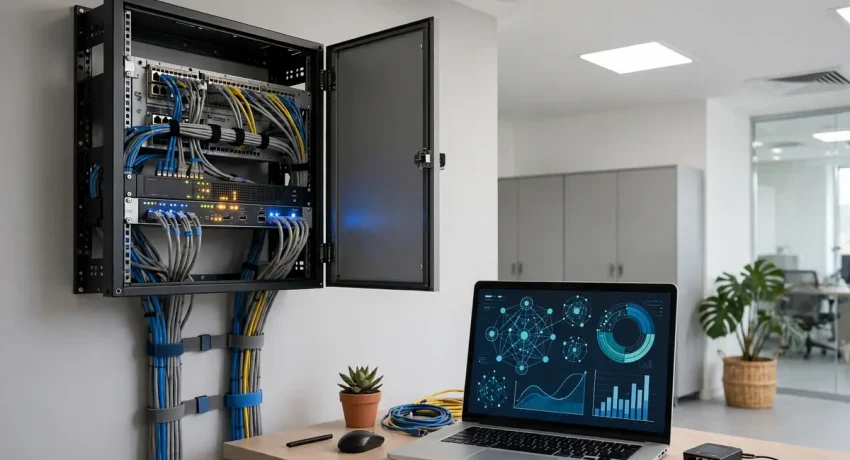
One cost people forget is the install. A tidy install with labelled cables, a wall-mounted rack, and a battery backup for the core stack is worth paying for. The battery backup, or UPS, keeps the gateway, switch, and access points alive through a short power cut. That alone prevents most “the internet is down” emergencies.
How Do You Choose the Right Setup for Your Business?
Start with three questions. How many people work in the office? Next, how many locations do you have? And what happens if the internet goes down for an hour?
A one-room office with five people needs a business-grade gateway, one managed switch, and one or two access points. Add a guest Wi-Fi network and a backup 4G line. That is enough. Do not buy enterprise hardware for a five-person office.
A 20-person office needs the full small-business stack. That means a managed gateway and firewall, a managed PoE switch with 2.5G ports, 2 to 5 access points, three VLANs, and a backup line. This is the standard business Wi-Fi setup for an office of this size. Plan for the busiest hour, not the average hour. Count the devices, not just the people. Every person brings a laptop and a phone. Many bring a tablet too.
A 50-person office needs the same stack with more capacity. Add more access points. Split the wired network into more segments. Put the servers and the payment systems on their own VLANs. And give the IT lead a cloud dashboard they can check from anywhere.
A multi-site business needs SD-WAN. Connect each site with a managed SD-WAN device. Manage them all from one cloud dashboard. Add SASE so the same security policy follows staff between sites and home. The per-site cost of $100 to $500 a month is usually less than the MPLS contract it replaces.
What Are the Most Common Business Network Mistakes?
The first mistake is building the office around the ISP router. That free router from your internet provider is built for a home, not an office. It has no VLANs, no proper firewall rules, and no way to manage multiple access points. Use a proper gateway instead.
The second mistake is putting all the access points in one place. Wi-Fi does not travel well through concrete, metal, and water. One access point per open room is a good starting point. Walk the office with a phone and check the signal in every corner. Dead spots are normal. Fix them with another access point, not with a louder one.
The third mistake is skipping the backup line. A single internet connection is a single point of failure. Business internet failover fixes this: a second line from a different provider, or a 4G or 5G failover, costs little and saves the day when the main line goes down. Automatic failover means the switch happens in seconds, without anyone touching a cable.
The fourth mistake is ignoring updates. Switches, access points, and firewalls all need firmware updates. Outdated firmware is the most common way attackers get into a small business network. Cloud-managed systems update automatically. On-site systems need someone to press the button. Either way, make it a monthly habit.
The fifth mistake is buying for today only. A switch with no free ports is full on the day you install it. Buy one size bigger than you need. The extra ports cost little now and save a replacement later.
How Do You Keep a Business Network Secure?
Network security for business is not one product. It is a short list of habits, repeated every month. Here is the checklist that covers most of the risk for a small or medium business.
- Change every default password on every network device on day one.
- Keep staff, guests, and devices on separate VLANs.
- Turn on the firewall and keep its rules tight. Block what you do not need.
- Update firmware on the gateway, switch, and access points every month.
- Use strong Wi-Fi passwords and a separate password for the guest network.
- Turn on multi-factor authentication for the network dashboard and for cloud apps.
- Back up the network configuration, so a dead gateway can be replaced in minutes.
- Log who connects and when, so you can spot the unusual.
Two trends matter in 2026. The first is AI-driven network management. Enterprise networks are starting to use AI to predict incidents, optimise traffic paths, and enforce policy in real time. For small businesses, this arrives as simpler cloud dashboards that flag problems before users notice them.
The second is sustainability and compliance. Boards now expect network programmes to report on energy use and regulatory compliance, not just uptime. Energy-efficient switches and access points, and clear records of who accessed what, are becoming standard requirements in requests for proposals.
Frequently Asked Questions
What is the best network setup for a small business in 2026?
A managed security gateway, a managed PoE switch with 2.5G ports, two to five Wi-Fi 7 or Wi-Fi 6E access points, three VLANs for staff, guests, and devices, and a backup internet line. That setup covers a 10-to-30-person office and costs roughly $6,500 to $11,000 installed.
Is Wi-Fi 7 worth it for a business?
Yes, if you are buying new access points anyway. Wi-Fi 7 gives steadier latency and more capacity in busy offices. It only shows its full benefit with Wi-Fi 7 devices, but it is backward compatible, so older devices keep working. If your current Wi-Fi works well, you can wait a year.
How much does SD-WAN cost per month?
SD-WAN typically costs $100 to $500 per site per month. Real 2026 quotes range from $95 to $272 per site per month at 200 Mbps, and $496 to $1,256 at 2 Gbps. Most businesses save 30% to 50% against the MPLS circuits SD-WAN replaces.
Do I need SASE for a small business?
Mostly when you have branch offices or an MPLS contract to replace. A cloud-first company with remote staff and no branches usually needs the security half, SSE, or less. Fix identity and device management first, then add zero trust access to retire an old VPN.
What is the difference between SD-WAN and MPLS?
MPLS is a private circuit rented from a carrier. It is reliable and expensive. In the MPLS vs SD-WAN debate, SD-WAN is software that runs over ordinary broadband lines and picks the best link for each type of traffic. It is cheaper, more flexible, and easier to manage across many sites.
How many Wi-Fi access points does an office need?
Plan for two to five access points in a 10-to-30-person office, depending on the floor plan. One per open room is a good starting point. Walls, concrete, and metal all weaken the signal, so test every corner with a phone before you finish the install.
A good business network is invisible. Staff join calls without freezing. Files move in seconds. The card machine always works. That is what the technology in this guide buys you. Start with the gateway and the switch. Add Wi-Fi 7 access points when you replace the old ones. Segment the network into staff, guest, and device lanes. Add a backup line. And if you run more than one site, let SD-WAN and SASE do the heavy lifting. The investment is modest. By contrast, the cost of a network that keeps failing is not.
Sources: Justia Trademarks, KITCER and AIKICO filings for Guangzhou Baomei Network Technology Co., Ltd.; iFeelTech, Small Business Technology Trends 2026 and Multi-Location Business Networking Guide 2026; Data Wire Solutions, Small Business Network Design Guide 2026; Damovo, Five Networking Trends Shaping Enterprise IT in 2026; Lightyear, SD-WAN Cost and Pricing Guide 2026; SASE.cloud, SASE Licensing and Pricing Guide 2026; Servnet UK, SD-WAN vs MPLS 2026; Daily Tech Review, What Is Wi-Fi 7; The Network DNA, Wi-Fi 7 Adoption Guide 2026. Prices are published 2026 figures and vary by vendor, bandwidth, and location.