
Heat breaks things. Solder joints crack under it. Batteries age faster. It also hides inside walls and motors until something fails. Thermal testing technology exists to find that heat before it causes damage. It is a mix of cameras, chambers, and standards. Some of it is simple. The rest is lab-grade science. What follows is a plain-word guide to thermal testing technology 2026. You will learn what thermal testing is, how the tools work, where it is used in 2026, and what is hype. No jargon. Just checked facts. Every fact here comes from a source you can check.
Who Needs Thermal Testing in 2026?
Thermal testing is not one job. Different people need different tools. This table matches the person to the test.
| Who you are | What you test | Tool that fits |
|---|---|---|
| Electronics engineer | Chips, boards, solder joints | Thermal cycling and shock chambers |
| Battery maker | Cells, packs, thermal runaway | High-speed thermal cameras |
| Home inspector | Insulation gaps, leaks, damp | Handheld thermal camera |
| Building manager | Electrical panels, motors, roofs | Thermal imaging surveys |
| Small business owner | Servers, fridges, wiring | Hired survey or a basic camera |
| Curious buyer | A gadget before you buy it | Reviews and test reports |
| Quality manager | Products before they ship | Standards-based test plans |
What Is Thermal Testing, Exactly?
Thermal testing means checking how heat affects a product. It answers two questions. First, how hot does it get? Second, does it survive heat and cold over time? The field splits into two families. One family watches heat. The other family creates heat stress. Both matter. They solve different problems.
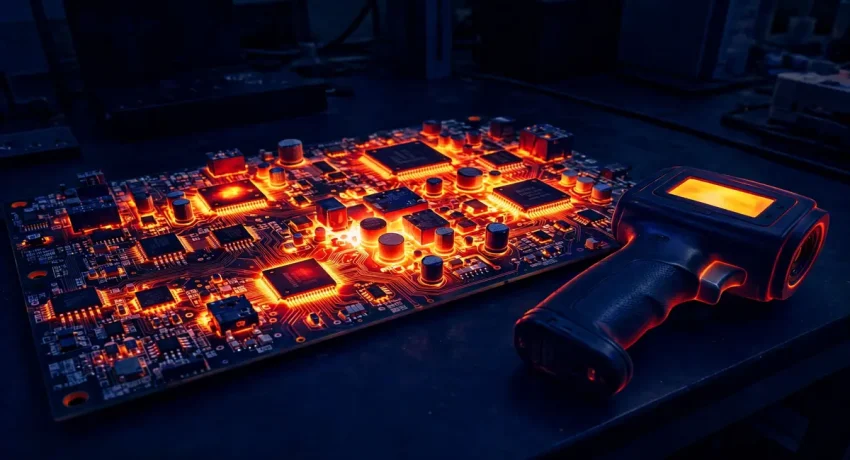
The first family is thermal imaging. A thermal imaging camera sees infrared radiation. It turns heat into a picture. Hot spots glow orange and red. Cool areas show blue and purple. You can see a loose wire, a damp wall, or a hot chip without touching it. This is fast. It is non-contact. Today it is the most common form of thermal testing in 2026.
The second family is thermal stress testing. A chamber heats and cools a product again and again. It simulates years of use in days or weeks. Engineers look for cracks, broken joints, and dead circuits. This is slow. It is destructive. Still, it is how phones, car parts, and military chips get qualified. People often ask about thermal testing vs thermal imaging. Imaging is one tool inside testing. Stress testing is another. Both belong to the same field.
So what is thermal testing in one line? It is the science of finding heat problems before users do. That is the whole job. Everything else is detail.
How Do Thermal Cameras Actually Work?
To understand how thermal cameras work, start with one fact. Every object above absolute zero gives off infrared radiation. Hotter objects give off more. A thermal imaging camera catches that radiation. It does not use visible light. Instead, it works in total darkness. That is why it feels like magic. The truth is simpler physics. The formal name for this method is infrared thermography.
Most modern cameras use a microbolometer sensor. Each pixel absorbs infrared energy. Its electrical resistance changes with temperature. The camera reads those changes. Then it builds a picture. Bright colours mean hot. Dark colours mean cool. The camera also estimates a temperature for each pixel.
Three things affect accuracy. The first is emissivity. Shiny metal reflects infrared. It can look cold when it is hot. Dull, dark surfaces read best. The second is distance. Far objects lose detail. The third is the air itself. Humidity and dust scatter infrared. Good cameras let you set emissivity and distance. Cheap ones do not.
Resolution matters too. A 160 by 120 sensor gives a rough picture. A 640 by 480 sensor shows fine detail. A 1280 by 1024 sensor, like the new FLIR A8481 science camera, shows microscopic heat patterns. More pixels cost more money. They also reveal more problems. For a home inspection, low resolution is often enough. Chip research needs far more.
Thermal cameras do not see through walls. They see surface temperatures. A warm patch on a wall may mean a leak behind it. It may also mean sunlight hit that spot an hour ago. The camera shows a clue. The inspector still has to prove the cause. That is the most common misunderstanding about thermal imaging. It finds suspects. Verdicts still need proof.
What Is Thermal Cycling Testing?
Thermal cycling testing heats and cools a product over and over. The goal is to find weak points. Materials expand when hot. They shrink when cold. Different materials expand at different rates. That mismatch creates stress. Over many cycles, the stress breaks things.
Think of a solder joint on a circuit board. The silicon chip expands a little. The board expands a lot. The joint sits between them. Each hot-cold cycle pulls it both ways. After hundreds of cycles, tiny cracks form. Then the joint fails. The device dies. A thermal cycling test finds that weakness in a lab. It saves a recall in the field.
The test runs in a single chamber. The chamber heats up. It holds the temperature. This hold is called soak time. Then it cools down. It holds again. Then the cycle repeats. The chamber changes temperature slowly. Ramp rates are often 1 to 5 degrees per minute. The product must reach a stable temperature at each extreme before the next move.
How many cycles? It depends on the product. Consumer electronics often run 500 to 1,000 cycles. Automotive electronics run 1,000 to 2,000 cycles under the AEC-Q100 Grade 0 rules. Aerospace parts run 100 to 500 cycles under military rules. Each cycle is one hot-to-cold-to-hot trip. The number is set by the standard, not by the maker.
The key standard is MIL-STD-883 Method 1010. It covers temperature cycling for military microcircuits. Its use reaches far beyond the military. Aerospace, telecom, and high-reliability industrial products use it too. The method uses air-to-air chambers. Transition rates are controlled. That makes it a fair test of long-term fatigue, not a shock test.
How Is Thermal Shock Testing Different?
Thermal shock testing is the violent cousin of thermal cycling. The change is sudden. A part moves from a hot chamber to a cold chamber in seconds. The temperature rate is 30 degrees per minute or higher. The goal is different too. Shock testing finds brittle failures. Cycling finds slow fatigue.
The setup uses two chambers. One chamber is hot. The other is cold. A basket or carriage moves the part between them. The transfer takes under 10 seconds. Slow transfers ruin the test. The part would warm up on the way. That is why the mechanism matters so much.
The military standard is MIL-STD-883 Method 1011. It sets clear rules. Total transfer time must be under 10 seconds. Dwell time must be over 2 minutes. The set temperature must be reached in under 5 minutes. The test must run at least 15 cycles. After the last cycle, the part gets a visual check under a magnifier at 10x to 20x. Then it gets electrical testing. Any damage means failure.
Typical failure modes are wire breaks, lifted wire bonds, cracked dies, and cracked packages. Liquid-to-liquid systems exist too. A basket moves the part between hot and cold baths. Liquid transfers more heat, faster. These systems are used when air is not severe enough.
| Feature | Thermal cycling | Thermal shock |
|---|---|---|
| Speed of change | Slow, 1 to 5 degrees per minute | Fast, 30 degrees per minute or more |
| Chambers | One chamber | Two chambers, transfer under 10 seconds |
| What it finds | Slow fatigue, solder cracks, seal failure | Brittle cracks, broken wires, die cracks |
| Typical cycles | 100 to 2,000, by standard | 15 minimum under MIL-STD-883 |
| Main standard | MIL-STD-883 Method 1010 | MIL-STD-883 Method 1011 |
| Best for | Long-term reliability | Sudden-change survival |
The difference matters when you read a test report. A product that passed cycling may still fail shock. The reverse is true too. Good qualification plans use both. They test different failure modes. Neither one replaces the other.
What Do the JEDEC Temperature Cycling Rules Say?
JEDEC is the body that sets standards for the chip industry. Its temperature cycling standard is JESD22-A104. It defines conditions from A to J. Condition A is minus 55 to plus 85 degrees Celsius. That fits consumer electronics. Condition H is minus 55 to plus 150 degrees. That fits high-temperature automotive parts. Each condition sets the hot and cold extremes. Dwell time at each extreme is usually 10 to 15 minutes. That is enough for the part to reach a steady temperature all the way through.
Why does this matter to a buyer? Because a chip rated for Condition A will not survive a car engine bay. A chip rated for Condition H costs more. It uses tougher materials. More cycles follow. When a seller claims “automotive grade,” the JEDEC condition is the proof. Ask which one. If the seller cannot name it, the claim is empty.
The same logic applies to thermal testing standards in general. Standards turn marketing into evidence. MIL-STD-883 thermal testing covers both cycling and shock, and it is the reference most labs cite first. The standard itself covers military microcircuits. JEDEC JESD22-A104 covers chip packages. IEC 60068-2-14 covers thermal shock for electronic components. Each one names the temperatures, the dwell times, the cycle counts, and the pass criteria. A test without a named standard is just a story.
Where Is Thermal Testing Used in 2026?
Thermal testing shows up in more places than most people think. Here are the main ones.
How Is Thermal Testing Used in Electronics?
Every phone, laptop, and server gets thermal testing before it ships. Engineers use thermal cameras to find hot chips on a board. They use cycling chambers to age solder joints. Shock tests check the packaging. The goal is simple. Nothing should overheat in normal use. After a year of hot and cold days, nothing should crack either. Thermal testing electronics is now a standard step before any device ships.
Chip makers face a harder problem. Chips keep getting smaller. Power density keeps rising. A small hot spot can kill a whole device. That is why high-resolution thermal cameras matter. The FLIR A8481, launched on 14 October 2026, packs a 1280 by 1024 sensor into a compact body. It sees heat at the level of single components. Engineers can then find problems that a low-resolution camera would miss. For more on how chips are tested and built, see our guide to Google Tensor chips explained and our look at the global chip shortage in 2026.
How Is Thermal Testing Used for EV Batteries?
Batteries are the most dramatic use case. Thermal testing batteries is where the stakes are highest. A damaged lithium-ion cell can go into thermal runaway. Heat builds fast. Gas vents out. Fire can follow. Makers test for this with abusive tests. One famous test is nail penetration. A nail pierces the cell. That simulates a short circuit. A high-speed thermal camera records the heat spread. It shows where the heat starts and how fast it moves.
The Battery Innovation Center in Newberry, Indiana, does exactly this. Its engineers use high-speed thermal imaging during nail penetration tests. Thermocouples alone cannot do the job. One engineer there put it plainly. To map the heat with thermocouples, you would need about a thousand of them across one cell face. A thermal camera sees every point at once. It also sees inside the cell as heat moves through it. That data shapes safer battery designs. Better cooling systems follow from it. So do the rules for EV battery packs. Thermal testing for EV batteries catches failures this way, before they reach a customer.
Normal use gets tested too. Packs get cycled between hot and cold. Charging generates heat. Fast charging generates more. Engineers check that cooling keeps every cell in a safe range. A single hot cell can age faster than its neighbours. That shortens the pack’s life. Thermal imaging finds the outlier before it becomes a problem.
How Is Thermal Testing Used in Buildings?
Home inspectors use handheld thermal cameras every day. A thermal camera for home inspection is usually a handheld model with modest resolution. Inspectors look for missing insulation. Air leaks around windows show up next. Damp patches appear behind paint. Underfloor heating gets checked too. Overloaded circuits in breaker panels round out the list. A hot breaker is a fire risk. A cold patch on a ceiling may mean a roof leak.
The work is quick. A survey of a house takes under an hour. But the camera alone is not enough. The inspector must know what the colours mean. A cold spot may be damp. It may also be a draught. A hot spot may be a fault. It may also be sunlight. Good inspectors confirm with a moisture meter or a visual check. They do not diagnose from one image.
How Is Thermal Testing Used in Data Centres?
Data centres are heat factories. Servers run hot. Cooling eats a huge share of the power bill. Thermal imaging maps the hot aisles and cold aisles. Blocked vents show up first. Dead fans follow. Overloaded racks complete the picture. Fixed thermal cameras now watch panels around the clock. They raise an alarm when a temperature crosses a limit. That catches a fire risk before smoke appears.
Cloud computing makes this more urgent. More workloads mean more servers. Each new server adds heat. Small businesses that move to the cloud still run local gear. Routers, switches, and storage boxes all get hot. A thermal check of a server room is cheap insurance. Our guide to cloud computing for small business explains what moves to the cloud and what stays on site.
What Is New in Thermal Imaging in 2026?
Thermal imaging is changing fast in 2026. Three trends stand out. The first is higher resolution at lower cost. The FLIR thermal camera 2026 launch, the A8481, is the clearest example. Launched on 14 October 2026, it brings a 1280 by 1024 HD sensor into a compact A-Series body. It keeps the same mounts, optics, and software as older models. Labs can upgrade without rebuilding their rigs. Its thermal sensitivity is below 30 mK. That means it can spot tiny temperature differences. It works for electronics, battery research, combustion studies, and materials testing.
The second trend is AI. Thermal cameras now pair with software that spots anomalies on its own. Deep learning models learn what normal looks like. They flag what does not match. That cuts false alarms. It also lets one operator watch many cameras. AI analysis is now a standard feature, not a luxury. Market reports link AI integration to faster fault detection and lower monitoring costs.
The third trend is standalone handheld cameras. For years, the cheapest thermal cameras plugged into a phone. That is changing. RISION launched the Torix handheld thermal camera on 26 October 2026. The device has its own 2.8-inch screen, so no phone is needed. Inside sits a 160 by 120 sensor with QuadIR processing to reach 320 by 240 output. Its range runs from minus 20 to 550 degrees Celsius with plus or minus 2 degrees accuracy. The refresh rate is 25 Hz. Drops from 2 metres are no problem, and the IP54 rating keeps out dust and splashes. Battery life reaches 10 hours, with a one-hour recharge. Open sales begin on 16 November 2026. It is aimed at HVAC technicians, building inspectors, and mechanics.
The market is growing too. One market research estimate puts the global thermal imaging market at 8.29 billion dollars in 2025. It projects 17.41 billion dollars by 2035. That is a compound annual growth rate of 7.7 percent. These are estimates from market research firms, not audited figures. Treat them as a sign of direction, not as exact numbers. The drivers are clear enough. Preventive maintenance, border security, and high-precision testing all need thermal data. North America holds the largest share. Asia-Pacific grows fastest.
Events show the same momentum. NDE 2026 runs from 14 to 17 November at the HITEX Exhibition Centre in Hyderabad. Teledyne FLIR and Atos Instruments will show thermal cameras for inspection and research. The event is organised by the Indian Society for Non-Destructive Testing. It runs alongside the 15th International Symposium on NDT in Aerospace. That symposium is held in India for the first time. Thermal imaging is now a core tool for aerospace inspection, not a side show.
What About Surenail?
Some readers arrive here looking for Surenail thermal testing technology. Here is the honest answer. No verifiable thermal testing product, company, or technology by the name Surenail exists in public sources. A datasheet cannot be found. Manufacturer pages are absent too. Test standards never mention it. A search turns up nothing that matches the name to thermal testing.
The closest real technology with a similar name is Owens Corning SureNail. This is a roofing product, not a thermal testing tool. Inside Duration shingles sits a patented woven fabric strip. That strip sits in the nailing zone. TruBond sealant works with it to form what the company calls Triple Layer Protection. The result is wind resistance. Duration shingles with SureNail carry a 130-MPH wind resistance limited warranty with only four nails per shingle. They are tested to ASTM D7158 Class H and ASTM D3161 Class F. That is real engineering. It has nothing to do with measuring heat.
So is this name the future of thermal testing or just another fancy gadget? Neither. The name does not map to a real thermal testing product. The real future of thermal testing is the technology in this guide. High-resolution cameras. AI analysis. Better standards. Cheaper handheld tools. If a seller offers you a product under this name for thermal testing, ask for a datasheet, a standard, and a test report. Without them, walk away.
How Much Does Thermal Testing Equipment Cost?
Prices vary widely. A basic handheld thermal camera for home use costs a few hundred dollars. A professional handheld camera with better resolution and accuracy costs a few thousand. A science-grade camera like the FLIR A8481 costs far more. Prices are rarely published for lab gear. You request a quote. That is normal in this market.
Thermal chambers cost more again. A small bench-top cycling chamber costs thousands. A large walk-in chamber costs tens of thousands. The price depends on the temperature range, the chamber size, and the ramp rate. Faster ramps cost more. Wider ranges cost more. Most small firms do not buy chambers. They hire a test lab. A lab charges by the test or by the day. That is cheaper than owning a chamber you use twice a year.
Here is a rough guide. Treat these as typical ranges, not fixed prices. Check before you buy.
| Equipment | Typical range | Best for |
|---|---|---|
| Basic handheld thermal camera | A few hundred dollars | Home checks, quick scans |
| Professional handheld camera | A few thousand dollars | Inspectors, electricians, HVAC |
| Science-grade thermal camera | Quote only, high five figures and up | Labs, chip and battery research |
| Bench-top thermal chamber | Thousands of dollars | Small-batch product testing |
| Walk-in thermal chamber | Tens of thousands of dollars | Large products, full systems |
| Hired lab test | By the test or by the day | Occasional qualification work |
Before you spend anything, ask what decision the test supports. A camera that finds a hot breaker is worth its price. A chamber that qualifies a product for sale is worth far more. A gadget with no standard behind it is worth nothing. Buy the test, not the toy.
How Do You Read a Thermal Image Without Being Fooled?
A thermal image is easy to misread. Five traps catch beginners. The first is emissivity. Shiny metal reflects heat from nearby objects. It can look hot when it is cool. The reverse also happens. Tape or paint fixes the reading. So does setting the right emissivity value in the camera.
The second trap is reflections. Glass, polished stone, and water reflect infrared. A window can show the heat of the room behind the camera. It does not show the window’s own temperature. Move the camera. Change the angle. The reflection moves. The real temperature does not.
The third trap is solar loading. Sunlight heats surfaces for hours. A wall in afternoon sun looks hot on camera. That heat is not a fault. It is the sun. Inspectors work in the morning or on cloudy days. They also compare both sides of a wall. A real leak shows on both sides.
The fourth trap is distance. Small hot spots vanish at range. A loose screw in a panel looks fine from two metres away. It looks dangerous from 30 centimetres. Get close. Fill the frame with the target. That is how you find small faults.
The fifth trap is the colour palette. Ironbow, rainbow, and greyscale all show the same data. They feel different. A rainbow palette makes small changes look dramatic. A greyscale palette hides them. Use one palette. Learn it well. Do not switch palettes mid-job.
Is Thermal Testing Worth It for a Small Business?
For most small businesses, the answer is yes, but only in the right form. You do not need a lab. A survey is enough. Once a year, a thermal camera scans your electrical panels, server rack, and cold storage. Loose connections show up before they arc. A dying fridge compressor appears before the stock spoils. A hot network switch warns you before it drops the office offline. That one survey can pay for itself many times over.
Start with the risks. What fails hot? Electrical panels, motors, compressors, and servers. What fails cold? Freezers, chilled storage, and air conditioning. List them. Then decide. Hire a survey once a year. Or buy a basic handheld camera and train one staff member. A basic camera plus a checklist beats no camera at all.
Do not buy a camera and forget it. Thermal testing works when it is repeated. The first scan sets a baseline. Later scans show change. A breaker that runs 10 degrees hotter than last year is a warning. One that runs hotter than its neighbours is a warning too. Comparison is the method. One reading alone says little.
Small business technology decisions work the same way. You compare options, you check the evidence, and you spend where the risk is highest. Our guide to business technology solutions in 2026 covers how small firms choose tools that actually pay off. And if your office network is part of the risk, our business network technology guide explains how to make it faster and safer. For firms planning a wider upgrade, the digital transformation guide for small business lays out the steps in order.
What Should You Ask Before Hiring a Thermal Testing Service?
Not every provider is equal. Ask these questions before you sign anything.
- Which standard will you test to? The answer should name a standard, such as MIL-STD-883, JEDEC JESD22-A104, or IEC 60068-2-14. A vague answer is a red flag.
- What camera and resolution will you use? For a home survey, 160 by 120 may be enough. Electronics need far more. Ask for the sensor size.
- Will you confirm findings with another tool? A moisture meter, a multimeter, or a visual check should back up the image. One image is not a diagnosis.
- What does the report include? It should list temperatures, images, locations, and recommendations. A folder of raw images is not a report.
- Are you certified? Look for thermography training, such as Level 1 or Level 2 certification. Experience matters more than a certificate, but both help.
- What will it cost, and what is excluded? Get the price in writing. Ask what happens if the test finds nothing. Then ask what a retest costs.
If a provider cannot answer these questions, find another one. Thermal testing is a measurement discipline. Good providers love clear questions. Bad providers hide behind jargon.
Frequently Asked Questions
What is thermal testing in simple words?
Thermal testing checks how heat affects a product. It uses cameras to see heat, and chambers to create heat stress. Problems get found before they cause failures.
Is thermal testing the same as thermal imaging?
No. Thermal imaging is one kind of thermal testing. It watches heat with a camera. Thermal testing also includes cycling and shock tests. Those create heat stress in a chamber. Both belong to the same field. They answer different questions.
Can a thermal camera see through walls?
No. It sees surface temperatures only. A warm patch may point to a leak behind the wall. It may also be sunlight or a draught. The camera finds clues. The inspector must confirm the cause.
What is the difference between thermal cycling and thermal shock?
Thermal cycling changes temperature slowly, at 1 to 5 degrees per minute, in one chamber. It finds slow fatigue. Thermal shock changes temperature fast, at 30 degrees per minute or more, moving the part between two chambers in under 10 seconds. It finds brittle cracks. The standards are MIL-STD-883 Method 1010 for cycling and Method 1011 for shock.
Is there a real thermal testing product by this name?
No. Nothing verifiable exists under this name in public sources. The closest real technology with a similar name is Owens Corning SureNail, a roofing strip that gives shingles a 130-MPH wind resistance warranty. It has nothing to do with measuring heat.
How much does a thermal camera cost?
A basic handheld camera costs a few hundred dollars. A professional one costs a few thousand. A science-grade camera costs far more and is usually sold by quote. Hiring a survey is often cheaper than buying, if you only need one test a year. All figures here are typical ranges. Check current prices before you buy.
So, Is Thermal Testing the Future or Just Hype?
It is the future, but not in the way gadget ads suggest. The real story is quieter. Cameras get sharper. Software gets smarter. Standards get clearer. Prices fall. That is how a technology matures. It does not arrive in one magic product. Instead, it arrives in a hundred small improvements.
Thermal testing earns its place when it answers a real question. Will this chip survive five years in a hot car? Can this battery stay safe when it is damaged? Might this roof leak before winter? If the test answers the question, it is worth the money. A pretty picture alone is not.
The hype lives in names that promise everything and prove nothing. A product with no datasheet, no standard, and no test report is not technology. It is a story. The tools in this guide have datasheets. They have standards. Test reports back them up. That is the difference. Buy the evidence. Skip the story.