
Open a Pixel phone and you will find a chip that no other phone has. Google calls it Tensor. It is the processor inside every Pixel since the Pixel 6, and it shapes almost everything the phone does, from photos to phone calls. This guide explains what Google Tensor chips are, how they changed from the first generation to the Tensor G6 in the Pixel 11, and what they mean for you in 2026.
Most phone chips chase one goal: raw speed. Google took a different road. Tensor puts artificial intelligence first. That choice explains both its strengths and its limits. Once you see the trade-off, the whole Pixel story makes sense.
What Is a Google Tensor Chip?
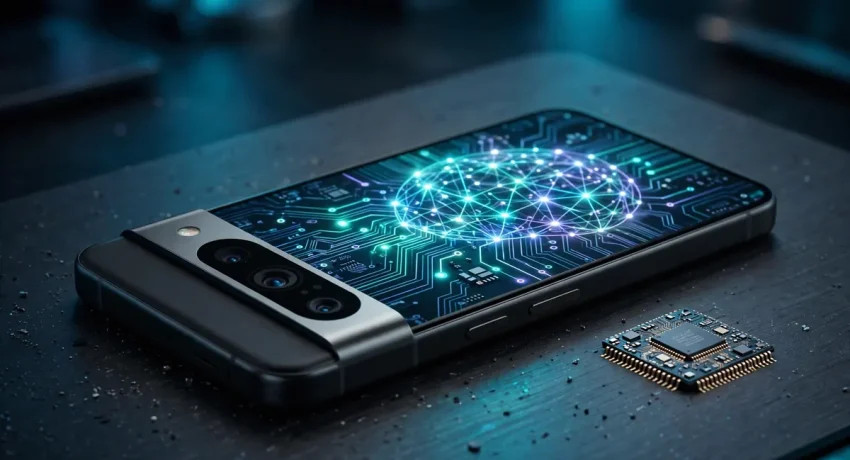
A Tensor chip is a system-on-a-chip, or SoC. It packs the processor, graphics unit, memory controller, modem link, and AI engine onto one piece of silicon. Google designed it for Pixel phones, and it runs only in Pixel devices.
Work on the project began in 2016, after the first Pixel phone launched. Google had spent years building machine learning into its apps, and it wanted hardware that matched. The company worked with Samsung on the first four generations, then moved production to TSMC for the Tensor G5.
Inside every Tensor chip sits the Tensor TPU (Tensor Processing Unit), a dedicated AI engine. It handles the tasks that make Pixel phones feel smart, like live translation, voice typing, and photo editing, without sending your data to the cloud.
Why Did Google Build Its Own Chip?
Before Tensor, Pixel phones used Qualcomm Snapdragon chips, the same processors found in many Android phones. That setup worked, but it limited Google. New AI features had to fit hardware that Google did not control.
Apple had already shown the value of custom silicon. Its A-series chips let the iPhone and its software grow together. Google wanted the same freedom for Android. A chip built for its own AI models would let Pixel phones do things rivals could not copy quickly.
So Google set a clear goal. Tensor would not win benchmark races. It would win on helpful features, on-device AI, and photography. Five years later, that bet still defines every Pixel phone.
Every Tensor Generation So Far
Tensor chip history now spans six generations since 2021. Each one arrived with a new Pixel flagship, and each one fixed something the last generation got wrong. Here is the full timeline at a glance.
| Chip | Year | Phones | Built by | Process | TPU |
|---|---|---|---|---|---|
| Tensor G1 | 2021 | Pixel 6, 6 Pro, 6a | Samsung | 5nm | 1st gen |
| Tensor G2 | 2022 | Pixel 7, 7 Pro, 7a, Fold, Tablet | Samsung | 5nm | 2nd gen |
| Tensor G3 | 2023 | Pixel 8, 8 Pro, 8a | Samsung | 4nm | 3rd gen |
| Tensor G4 | 2024 | Pixel 9, 9 Pro, 9a, 9 Pro Fold | Samsung | 4nm | 3rd gen |
| Tensor G5 | 2025 | Pixel 10, 10 Pro, 10 Pro XL, 10 Pro Fold | TSMC | 3nm | 4th gen |
| Tensor G6 | 2026 | Pixel 11, 11 Pro, 11 Pro XL | TSMC | 3nm | 5th gen |
Tensor G1 (2021): the First Step
The first Tensor chip arrived in the Pixel 6 and Pixel 6 Pro in October 2021. It used two powerful Cortex-X1 cores, two mid-range Cortex-A76 cores, and four efficient Cortex-A55 cores. Its Mali-G78 graphics unit was strong for its time.
What stood out was not speed. It was the new AI features. Magic Eraser could remove unwanted people from photos. Live Translate could turn speech into text in real time. Recorder could transcribe conversations on the device, with no internet needed.
Early reviews praised the camera and the clever software. They also flagged a weak spot that would follow Tensor for years. The chip ran hot under heavy use, and battery life suffered in warm weather.
Tensor G2 (2022): Small Steps Forward
The Pixel 7 series ran on Tensor G2 in 2022, joined later by the Pixel 7a, the first Pixel Fold, and the Pixel Tablet. Google said it was 60% faster at machine learning than the first Tensor chip. Its CPU layout stayed close to the original, with the same Cortex-X1 prime cores at slightly higher speeds.
Photo Unblur was the headline feature. It could sharpen old, blurry photos using on-device AI. Cinematic Blur added depth effects to video. Call Screen got smarter, and the speech recognition improved.
Even so, the G2 felt like a modest update. Raw performance still trailed the best Snapdragon chips of the time. Heat remained an issue, though it was less severe than on the Pixel 6.
Tensor G3 (2023): the AI Leap
The Pixel 8 and Pixel 8 Pro arrived with Tensor G3 in October 2023. It was the biggest redesign yet. Google moved to Armv9 cores, with one Cortex-X3 prime core, four Cortex-A715 mid cores, and four Cortex-A510 efficiency cores. That made nine cores in total, an unusual layout.
Security improved with Arm memory tagging, a feature that blocks some memory attacks. Video gained AV1 encoding, which shrinks file sizes without hurting quality. The new TPU powered features that felt like science fiction at the time.
Best Take could swap faces between burst photos, so everyone looks their best. Magic Editor could move objects around a photo. Video Boost sent clips to the cloud for extra processing. Audio Magic Eraser could remove background noise from video. Few phones could match that list in 2023.
Tensor G4 (2024): Quiet Refinement
The Pixel 9 series launched with Tensor G4 in 2024. It kept the same third-generation TPU as the G3, but the CPU moved to a newer layout: one Cortex-X4 prime core at 3.1GHz, three Cortex-A720 mid cores, and four Cortex-A520 efficiency cores.
Google focused on polish rather than big new features. The modem improved, which fixed the weak signal complaints of earlier Pixels. Heat management got better. Gemini, Google’s AI assistant, became built into the phone rather than an add-on app.
Many reviewers called the G4 a small upgrade. They were right about the numbers. Yet it mattered, because it steadied the platform before the much bigger change that came next.
Tensor G5 (2025): the Big Reset
Of all six generations, the G5 is the most important Tensor chip so far. It powers the Pixel 10 series, and it changed almost everything behind the scenes. Google moved production from Samsung to TSMC, using a 3nm process. It also made the design fully its own, ending years of shared work with Samsung’s chip division.
Those two changes fixed the oldest Tensor complaint. The G5 runs far cooler than earlier chips under sustained load. Phones stay comfortable during long video calls, navigation, and gaming. Battery life improved as a direct result.
Performance jumped too. Google claims the G5 CPU is 34% faster than the G4 in the Pixel 10 Pro, and its fourth-generation TPU is 60% more powerful. Tensor G5 benchmarks back the CPU gain: in one comparison, Geekbench 6 scores rose from about 1,707 single-core and 4,431 multi-core on the G4 to about 2,305 and 6,054 on the G5. AnTuTu scores moved from roughly 1.52 million to 1.55 million.
Graphics tell a mixed story. The G5 switched to a PowerVR DXT-48-1536 GPU. It holds frame rates well and stays cool, but some benchmarks score it below the G4’s Mali GPU. Gamers who play demanding titles may notice the gap. For most people, the cooler, steadier chip matters more.
AI is where the G5 shines. It runs the latest Gemini Nano model fully on the device. That enables Magic Cue, which surfaces useful information before you ask for it, and Camera Coach, which gives live tips while you frame a photo. Real-time call translation works without the cloud, which keeps private calls private.
Tensor G6 (2026): AI First, Speed Second
The Pixel 11 series runs on Tensor G6, launched in 2026. Early rumours said it would use TSMC’s 2nm process, but that turned out to be wrong. It stays on a 3nm process, like the G5.
Google trimmed the CPU to seven cores: one Arm C1-Ultra prime core at 4.11GHz, four C1-Pro performance cores, and two C1-Pro efficiency cores. Fewer cores freed space for a much stronger AI engine. The fifth-generation TPU is claimed to be around 50% faster at AI tasks than the G5.
Security moved up a step as well. Titan M3 replaces the Titan M2 security chip, guarding passwords, payment data, and biometric details in a separate, isolated core. A new MediaTek modem is claimed to be faster and more power efficient than the modem in the Pixel 10.
Graphics use a PowerVR CXTP-48-1536 GPU. On paper, it looks like a modest step over the G5. Google clearly chose to spend its silicon budget on AI and security rather than on raw graphics power. That trade-off will divide opinion, but it fits the Tensor story so far.
What Does Tensor Actually Do on a Pixel Phone?
A spec sheet only tells half the story. Tensor earns its place through everyday features that other phones struggle to match. Most of them run on the device, so they work offline and keep your data private.
Call Screen answers unknown callers and shows you a live transcript before you pick up. Hold for Me waits on hold in your place and alerts you when a human answers. Live Translate turns phone calls and videos into your language as they play.
Photos are the clearest example. Night Sight brightens dark scenes without a flash. Super Res Zoom sharpens distant subjects. Magic Editor can reframe a shot after you take it. All of these lean on the TPU, not on the cloud.
Voice tools benefit too. Recorder transcribes speech in real time and labels different speakers. Voice typing fixes grammar as you speak. These small touches add up to a phone that feels built around you, not around a benchmark chart.
How Fast Is Tensor, Really?
When people ask about Tensor chip performance, the honest answer is simple: fast enough for almost everyone, but not the fastest chip you can buy. That gap has shrunk with each generation, and the G5 closed much of it. Yet Qualcomm’s latest Snapdragon and Apple’s A-series still lead in raw CPU and GPU tests.
What the numbers miss is how a phone feels. Pixel phones open apps quickly, scroll smoothly, and handle multitasking without stutter. Tensor’s tight link with Android means the software and the chip work as one system. A slightly slower chip with great software can feel faster than a quicker chip with poor tuning.
Gaming is the one area where the gap shows. Heavy games run well on the Pixel 10 and Pixel 11, but they do not match the frame rates of the best gaming phones. If gaming is your top priority, Tensor is not the best pick. For everything else, it is more than enough.
Tensor vs Snapdragon vs Apple Silicon: What Should You Know?
Three philosophies now compete in phone chips. Qualcomm builds for everyone, so Snapdragon powers hundreds of different Android phones. Apple builds for one phone line, tuned to its own software. Google sits between the two, building for Pixel alone but with AI as its main goal.
Snapdragon leads on raw speed and graphics, and its chips run in phones of every shape and price. Apple leads on efficiency and single-core speed, and its chips power the smoothest mobile experience overall. Tensor leads on on-device AI, photography, and call features that neither rival matches.
Your choice comes down to what you value. Choose Snapdragon for peak gaming and broad choice. Apple suits buyers who want the fastest, most polished all-rounder. Tensor fits the smartest camera, the best call tools, and AI that works without the cloud.
Do Tensor Phones Still Overheat?
Tensor overheating is the question that follows these chips everywhere, and the answer has changed. Early Pixel 6 and Pixel 7 phones could get uncomfortably warm during video recording, navigation, or 5G use. Some users saw their phones throttle, which means the chip slowed down to cool off.
Google improved cooling and efficiency with each generation. The G4 helped, and the G5 changed the story. Moving to TSMC’s 3nm process cut power use and heat at the source. Reviewers found the Pixel 10 stays cool under loads that made older Pixels sweat.
No phone is immune to heat in direct sun or during long 4K recording. Still, the overheating reputation now belongs to the past. A Pixel 10 or Pixel 11 handles normal use, and most heavy use, without getting hot.
Which Pixel Should You Buy in 2026?
Your budget decides most of it. The Pixel 11 series has the newest chip, the best AI, and the longest support ahead of it. If you want the latest Tensor G6 and the newest camera tricks, that is the one to buy.
Pixel 10 phones remain a smart buy. They run the Tensor G5, which fixed the heat problem and brought the big AI upgrade. Prices often drop after a new launch, so a Pixel 10 can offer most of the experience for less money.
Reports suggest the Pixel 10a will use the older Tensor G4 instead of the G5, breaking the pattern of A-series phones sharing the flagship chip. That still leaves it a capable phone, but check the chip before you buy if AI features matter to you.
Older Pixels still hold up. Pixel 8 phones get seven years of updates, and their G3 chip handles daily use well. With the G4 inside, Pixel 9 phones are a solid middle ground. Avoid the Pixel 6 and 7 unless the price is very low, since their chips run hotter and their update window is shorter.
What Comes Next for Tensor?
Google has not announced what follows the Tensor G6. The pattern so far points to more of the same direction: stronger AI, better efficiency, and tighter links with Gemini. A move to a smaller manufacturing process is likely when the technology is ready, but the G6 shows Google will not rush it.
One open question is whether Tensor will ever leave Pixel phones. Google has kept the chip exclusive so far. That focus lets it tune the chip and the software together, but it also keeps Tensor volumes small. For now, Pixel buyers are the only ones who get it.
Another question is gaming. Google has improved graphics slowly, and the G5 and G6 both favour AI over GPU power. If Google wants to win over gamers, a future Tensor will need a bigger graphics leap. Until then, Tensor remains the smart chip, not the fast chip.
Frequently Asked Questions
What is the Google Tensor chip?
It is Google’s custom processor for Pixel phones. One piece of silicon combines the CPU, GPU, AI engine, and security chip. The first version appeared in the Pixel 6 in 2021, and the latest is the Tensor G6 in the Pixel 11.
Which phones use Google Tensor chips?
Every Pixel phone from the Pixel 6 onwards uses a Tensor chip. That includes the Pixel 6, 7, 8, 9, 10, and 11 series, plus the A-series models, the Pixel Fold, and the Pixel Tablet.
Is Tensor G5 better than Tensor G4?
Yes, in most ways. The G5 moves to TSMC’s 3nm process, runs much cooler, and its CPU is about 34% faster. Its AI engine is 60% more powerful. Graphics results vary by test, so the G4 can still win some GPU benchmarks.
Is Tensor better than Snapdragon?
It depends on what you need. Snapdragon wins on raw speed and graphics. Tensor wins on on-device AI, computational photography, and call features. For daily use and photos, most people will prefer Tensor. Heavy gaming is different, and Snapdragon is the safer pick there.
Do Pixel phones overheat with Tensor chips?
Older Tensor phones could run hot, but the problem is largely fixed. The Tensor G5 in the Pixel 10 runs far cooler than earlier chips, thanks to TSMC’s 3nm process. Pixel 11 phones with the Tensor G6 continue that trend.
How long will my Pixel keep getting updates?
Pixel 8 and newer phones get seven years of operating system, security, and feature updates. A Pixel 10 bought in 2026 will stay current until 2032, which is longer than almost any other Android phone.
The Bottom Line
Google Tensor chips started as a bold experiment in 2021. Six generations later, they have grown into the heart of the Pixel line. Early chips ran hot and lagged rivals on speed, but each generation fixed a real problem. Moving to TSMC with the G5 ended the heat issue, and the G6 doubled down on AI and security.
Tensor will probably never top a benchmark chart, and Google seems fine with that. Its goal is a phone that takes better photos, answers calls for you, translates speech on the spot, and keeps your data on the device. Judged on that goal, Tensor is now one of the best phone chips you can buy. If you want the smartest Android phone in 2026, start with a Pixel.