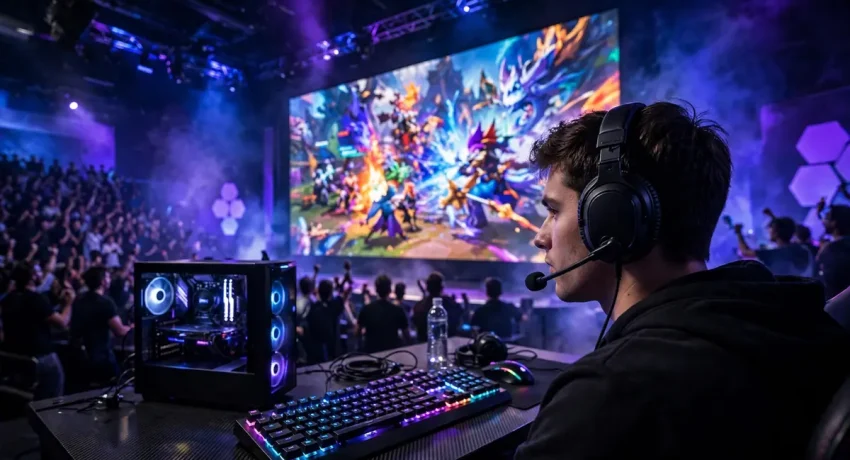

Picture a packed arena in Riyadh. Thousands of fans cheer as two teams fight for a share of a $75 million prize pool. That is the Esports World Cup in 2026. Now picture a different scene. A player in the Philippines earns a few dollars of crypto for winning a card battle on a phone. Both scenes are real. Still, both live under the same label: cryptocurrency esports. But they are not the same thing at all.
This guide separates the two worlds. It shows where crypto genuinely touches competitive gaming, and where the promises fall apart. You will find real prize pools, real games that still pay, and real projects that collapsed. No hype. Only facts, and no promise of guaranteed income.
What Is Cryptocurrency Esports, Really?
Cryptocurrency esports is not one thing. It is six different ideas wearing the same name. Each one works differently. Risks differ just as much across them.
First, there are crypto prize pools. Some tournaments pay winners in Bitcoin, stablecoins, or a platform token instead of cash. Second, there are blockchain tournaments. These run brackets, leaderboards, and payouts through smart contracts. Third, there are NFT in-game items. Skins, cards, and characters exist as tokens a player can own and trade. Fourth, there are play-to-earn games. Players earn tokens by winning matches or completing tasks. Fifth, there are fan tokens. Supporters buy a team token and vote on small club decisions. Sixth, there is betting. Some sportsbooks accept crypto wagers on esports matches.
Most guides blur these together. That is a mistake. A fan token has nothing in common with a prize pool. A betting site is not a game. The label blockchain esports gets used for all six ideas at once. Keep the six ideas apart, and the whole space becomes much easier to judge.
How Big Is Esports in 2026 — and How Much of It Is Crypto?
Esports itself is huge. The audience now runs into the hundreds of millions. Prize money keeps growing. But almost all of that money is still ordinary money, not crypto.
| Tournament | Game | 2026 prize pool | Paid in crypto? |
|---|---|---|---|
| Esports World Cup | 24 games | $75 million | No — cash prizes |
| League of Legends Worlds | League of Legends | $5 million | No — cash prizes |
| The International | Dota 2 | Just over $3.3 million | No — cash prizes |
The Esports World Cup closed in Riyadh on 23 August 2026 with a record $75 million pool. That figure breaks down into $30 million for the Club Championship, $39 million across individual game championships, and $6 million for qualifiers. League of Legends Worlds 2026 runs from 15 October to 14 November in the United States, with 19 teams chasing a $5 million pool. The winner takes home $1 million.
The International tells a different story. Its prize pool once passed $40 million in 2021, funded by fans buying in-game items. Valve ended that crowdfunding model in 2023. The 2026 edition offered just over $3.3 million. Crowdfunding can vanish fast. That lesson matters for every crypto prize scheme too.
So where does crypto fit? It sits at the edges. Crypto prizes appear in smaller blockchain tournaments, not in the headline events. The blockchain gaming market is growing — one widely cited forecast puts it at $13 billion in 2024 and projects $301.53 billion by 2030 — but that is a forecast, not a fact. Treat it as a guess about the future, not as money already on the table.
Can You Actually Win Crypto in Esports Tournaments?
Yes, but the scale is far smaller than the headlines suggest. Real crypto gaming tournaments exist. They pay in tokens or stablecoins. Their prize pools usually run from a few hundred dollars to a few thousand. A handful reach six figures. None of them rivals the Esports World Cup.
One honest distinction matters here. Trading tournaments are not gaming tournaments. Bybit runs the World Series of Trading, known as WSOT. The 2026 edition runs from 29 October to 2 December, with prizes worth up to $10 million. Traders compete on profit and loss. That is a trading contest. It has nothing to do with playing a game well. Many articles mix the two together. Do not be fooled by the shared word “tournament”.
Real crypto esports prize money lives in three places. First, Web3 games run their own ranked seasons with token rewards. Axie Infinity, Gods Unchained, and Splinterlands all pay top players in tokens. Second, third-party platforms host open brackets where entry is free and winners split a small crypto pool. These crypto gaming platforms usually fund small pools from sponsorship or token treasuries. Third, some NFT projects fund invitation-only show matches. These are real, but they are niche. Blockchain gaming tournaments with on-chain brackets are the most transparent of the three, because payouts run through smart contracts. The audience is small, and the rewards are modest.
That is the honest scale of cryptocurrency esports today: real, but small. Before you enter any crypto tournament, check four things. Who runs it? Where does the prize money come from? How and when does it pay out? What happens if the token loses value before you sell? If any answer is missing, walk away.
What Happened to Play-to-Earn?
Play-to-earn was the loudest promise in crypto gaming. In 2021, Axie Infinity had around 2.7 million daily active users. Some players in the Philippines earned a living from it. Then the economy broke. The reward token, Smooth Love Potion, was printed without limits. Its value collapsed. New players stopped joining. In March 2022, hackers stole about $625 million from the Ronin bridge. The dream of gaming as a job died with it.
What does Axie Infinity 2026 look like? The game is still live. Its developer, Sky Mavis, rebuilt the economy. Rewards moved to a new token called bAXS in February 2026. SLP rewards ended in January 2026. The Ronin network completed its move to become an Ethereum layer 2 on 13 May 2026. AXS itself traded near $1 in October 2026. That is roughly 99% below its November 2021 peak of about $165. The game survives. The income does not.
Most play to earn crypto games from the last boom are gone. A CoinGecko study found that 75% of Web3 games launched between 2018 and 2023 have stopped working. The tap-to-earn Telegram games of 2024 collapsed even faster. Hamster Kombat and its rivals lost almost all their value within months.
| Game | Still running in 2026? | How players earn |
|---|---|---|
| Axie Infinity | Yes, on Ronin | Ranked battles, bAXS rewards, AXS staking |
| Pixels | Yes, on Ronin | Farming and social tasks, PIXEL token |
| Gods Unchained | Yes | Winning matches, selling cards, GODS token |
| Splinterlands | Yes | Card battles, quests, tournaments, SPS and DEC |
| Alien Worlds | Yes | Mining and quests, TLM token |
| The Sandbox | Yes | Creating and selling land and assets, SAND token |
| Illuvium | Rebuilding | Main game cut back, scope reduced |
The honest summary is simple. A small set of games still functions. Their rewards are real but tiny. Independent guides put median earnings at $5 to $10 a month for casual players, even with hours of daily play. Only top competitive players earn more, and only in favourable market conditions. Treat these games as entertainment with a small bonus, never as a job.
Are NFT Skins and In-Game Items Worth Anything?
Skins are the oldest money in gaming. Players have traded Counter-Strike and Dota 2 cosmetics for real cash for more than a decade. The biggest market is still the old one. Valve’s Steam Community Market handles the most volume. Independent marketplaces such as Skinport, Buff, and DMarket add more liquidity. None of these use blockchain.
NFT gaming skins promise something extra. True ownership. A skin recorded on a blockchain belongs to the player, not the developer. It can move between marketplaces. Survival is possible even if one game shuts down. That promise is real in theory. In practice, it is still mostly theory.
Why has it not taken off? Three reasons. First, the biggest games refuse to join. Valve, Riot, and Epic run closed economies, and they earn billions from them. They have no reason to hand ownership to players. Second, cross-game use is a myth so far. A sword from one game has no stats, art style, or code that fits another game. Third, most NFT items lose value fast. Scarcity on paper means nothing when nobody wants the item.
Blockchain marketplaces such as Immutable X and WAX do exist. They let players trade tokenised items with lower fees. Their volumes remain far below the Steam market. If you buy an NFT skin, ask who else wants it. An item is only worth what the next buyer will pay. For most NFT items, that answer is very little.
What Are Esports Fan Tokens — and Do They Do Anything?
Esports fan tokens let supporters buy a small stake in a team’s community life. The best-known platform is Socios, built on the Chiliz blockchain. Fans use tokens to vote on polls. They might choose a jersey design, pick a goal celebration song, or select a message on the team bus. Some tokens unlock meet-and-greets or signed merchandise.
What fan tokens do not do matters more. They are not shares. Dividends never arrive. Control over the team stays at zero. Wins on the pitch do not push the price up. Instead, the price moves with the crypto market and with speculation. Many team tokens have fallen sharply from their launch prices.
Fan tokens make sense as a souvenir with a small perk. They make no sense as an investment. Buy one only if you enjoy the team and you accept that the money may be gone. Never buy a fan token because a team just signed a star player. The token price already knows.
Can You Bet on Esports With Crypto?
Crypto esports betting is real, large, and risky. Many offshore sportsbooks accept Bitcoin and other coins for wagers on League of Legends, Counter-Strike 2, Dota 2, and Valorant. Deposits clear fast. Payouts can be quick. Some sites offer better odds than traditional bookmakers because they dodge licensing costs.
Those same features are the danger. An unlicensed site can freeze your funds. It can change its terms. Vanishing entirely is also possible. There is no regulator to call. Esports betting with bitcoin also raises a sharper problem: age. Most fans in this scene skew young. Many are under 18. Crypto betting sites rarely verify age properly. Regulators watch cryptocurrency esports betting closely because the audience is young. That combination has drawn the attention of regulators in several countries.
Rules vary wildly by country. Some places ban online betting entirely. Others allow it only through licensed operators. A few have no clear rules at all. Your location decides what is legal, not the website’s claims. Check your local law before you deposit a single coin. Never bet with money you need for rent, food, or bills. Chasing losses only digs the hole deeper. If betting stops feeling fun, stop entirely and seek help from a gambling support service in your country.
Why Did Crypto Sponsors Leave Esports?
Five years ago, crypto logos covered esports. FTX signed a $210 million naming-rights deal with TSM, one of the biggest teams in North America. Coinbase sponsored the League of Legends Championship Series. Bybit, Binance, and Crypto.com poured money into teams and tournaments. Then the money stopped.
FTX collapsed in November 2022. The TSM deal died with it. Celsius went bankrupt. Terra imploded. Surviving crypto firms cut marketing budgets by 70 to 90% almost overnight. Teams that had built revenue plans around crypto sponsors were left scrambling.
Regulation finished the job. The European Union’s MiCA framework, which took effect in 2024, tightened rules on crypto promotions aimed at minors. Esports audiences are young, so sponsors pulled back rather than risk fines. In the United States, the SEC’s enforcement actions made firms cautious about any promotion that sounded like investment advice.
Industry trackers report that blockchain-native sponsorships tied to top esports organisations fell by more than half from their 2021 peak. The exact numbers vary by source, but the direction does not. Traditional brands moved back in. Red Bull, Intel, and Mastercard now fill the jersey space that crypto once bought.
Some crypto sponsors remain. Chiliz still works with teams through fan tokens. Immutable still backs Web3 gaming events. Coinbase still appears in esports. But the gold rush is over. Crypto esports sponsorship today is smaller, quieter, and far more careful about compliance than it was in 2021.
What Are the Real Risks of Cryptocurrency Esports?
Every part of this space carries risk. The risks differ by activity, so here they are side by side.
| Activity | Main risks |
|---|---|
| Play-to-earn games | Token inflation, tiny rewards, project shutdowns, fake game sites |
| NFT items | Illiquidity, value collapse, fake collections, wallet theft |
| Fan tokens | Price swings, no real ownership, speculation-driven value |
| Crypto betting | Unlicensed operators, frozen funds, addiction, legal trouble |
| Crypto tournaments | Unpaid prizes, changing rules, token devaluation before payout |
Scams deserve a special warning. Fake game websites are the biggest threat in 2026. A player clicks a link, connects a wallet, and signs a transaction that empties it. Airdrop scams work the same way. No real game asks you to sign a blank transaction or share a seed phrase. Ever. If a site demands either, close it.
Volatility is the second risk. A prize worth $500 on Monday can be worth $300 by Friday. Teams that accepted sponsorship in a sponsor’s native token learned this the hard way. Convert winnings to a stablecoin or fiat quickly, or accept that the value may fall.
Age rules are the third risk. Most crypto platforms require users to be 18 or older. Many esports fans are younger. Parents should know that a teenager with a phone can reach crypto betting and trading sites in minutes. Talk about it before it becomes a problem.
How Can You Get Started Safely?
Start small. Treat every dollar as money you can lose. Follow these steps in order.
- Pick one activity, not five. Choose play-to-earn, collecting, or spectating. Master one before trying another.
- Use a game that is still live. Check for recent updates, active players, and a working marketplace. Dead games pay nothing.
- Use a separate wallet. Keep your main funds elsewhere. Never connect your main wallet to a new game or site.
- Read the payout rules first. Find out when prizes pay, in what token, and whether there is a minimum withdrawal.
- Track what you spend. Entry costs, gas fees, and item purchases add up fast. Write them down.
- Set a time limit. An hour a day is plenty for a hobby. If it feels like a job, step back and reassess.
- Ignore guaranteed returns. Any project promising fixed daily profits is either lying or running a scheme that will collapse.
The safest way to enjoy cryptocurrency esports is as a spectator. Watch the tournaments. Follow the teams. Learn how the economies work. Spend nothing until you understand the game, the token, and the risks. Knowledge is free. Recovering a drained wallet is not.
What Does the Future Hold for Web3 Esports?
Web3 esports has a real future, but it looks nothing like the 2021 pitch. The fantasy was that every player would earn a living from gaming. That fantasy is dead. The reality is smaller and more honest.
Three trends are worth watching. First, play and earn games are replacing play-to-earn. The new model pays skilled players a bonus on top of a fun game, instead of making the token the whole point. Second, big publishers are testing blockchain quietly. They tokenise collectibles and rewards without shouting about crypto. Third, regulation is bringing order. Licensed operators, clear age rules, and honest advertising will push out the worst actors.
Esports itself will keep growing with or without crypto. The Esports World Cup, Worlds, and The International prove that the audience is real and the money is real. Crypto will stay at the edges — in niche tournaments, in collectibles, in fan engagement. That is a fine place for it. Cryptocurrency esports belongs at those edges in 2026, where experiments stay honest about what they are.
Frequently Asked Questions
Is cryptocurrency esports legal?
It depends on the activity and the country. Playing a blockchain game is legal in most places. Betting with crypto is restricted or banned in many countries. Fan tokens sit in a grey area in some jurisdictions. Check your local law before you spend money.
Can you make a living from play-to-earn games in 2026?
Almost certainly not. Median earnings for casual players run to a few dollars a month. Only a small number of top competitive players earn more, and their income swings with the market. Treat it as a hobby with a bonus.
Which crypto esports game pays the most?
No game guarantees the most. Axie Infinity has the deepest history and the highest earning ceiling for elite players, but it also demands the most skill and the most upfront investment. Gods Unchained and Splinterlands cost less to start. Earnings in all of them depend on skill, time, and token prices.
Are NFT skins a good investment?
Usually not. Most NFT items lose value. A few rare items from popular games hold value, but picking them requires deep knowledge of the game and its community. Buy an NFT skin because you like it, not because you expect a profit.
What is the biggest esports prize pool in 2026?
The Esports World Cup offered $75 million across 24 games in 2026. For a single game, League of Legends Worlds led with $5 million. Neither paid prizes in crypto.
Is crypto esports betting safe?
No form of betting is safe. Crypto betting adds extra risks: unlicensed operators, no chargebacks, and volatile deposits. Use licensed sites only where betting is legal, set strict limits, and never bet money you cannot afford to lose.
Educational content only. This article is not investment advice, financial advice, or a recommendation to buy, sell, or hold any token, game item, or fan token. Cryptocurrency and esports betting carry risk, including the possible loss of all funds. Prices and prize pools in this guide are dated snapshots from late October 2026 and will change. Always verify current facts and your local laws before taking part.