
A silver backed cryptocurrency sounds like the best of both worlds. You get a real, tangible metal. It also gives you the speed of a digital token. One click buys you silver. Another click sells it. No vault to rent. And no bars to hide under the bed.
That promise is real. It is also smaller, thinner and riskier than most of the articles about it admit. One token dominates the whole market. A second one launched in 2026 with institutional backing. The rest are tiny, quiet or impossible to verify. Price trackers cannot even agree on the biggest token’s market value. That is the honest starting point for this guide.
This article explains what silver backed cryptocurrency actually is, which tokens are real in 2026, how they differ from gold-backed tokens and from physical silver, and where the risks hide. This guide is educational only. It is not investment advice. No token is recommended here.
What Is Silver Backed Cryptocurrency?
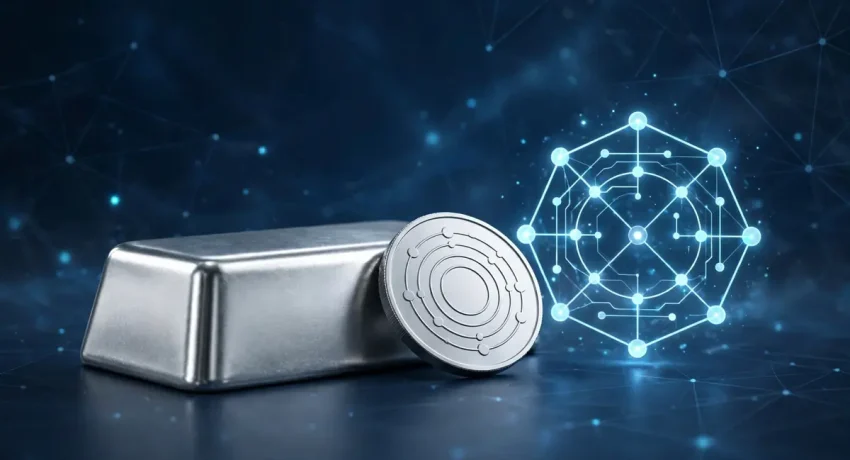
Silver backed cryptocurrency is a digital token that claims to represent a set amount of physical silver. The issuer stores silver bars in a professional vault. It then creates tokens on a blockchain. Each token stands for a fixed weight of that silver.
The most common designs are simple. One token equals one troy ounce of silver. Some tokens equal one gram instead. A gram design lowers the entry price. An ounce design matches the way bullion markets trade.
Think of the token as a receipt. You hold the receipt. A vault holds the metal. The blockchain records who owns which receipt. When you sell the token, the receipt changes hands. The silver stays in the vault.
That is the theory. In short, a silver backed cryptocurrency is a receipt for metal in a vault. The practice depends on three things. The issuer must really hold the silver. An auditor must really check it. The holder must really be able to redeem it. Every risk in this market lives in one of those three places.
How Does a Silver-Backed Token Actually Work?
Most silver-backed tokens follow the same five-step pattern. The steps look clean on paper. Each one hides a question worth asking.
- Silver goes into a vault. The issuer buys standard bars, usually 99.9% fine silver from refiners on the London Bullion Market Association Good Delivery list. The bars sit with a professional custodian.
- Tokens are minted. The issuer creates one token for each unit of silver in the vault. A smart contract records the supply on a blockchain such as Ethereum, Stellar or Sui.
- An auditor checks the vault. An independent firm counts the bars and compares them with the token supply. Good issuers publish the audit report. Weak ones publish a summary, or nothing at all.
- Tokens trade. Holders buy and sell on exchanges or decentralised exchanges. The silver token price should track the silver spot price. Thin trading can break that link.
- Redemption is offered. Some holders can swap tokens back for physical silver. Minimums are usually high. Fees and delivery costs apply. Most retail holders never redeem anything.
One detail matters more than the rest. A smart contract cannot see inside a vault. It can count tokens. But it cannot confirm that a bar exists. Trust in the issuer, the custodian and the auditor does the real work. The blockchain only moves the receipts around.
Which Silver-Backed Tokens Are Real in 2026?
Tokenized precious metals now exceed $4 billion in combined value, but the tokenized silver market is tiny. The whole silver category is worth roughly $274 million, according to a 2026 market estimate. Gold-backed tokens are worth more than $3.9 billion. Silver tokens are a side room in a much bigger building.
Here is the honest map of the market as it stands in late 2026.
| Token | Backing | Size (late 2026 snapshot) | Status |
|---|---|---|---|
| Kinesis Silver (KAG) | 1 troy ounce of allocated silver per token | Largest in the category; market value estimates range from about $40 million to about $187 million | Live, trading, redeemable at high minimums |
| Matrixdock Silver (XAGm) | 1 troy ounce of LBMA silver per token at launch | Small; about $3.8 million market value | Live since March 2026; institutional grade |
| Aurus tSILVER (TXAG) | 1 gram of 99.9% LBMA silver per token | Near zero on public decentralised exchanges | Technically live, effectively illiquid |
| Silver (GRAMS) | 1 gram of physical silver per token | Small; figures vary by source | Live; Turkey-based issuer |
| iShares Silver Trust token (SLVon) | Shares in a BlackRock silver ETF | Growing; ETF-linked | Live; tracks fund shares, not vault bars |
| SilverToken (SLVT) | Claimed silver backing | Could not be verified | Listed in older roundups; current status unclear |
Notice the pattern. Two tokens have real, checkable operations. One is a rounding error on decentralised exchanges. Another is an ETF wrapper rather than a vault claim. One cannot be verified at all. That is the whole market.
What Is Kinesis Silver (KAG) and Why Does It Dominate?
Kinesis Silver KAG is the biggest silver-backed token by a wide margin. The Kinesis platform launched in 2018. Its partner, the Allocated Bullion Exchange, handles vaulting. Each KAG token represents one troy ounce of fully allocated, 999-fine silver bullion. The silver sits in insured vaults across six continents.
KAG has one feature no rival offers. Holders earn a monthly yield, paid in KAG, funded by a 15% share of Kinesis transaction fee revenue. It is the only major silver token that pays holders an income in the metal itself. Kinesis also offers a debit card that lets holders spend their silver balance.
Silver crypto redemption is real but not retail-friendly. Sources commonly cite a 200-ounce minimum for physical delivery through Kinesis vaulting hubs. Some sources cite 1,000 ounces. The gap between those figures is itself a warning. Always check the current terms on the issuer’s own pages before assuming you can take delivery.
KAG’s price history shows how wild this market is. The silver price 2026 peak came in early February, when the token touched about $130 during silver’s extraordinary run. By late October 2026, snapshots put it near $50 to $51. Silver averaged just over $40 per ounce in 2025, a 42% rise on the year, according to the Silver Institute. The token follows the metal. The metal moves fast.
What Is Matrixdock Silver (XAGm) and Who Is It For?
Matrixdock XAGm (Matrixdock Silver) launched in March 2026. The platform is part of the Matrixport group. Each XAGm token represented one troy ounce of LBMA Good Delivery silver at launch. The bars sit in institutional vaults in Asia.
XAGm uses a design called the Fungible Reserve Standard. It builds the cost of holding silver into the token itself. Each token starts at one ounce. Its ounce-per-token value then falls slowly, by about 0.3% a year, as custody fees accrue. At one late-2026 check the value stood at 0.998 ounces per token. That is honest engineering. Storage is not free. XAGm shows the cost instead of hiding it.
The audit trail is unusually strong for such a young token. In July 2026, Bureau Veritas completed the fourth consecutive semi-annual reserve audit. It covered 574 gold and silver bars, including 66 silver bars totalling 65,934 troy ounces. The audit confirmed that the silver matched the circulating tokens.
XAGm is small, with a market value near $3.8 million and about 73,000 tokens in supply. Direct minting needs identity checks and a $10,000 minimum. Smaller buyers must use secondary markets. It expanded to the Sui network in May 2026 and was listed by OSL in Hong Kong. XAGm is built for treasuries and institutions, not for casual retail buyers.
What Happened to the Smaller Silver Tokens?
Aurus tSILVER, known as TXAG, still exists on paper. Each token is meant to equal one gram of 99.9% LBMA silver. The reality on public decentralised exchanges is stark. One tracker showed total DEX liquidity near $59 and 24-hour trading volume under $1 in late October 2026. A token nobody trades is a token nobody can exit.
Silver, ticker GRAMS, comes from a Turkey-based issuer. One token equals one gram of physical silver. It runs on Avalanche and Polygon. Its fractional design suits small buyers. Public figures on its size vary by source, so treat any single number with care.
SilverToken, ticker SLVT, appears in older “best silver crypto” lists. Its current status could not be verified from reliable sources in 2026. That does not prove it is gone. It does mean no buyer should trust a list that still ranks it without fresh evidence.
One more name deserves a warning. Some 2026 listicles mention a “Digix Silver” token. Digix, the project behind it, wound down its operations in 2020. Any list still presenting its silver token as a live option is copying old material. Check the date on every ranking you read.
Why Do Price Trackers Disagree About KAG?
Here is a fact that should make any careful reader pause. In late October 2026, different data sites gave wildly different values for the same token, Kinesis Silver.
- CoinGecko-based trackers put the market value near $182 to $187 million, with about 3.67 million tokens in circulation and a price near $50 to $51.
- CoinMarketCap showed a market value near $60 million, with a confusing total supply figure of 100 billion tokens.
- Other trackers showed values near $42 to $43 million, with the same 3.67 million circulating supply.
Why the gap? KAG exists in more than one form. The native token runs on the Kinesis blockchain, a Stellar fork. An ERC-20 version runs on Ethereum. Different trackers count different versions, different supplies and different venues. Some count only exchange-traded supply. Others count the whole platform.
The lesson is simple. Never quote one tracker as the truth. Check two or three. Treat every market value in this niche as a range, not a fact. If a token’s own data is this messy at the top of its market, imagine the data quality further down the list.
How Do Silver Tokens Compare With Gold-Backed Tokens?
A gold-backed cryptocurrency is the grown-up version of this idea. Pax Gold PAXG and Tether Gold XAUT together hold more than $3.9 billion in market value. That is more than ten times the whole silver token category. The comparison explains a lot about silver tokens.
| Feature | Silver-backed tokens | Gold-backed tokens |
|---|---|---|
| Market size | About $274 million for the whole category | More than $3.9 billion for PAXG and XAUT alone |
| Main tokens | KAG dominates; XAGm is new | Pax Gold PAXG and Tether Gold XAUT |
| Unit per token | Usually 1 ounce or 1 gram of silver | Usually 1 fine troy ounce of gold |
| Price volatility | Higher; silver swings more than gold | Lower; gold is the classic safe haven |
| Demand drivers | About 55% industrial: solar, electronics, vehicles | Mostly investment, jewellery and central banks |
| Liquidity | Thin; wide spreads, low daily volume | Deep; tight spreads, heavy volume |
| DeFi use | Limited; Kinesis chain or Ethereum | Strong; multi-chain, lending and collateral |
| Regulation | Mostly unregulated; MiCA rules apply in the EU | PAXG is regulated by New York’s financial regulator |
| Entry price | Low; a gram costs a few dollars | High; an ounce costs thousands of dollars |
Silver tokens have one real edge. The entry price is low. A gram of silver costs a few dollars. The same weight in gold costs far more. Small buyers can build a silver position token by token.
Gold tokens win on almost everything else. They are bigger, more liquid, better audited and more widely accepted. Pax Gold is issued by Paxos and regulated by the New York Department of Financial Services. Tether Gold stores its metal in Swiss vaults. Silver tokens have no equivalent of that regulatory comfort.
The gold silver ratio tells the same story in one number. It recently sat near 80 to 90 ounces of silver per ounce of gold. The long-run average is closer to 40 to 60. Silver bulls read that gap as upside. Sceptics read it as proof that silver is the riskier, more cyclical metal. Both readings are honest. Neither is a prediction.
Why Does Silver Itself Move the Way It Does?
A silver token follows silver. Silver does not behave like gold. Gold is mostly a monetary metal. Silver industrial demand is the force that sets this metal apart. That difference drives everything about its price.
Industrial uses took about 680 million troy ounces in 2024, roughly 56% of total silver demand of about 1,219 million ounces. Those figures come from the Silver Institute’s World Silver Survey 2025. Solar panels alone used about 232 million ounces, around 19% of all demand. Electric vehicles use 25 to 50 grams of silver each, about twice the amount in a petrol car. Phones, servers, medical devices and power grids all need silver too.
Supply cannot keep up easily. Mine production reached about 844 million ounces in 2024. Total demand passed 1,219 million ounces. The gap, about 195 million ounces, marked the fourth straight annual deficit. The Institute later reported a fifth straight deficit in 2025, of 40.3 million ounces, and forecast a sixth in 2026, of about 46.3 million ounces.
Two forces pull in opposite directions. Solar makers are cutting silver out of panels to save money. Photovoltaic silver use fell 6% in 2025, to 186.6 million ounces, and is forecast to fall 19% further in 2026. At the same time, about 70% of silver comes as a by-product of copper, lead and zinc mining. Miners cannot simply dig more silver when the price rises. They dig what the base metals justify.
What does this mean for a token holder? Your token tracks a metal with two personalities. One is a green-tech industrial input. The other is a monetary metal that panics and soars in a crisis. Silver rose more than 150% in 2025, by one exchange’s estimate, then fell hard from its early 2026 peak. A silver token gives you all of that ride, with token risks on top.
What Are the Honest Risks of Silver-Backed Tokens?
Every silver-backed token carries six risks. These are the main silver-backed crypto risks. Read them before you read any sales page.
Is the Silver Really There?
This is counterparty risk. You trust the issuer to hold the metal. Audits help, but they are snapshots. An audit in July says nothing about November. Kinesis uses Inspectorate International audits. Matrixdock uses Bureau Veritas. Smaller tokens may use no auditor at all. Ask for the latest report. Read it. Check the date.
Can You Actually Redeem It?
Redemption minimums are high by design. Two hundred ounces of silver is worth roughly $10,000 at late-2026 prices. Add redemption fees, assay fees, shipping and insurance. Most retail holders will never redeem. They own price exposure, not a claim they can use. Be honest with yourself about which one you are buying.
Can You Sell When You Need To?
Liquidity is thin. KAG’s daily trading volume often sits below $100,000 on public trackers. Smaller tokens trade in the hundreds of dollars a day, or less. A thin market means wide spreads. You may buy at one price and find no buyer near it when you want out. A market crash makes this worse, not better.
What Do Regulators Say?
The rules are still forming. In the European Union, the MiCA regulation treats commodity-linked tokens as asset-referenced tokens. Issuers need authorisation, an EU entity and published reserve disclosures. In the United States, tokenised commodities sit in a grey zone. No silver token carries the kind of clear regulatory stamp that Pax Gold has in New York. Rules can change fast. A token that is legal today can face restrictions tomorrow.
What If the Price Falls?
Silver is volatile. It can rise 150% in a year. Yet it can also fall by a third in a few months, as it did from its early 2026 peak. A silver token does not soften that fall. It is not a stablecoin. The word “backed” describes where the value comes from. It does not mean the value is stable.
What About the Technology?
Smart contracts can have bugs. Bridges can be hacked. Wallets can be drained. A token on a small chain carries more of this risk than one on Ethereum. The silver in the vault is safe from hackers. Your token is not. Keep that distinction clear in your head.
Silver Token or Physical Silver — Which Fits Whom?
Both give you silver exposure. They fit different people. The physical silver vs crypto silver choice comes down to one question: do you want to hold the metal, or hold a receipt for it?
| Question | Silver-backed token | Physical silver |
|---|---|---|
| Who holds the metal? | A custodian, in a vault you cannot visit | You, or your chosen vault |
| How fast can you sell? | Minutes, if a buyer exists | Days, through a dealer |
| Smallest sensible buy? | A gram, worth a few dollars | A coin or a small bar |
| Storage cost? | Built into the token or the platform fee | Your safe, or a vault fee |
| Counterparty risk? | Yes: issuer, custodian, auditor | Almost none, once it is in your hands |
| Can you spend it? | Sometimes, via a card (Kinesis) | Rarely, and only after selling |
| What if the issuer fails? | You join a queue of creditors | Nothing changes; the metal is yours |
A token suits someone who wants small, fast, fractional exposure and accepts issuer risk. Physical silver suits someone who wants no counterparty at all and accepts slow selling and storage hassle. Silver ETFs sit between the two. They are regulated, liquid and easy to buy, but they are fund shares, not metal in your hands.
There is no wrong answer here. The only danger is a mismatch between what you think you own and what you actually own. Close that gap before you buy anything.
How Do You Check a Silver-Backed Token Before Touching It?
Use this checklist on any silver-backed token. If a project fails more than one item, walk away.
- Read the latest audit. Who audited it? When? Does the bar count match the token supply? A report older than six months is stale.
- Check the custodian. Is the vault named? And is it insured? Is the silver allocated to holders, or pooled with the issuer’s own metal? Allocated is stronger.
- Test the redemption terms. What is the minimum? And what are the fees? How long does delivery take? If you cannot afford the minimum, you cannot redeem. Admit that.
- Look at real trading volume. Check two or three trackers, not one. Daily volume under a few thousand dollars means you may not be able to sell at a fair price.
- Read the legal terms. What does the token actually entitle you to? Some tokens are a claim on metal. Others are a claim on the issuer. Those are different things.
- Check the regulator. Is the issuer authorised anywhere? Under which law? A token with no regulator is not automatically a scam. It is automatically riskier.
- Search for the team. Named people, real offices, real history. Anonymous teams and borrowed logos are red flags.
- Ignore the ranking lists. Many listicles recycle old data. One still lists a dead project as a live option. Verify every claim yourself.
Is Silver Backed Cryptocurrency a Safe Investment?
No. It is not safe in the way a bank deposit is safe. Nothing about it is guaranteed. The silver backing limits one kind of risk. It does not remove the others.
What the backing does: it ties the token to a real asset with centuries of use. Silver has industrial demand, monetary history and a global market. A token backed by real bars is worth more, in principle, than a token backed by nothing.
What the backing does not do: it does not stop the price falling. It does not guarantee the issuer is honest. Nor does it guarantee you can redeem. Selling is not guaranteed either. And it does not protect you from a hack, a freeze or a rule change.
Silver-backed tokens make sense only as a small, eyes-open part of a wider plan, for someone who understands silver, accepts volatility and has done the checks above. They make no sense as a first crypto purchase, as a savings account or as a bet on a single token. That is the full picture of silver backed cryptocurrency in 2026. This article is educational only. It is not investment advice. Nor is it legal advice. Talk to a licensed adviser before you put money into any token.
Frequently Asked Questions
What is the biggest silver-backed cryptocurrency?
Kinesis Silver (KAG) is the biggest by a wide margin. One token equals one troy ounce of allocated silver. Estimates of its market value in late 2026 range from about $40 million to about $187 million, depending on which tracker you check. It is the only major silver token that pays holders a monthly yield in silver.
Is a silver-backed token the same as a silver stablecoin?
Not quite. People sometimes call these tokens a silver-backed stablecoin, but the label is misleading. A stablecoin tracks a currency, usually the US dollar, and aims to stay flat. A silver-backed token tracks silver, and silver moves. The token is stable only in the sense that it is tied to metal. Its price rises and falls with silver.
Can I redeem a silver token for real silver bars?
Sometimes, if you hold enough. Kinesis commonly cites a 200-ounce minimum for physical delivery. Matrixdock’s XAGm is aimed at institutions, with a $10,000 direct-mint minimum. Fees, shipping and insurance apply. Most retail holders never redeem.
Are silver-backed tokens better than gold-backed tokens?
They are cheaper to buy in small amounts, and silver has strong industrial demand from solar panels and electronics. Gold-backed tokens are far bigger, more liquid, better regulated and less volatile. For most buyers seeking stability, gold tokens are the safer choice. Silver tokens suit a specific view on silver, not a general hedge.
How do I buy silver-backed crypto?
The question of how to buy silver-backed crypto has no single answer: use the issuer’s platform, a crypto exchange that lists the token, or a decentralised exchange. Steps vary by token and by country. Check whether the token is available in your jurisdiction, what identity checks apply, and what the fees are. Never buy a token you have not checked against the list in this guide.
What happened to silver prices in 2025 and 2026?
Silver averaged just over $40 per ounce in 2025, up 42% on the year, according to the Silver Institute. It surged further in early 2026, with the KAG token touching about $130 in February 2026, then fell back sharply. By late October 2026, snapshots put KAG near $50 to $51. Treat all of these as dated snapshots, not live prices.
Disclaimer: This article is for education only. It is not investment advice, financial advice or legal advice. Silver-backed tokens carry price, liquidity, counterparty, custody and regulatory risks. Prices and market values in this article are dated snapshots from late October 2026, drawn from public trackers that disagree with each other. Do your own research and consult a licensed adviser before making any financial decision.