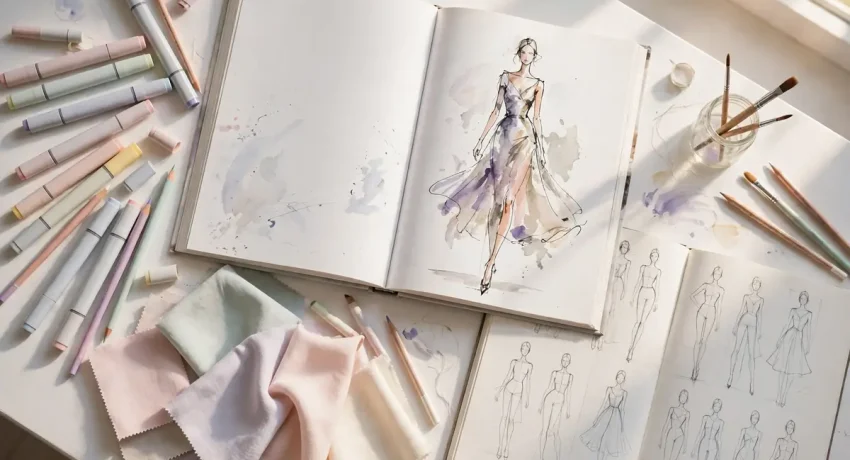

Open a fashion illustration book and you will notice something at once. The pages ask you to slow down. A video can show you a finished drawing in thirty seconds. A book shows you how the drawing was built, line by line, and lets you study each step at your own pace.
That is why fashion illustration techniques still matter in 2026, and the books that teach them still matter too. Designers sketch by hand to think. A quick drawing tests a silhouette faster than any software can. It also carries a human touch that brands now want, as illustration enjoys a fresh comeback against overly polished AI imagery.
This guide gathers the best fashion illustration books for every level. You will find books for complete beginners, books for fabric rendering, books for flats, books for digital work, and books for pure inspiration. Each title here is a real, published book. Nothing is invented.
What makes a great fashion illustration book?
Not every pretty book teaches well. A great one does four things. It breaks the process into steps you can follow. Real examples appear throughout, not just finished art. The figure, the garment, and the fabric all get proper coverage. And it is honest about who it is for.
Fashion design books cover sewing, patternmaking, and business too, but illustration books focus on drawing. Beginners need clear figure construction and simple exercises. Working designers need fabric rendering, flats, and presentation. Collectors and students need history and visual reference. The books below fall into those groups, so you can pick by need instead of by cover.
One more test helps. Flip to a random page and try the exercise. If you can follow it without a teacher, the book earns its place on your shelf. A book that only shows beautiful work with no method belongs on a coffee table instead.
How do you draw a fashion figure from scratch?
Fashion figure drawing starts with the figure itself. This kind of drawing is not life drawing. The body is stretched and stylised, so the clothes read clearly on the page. Most books teach the same foundation, and it is worth learning properly.
The 9 heads fashion figure is the standard measure in most classrooms. The head is the unit. The body is nine heads tall from crown to ankle. Legs take up most of that length. That elongation is what makes a fashion sketch look like fashion, not like a portrait.
Anna Kiper stretches her figures even further, to ten heads, with most of the extra length in the legs. Other books stay at nine. Neither is wrong. Nine heads is the classroom standard. Ten heads is a stylistic choice for a more dramatic, editorial look.
Next comes the balance line. Drop an invisible line from the middle of the neck straight down to the floor. It runs at a right angle to the ground. The figure must balance around it, or the pose will look as if it is falling over. Draw it first, then build the pose around it.
After that, sketch the croquis. A fashion croquis is a quick, loose outline of the fashion figure. It is a template, not a finished drawing. You draw the clothes on top of it. Many designers keep a set of croquis templates in different poses, so they can start a new idea in minutes.
Gesture comes before detail. Draw the whole pose in a few loose lines. Check the angles of the shoulders and hips. Then check the tilt of the head. Only then add the garment, the folds, and the face. That sequence is the heart of how to draw fashion figures. Books that teach this order save beginners months of frustration.
What book should a complete beginner buy first?
Fashion illustration for beginners works best when the first book teaches the figure before anything else. If you buy one book, make it Anna Kiper’s Fashion Illustration: Inspiration and Technique. It was published by David & Charles in 2011, and it is still the book other guides measure themselves against. Anna Kiper fashion illustration lessons come from a designer’s point of view. Every lesson tells a small story, with design details that push you to draw rather than just look.
The book covers the full journey. It starts with the fashion figure and freehand gesture. From there it moves through faces, arms and hands, legs and feet. Then it dresses the figure, layer by layer. Later chapters cover flats, accessories, page composition, men, children, fabric rendering, and media. Few books cover this much ground in 144 pages.
Kiper also teaches skin tone with care. She works with seven skin tones and shows that skin is never one flat colour. Her fabric chapters are the strongest part of the book. Lace, beads, sequins, prints, and patterns each get their own method. That is the section beginners return to again and again.
Holly Nichols modern fashion illustration offers a different starting point. Her book, Modern Fashion Illustration: Simple Techniques for Stylish Drawings, came out with Page Street Publishing in December 2023. It is warm, modern, and built for the way illustrators work now. Nichols is a Boston-based fashion illustrator with more than a million Instagram followers. Her clients have included Saks Fifth Avenue, Neiman Marcus, and Disney.
Nichols teaches proportions, couture and casual outfits, hair, colouring, and backgrounds. She also teaches narrative, which is how you give a drawing a story. Three tutorials close the book: a couture dress, a casual scene, and a Procreate lesson. Templates and colouring pages are included. One honest limit: the book does not cover drawing men, because most of her own work shows women.
Bina Abling’s Fashion Sketchbook is the classroom standard. The sixth edition, from Fairchild Books, is in full colour and fully revised. Abling explains the fashion figure with simple, step-by-step directions. She covers women, men, and children. Posing, heads and faces, accessories, garment details, flats, and specs all get coverage too. Runway and showroom photographs from Women’s Wear Daily sit beside the lessons. An appendix holds more than 400 garment and accessory references.
Two more beginner books deserve a mention. Fashion Drawing For Dummies, by Lisa Arnold and Marianne Egan, starts at the very beginning. It explains art supplies, workspace setup, and the difference between fashion drawing and figure drawing. Its croquis method is simple: trace a magazine figure, mark the shoulder and hip angles, draw the centre line, then ink the outline. It is a gentle first book.
Lisa Steinberg’s Beginner’s Guide to Sketching the Fashion Figure: Croquis to Design (2020) builds the croquis from anatomy. It mixes real anatomy with fashion proportions. Female, male, and children’s figures are all taught, plus faces, hands, and feet. Timed exercises, do’s and don’ts, and downloadable templates come with the book. It also shows figures of diverse sizes, which matters when you design for real people.
Which books teach fabric rendering and colour best?
Fabric rendering fashion is where most beginners stall. A flat colour shape looks dead. A rendered fabric looks like cloth. The best books treat rendering as a skill with rules, not as talent.
Kiper’s fabric chapters are the clearest available. She shows how every fold is a single shape. Depth comes from highlight, mid-tone, shadow, and reflection. Stripes shift and break at creases but keep their spacing. Lace and tulle look best layered over contrasting undergarments. Beads and sequins need glitter pens, metallic markers, and white paint for shine. Gouache, mixed and diluted, can imitate almost any colour or texture.
Fashion illustration markers are Nichols’ main tool. She works mainly with Copic markers. Nichols discovered them as a student and has used them for over ten years. The brush tip suits sketching movement in garments. Her book shows how to render leather, tulle, and velvet, and how to colour hair and skin with earth tones. A soft periwinkle is her favourite marker colour, and it even appears on the book cover.
Watercolour, gouache, and collage each get space in Kiper’s media chapter. She describes dropping watercolour dye on a wet surface and sprinkling sea salt for texture. Collage is spontaneous and freeform. It can replace detailed print rendering with simple paper cutouts. These methods suit illustrators who want a looser, more expressive style.
One practical tip runs through all of these books. Work in layers. Block the base colour fast. Leave the highlights. Add shadows for depth. Rushing to finish kills the drawing. Layers give you control, and control gives you confidence.
How do you learn to draw fashion flats?
A fashion illustration sells a feeling. A flat sells a garment. In plain terms, a flat is a precise technical drawing of a piece of clothing, shown front and back, with every seam, pocket, and closure in place. Factories work from flats. Buyers judge from flats. Every designer must learn them.
Kiper includes a fashion dictionary and a flats chapter. She explains that freehand flats, sometimes called floats, can show more movement than rigid technical flats. Her book shows tailored jackets, activewear, and sportswear as flats, with construction details drawn in. It is a good first look at how a sketch becomes a specification.
Abling goes further. Her book teaches flats and specs as a working skill. She shows how to prepare a flat, how to add garment details, and how to present a full technical package. Students who plan to work in the industry should study this section closely. It is the least glamorous part of fashion drawing, and the most employable.
Fashion flats drawing improves your illustrations too, because it teaches construction. Start with simple garments. Draw a plain shirt flat, front and back. Add the collar, the placket, the cuffs, and the hem. Then try a jacket. After that, try a dress with a gathered skirt. Each flat teaches you to look at construction, not just shape. That habit improves your illustrations too.
What are the best books for digital fashion illustration?
Digital work is now part of the job. Many illustrators sketch on paper and finish on a tablet. Others work fully digital. The books below treat digital tools as real tools, not as a shortcut.
Nichols gives Procreate a full tutorial. Procreate fashion illustration works best when the drawing starts on paper. She shows how to move a hand sketch into the app, how to build layers, and how to colour with digital brushes. Her approach keeps the hand-drawn feel. That matters, because a digital drawing that looks like a vector graphic loses the charm of illustration.
The wider trend helps digital illustrators. In 2026, brands are seeking authentic, human-touch work as a response to overly polished AI imagery. A hand-drawn line, even a digital one, reads as personal. Illustrators who can draw by hand and finish digitally have an edge.
One warning applies. Digital tools do not fix weak drawing. If your croquis is wrong, no brush will save it. Learn the figure on paper first. Then let the tablet speed up your colouring, your corrections, and your delivery.
Which books cover the history of fashion illustration?
History books will not teach you to draw. They will teach you to see. Fashion illustration history shows how styles change, how line work evolves, and how much a single drawing can say.
Drawing Fashion: A Century of Fashion Illustration, by Holly Brubach and Colin McDowell, covers one hundred years of the art. It celebrates famous illustrators and lesser-known ones. Students use it to understand how art and fashion connect, and how illustration shaped the way we see clothes.
Marnie Fogg’s Vintage Fashion Illustration: 1930–1970 draws on the archives of Harper’s Bazaar. It moves through four decades of elegant illustration. The work shows how each era had its own line, its own colour, and its own idea of beauty. It is a strong source of poses and moods for modern designers.
Walter T. Foster’s Fashion Illustration 1920–1950: Techniques and Examples is older and more practical. It teaches the drawing methods illustrators used from the 1920s to the 1950s. If you like traditional technique, this is a useful reference.
Somer Flaherty Tejwani’s The Art of Fashion Illustration blends classic and modern styles. It gathers more than 150 illustrations from masters and rising stars. Designers at any level will find it useful, whether they want inspiration or instruction.
Copy the masters first, as the best teachers advise. Study David Downton, Ruben Toledo, and the illustrators in these history books. Copy to understand their choices, not to imitate them. Your own style grows from that study.
Do you need a croquis sketchbook?
A croquis sketchbook is a sketchbook with faint figure outlines printed on each page. You draw the clothes straight onto the printed figure. It removes the hardest step for beginners, which is drawing the body itself.
Fashionary made this format popular. Its sketchbooks carry faint dotted croquis on every page. The dots guide your pencil without showing in the finished drawing. Designers use them for quick ideas, for travel, and for building a portfolio fast.
Fashionary also publishes Fashionpedia, a visual dictionary of fashion design. It covers technical terms, styles, apparel, details, accessories, textiles, manufacturing, measurement, and care. As a reference book rather than a drawing book, it still sits well beside a sketchbook on a designer’s desk.
Templates have limits. A printed croquis always shows the same body. If you only ever draw on templates, your figures will all look alike. Use the sketchbook to learn speed. Then practise freehand figures too. The two skills support each other.
How do you build a practice routine with these books?
A book only helps if you use it. A short daily routine beats a long session once a month. Twenty minutes a day will change your drawing faster than any new book.
Start with gesture. Spend five minutes drawing quick poses. Use a timer. Draw the balance line, the shoulder angle, and the hip angle. Do not finish anything. Speed teaches your hand to trust your eye.
Then spend ten minutes on one lesson from your book. Copy a fabric swatch. Draw a sleeve. Render a fold. Work small and finish the exercise. Small finished studies teach more than large unfinished drawings.
Finish with five minutes of free drawing. Sketch an outfit from your own wardrobe. Try a pose from a magazine. Let yourself play. Play is where style appears.
Once a week, do a full illustration. Pick a figure, a garment, and a fabric. Draw it from croquis to colour. Compare it with last week’s version. Progress in fashion illustration is slow to see day by day, and obvious month by month.
What should guide your choice of book?
Use the table below to match a book to your stage. Start with one row, not with the whole shelf. Finish the book before you buy the next one.
| Your level | Best first book | What it teaches |
|---|---|---|
| Complete beginner | Anna Kiper, Fashion Illustration: Inspiration and Technique | Figure, gesture, fabric, flats, media |
| Beginner who likes modern style | Holly Nichols, Modern Fashion Illustration | Proportions, markers, hair, Procreate, social media |
| Design student | Bina Abling, Fashion Sketchbook | Figure, flats, specs, men and children |
| True first-timer | Lisa Arnold and Marianne Egan, Fashion Drawing For Dummies | Croquis basics, supplies, first figures |
| Anatomy-first learner | Lisa Steinberg, Beginner’s Guide to Sketching the Fashion Figure | Anatomy, proportions, diverse figures |
| History and inspiration | Holly Brubach and Colin McDowell, Drawing Fashion | A century of illustration styles |
| Quick daily practice | Fashionary sketchbook | Printed croquis templates for fast sketching |
Budget matters too. Start with one book and a basic set of pencils and markers. You do not need every medium at once. Kiper’s book alone can carry a beginner for a year. Add a second book when you know which skill you want to grow next.
Check the edition before you buy. Abling’s book is in its sixth edition, and the newer edition is in full colour. Older editions of some books lack the colour plates. A library copy is a good way to test a book before you buy your own.
Frequently Asked Questions
Can you learn fashion illustration from books alone?
Yes, for the core skills. Books teach figure construction, fabric rendering, and flats clearly. Practice and feedback matter more than the source. A class or a critique group helps, but many working illustrators started with books and daily drawing.
What is the nine-heads rule in fashion illustration?
It is the standard proportion for a fashion figure. The head is the unit of measure. The body is nine heads tall from crown to ankle, with long legs. Some illustrators, like Anna Kiper, stretch the figure to ten heads for a more editorial look.
Which supplies do you need to start fashion illustration?
A pencil, a fine black pen, tracing paper, sketch paper, and a few markers will do. Add watercolour or gouache later, when you want to practise colour. Nichols built her style on Copic markers, but any good alcohol marker works for learning.
Is digital fashion illustration better than hand drawing?
Neither is better. Hand drawing teaches the eye and the figure. Digital tools speed up colouring, correction, and delivery. Most working illustrators use both. Learn the figure on paper first, then add digital skills like Procreate.
Fashion illustration books reward patience. Pick one book. Work through it slowly. Draw every day, even for twenty minutes. Your figures will loosen, your fabrics will gain depth, and your own style will start to show. That is the point of every book on this list.