
Picture a work site 400 kilometres from the nearest town. There is no hotel. No restaurant serves the crew. The site has no paved road at all. Yet hundreds of workers need beds, meals, showers, power, and a way in and out — every single day, in minus 30 degrees. Somebody has to build that whole town, run it, feed it, and take it away again when the job ends. That is the world Horizon North Logistics was built for.
Horizon North Logistics is not a parcel company. It does not deliver boxes to your door. Instead, it moves entire workforces, camps, kitchens, and buildings into places where almost nothing exists. This guide explains what the company is, what it actually does, what happened when it changed its name, and what any business can learn from it about supply chain excellence in 2026.
What Is Horizon North Logistics?
Horizon North Logistics Inc. is a Canadian industrial services company. It was incorporated on June 1, 2006, and it traded on the Toronto Stock Exchange under the symbol HNL. Its head office was in Calgary, Alberta.
The company served resource and infrastructure projects across Western Canada, the northern territories, and Alaska. Its customers worked in oil sands development, oil and gas exploration, mining, LNG, forestry, and construction. These are industries where the work happens far from towns, roads, and hotels.
Here are the basic facts in one place.
| Fact | Detail |
|---|---|
| Company | Horizon North Logistics Inc. |
| Founded | Incorporated June 1, 2006 |
| Former stock symbol | TSX: HNL |
| Former head office | Calgary, Alberta, Canada |
| Main markets | Western Canada, northern territories, Alaska |
| Core customers | Oil sands, oil and gas, mining, LNG, forestry, construction |
| Current name | Dexterra Group Inc. (renamed November 2020) |
| Current stock symbol | TSX: DXT |
| Current head office | Mississauga, Ontario, Canada |
The name change matters. In November 2020, Horizon North Logistics changed its name to Dexterra Group Inc. The business did not disappear. It grew, added new service lines, and kept the Horizon North name alive as a brand inside the group. We will come back to that.
What Does Horizon North Actually Do?
Horizon North worked through three operating segments. Each one solved a different piece of the remote-site problem. Together, they let a client hand over almost everything except the work itself.
What Did Camps and Catering Cover?
This was the biggest part of the business. Most of the company’s revenue came from this segment. It covered camp management, catering, and maintenance for workforce accommodation sites.
Think about what a camp needs. Workers need rooms, beds, laundry, showers, and toilets. They need three hot meals a day. Heating, water, power, and waste handling must all work. Someone has to keep the whole site clean and safe. Horizon North supplied the camp and ran it, day after day, for months or years at a time.
The segment also included camp manufacturing, sale, and repair. The company built the accommodation units, moved them to site, and kept them working. When a project ended, the camp could be packed up and moved to the next site.
What Did Rentals and Logistics Cover?
This segment handled rental operations, mat rental, relocatable structures, and transportation. It is the part of the business closest to what most people mean by logistics.
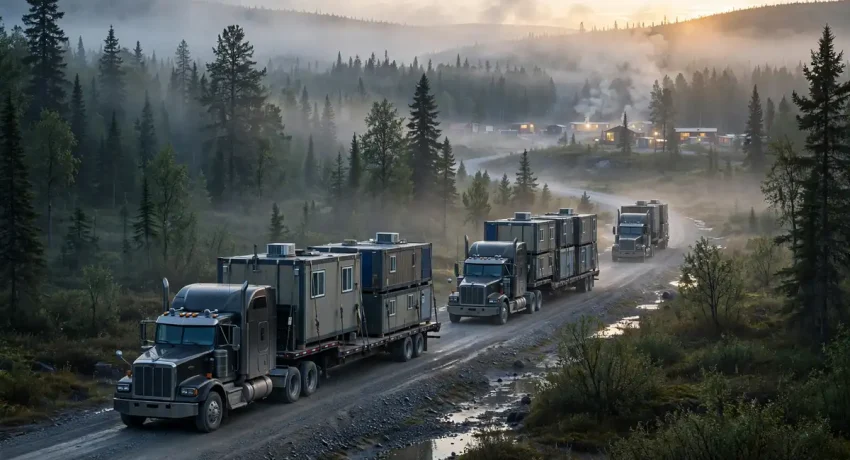
Its teams handled modular buildings transport, matting, equipment, and oilfield and mining supplies across Western Canada. Class 1 drivers carried the loads over long distances, through all weather, and often over rough ground. They also handled cargo, secured loads, and completed the safety paperwork that remote work demands.
The logistics work was not just driving. It was planning. A camp cannot open until the mats are down, the buildings are set, and the power is on. Every load had to arrive in the right order. One late truck could delay a whole camp opening.
What Did Modular Solutions Cover?
This segment covered modular manufacturing and installation for commercial and residential markets. The company built structures off site, in a factory, and then transported and installed them where they were needed.
In 2016, Horizon North bought Karoleena Inc. for $2.5 million. Karoleena made designer prefabricated homes in Okanagan Falls, British Columbia. The deal widened the company’s permanent modular offering beyond work camps.
One fact is worth noting here. Dexterra sold its Modular Solutions business in 2024. The segment was part of the Horizon North story for years, but it is no longer part of the group today.
Why Does Remote-Site Logistics Exist at All?
Most supply chains move goods between places that already have roads, warehouses, and workers. Remote-site logistics starts from the opposite position. There is no infrastructure. The logistics provider has to create it.
An oil sands project or a mine can sit hundreds of kilometres from the nearest town. A pipeline crew may work in muskeg, forest, or frozen ground. A construction team may spend two years on a dam in a valley with no services at all. Workers still need to sleep, eat, wash, and stay warm.
That is why companies like Horizon North exist. They turn an empty patch of ground into a working town, then run it like a small hotel, restaurant, and transport company combined. When the project ends, they take the town away again. This whole field is called remote site logistics, and it follows different rules from city logistics. Oil sands logistics is the clearest example: huge projects, harsh winters, and no nearby towns. Moving, housing, and feeding a remote workforce is remote workforce logistics at its hardest, and the same ideas apply to easier supply chains too.
This is a very different kind of logistics from parcel delivery. The cargo is not small and light. It is buildings, kitchens, generators, and fuel. The customers are not shoppers. They are project managers with hard deadlines and safety rules. The cost of a mistake is not a late parcel. It is a crew that cannot work.
How Does a Remote-Site Supply Chain Actually Work?
A remote-site supply chain runs in a clear sequence. Each step depends on the one before it. Miss one, and the whole chain stalls.
How Do You Reach the Site?
First comes access. Heavy equipment cannot drive over soft ground. The answer is access matting — large mats laid down to form a temporary road or work pad. Horizon North supplied, installed, and managed matting, and it also sold and repaired mats.
Matting protects the ground as well. It spreads the weight of trucks and cranes, and it stops vehicles from sinking into muskeg or mud. Walking and working on the site also becomes safer. When the project ends, the mats are lifted and the ground is restored. Matting rental was a core service: clients could rent mats for one project instead of buying them outright.
How Do the Buildings Get There?
Next comes transport. Modular buildings are built in a factory, loaded onto flatbed trailers, and hauled to site. Horizon North’s manufacturing sites included Kamloops, British Columbia, and Grande Prairie, Alberta. From there, trucks carried units across Western Canada.
The loads are wide, heavy, and awkward. Drivers need special licences and training. Routes need permits. Weather can close a road for days. This is why the company’s logistics teams planned loads carefully and tracked them closely. The last leg is often the hardest: last mile delivery to a remote site can mean an ice road, a barge, or a helicopter, and it decides whether the whole chain works.
How Does the Camp Come Alive?
Once the buildings arrive, they are set, connected, and tested. Power, water, heating, and waste systems all have to work before anyone moves in. The camp then needs staff: cooks, cleaners, maintenance workers, and managers.
Food is a supply chain of its own. A camp of 500 workers eats around 1,500 meals a day. That means regular deliveries of fresh food, dry goods, and fuel, on roads that may be ice-covered for months. Catering teams plan menus, order stock, and store it safely.
How Does the Site Keep Running?
Daily operations are the long middle of the chain. Laundry runs. Showers run. Generators run. Waste is removed. Supplies arrive on schedule. Staff are transported to and from the site. Safety checks happen every day.
This is where reliability matters most. A missed food delivery is not an inconvenience. It is a hungry crew. A failed generator is not a small problem. It is a camp without heat in winter. Remote-site logistics is mostly about preventing small failures from becoming big ones.
How Does the Site Close Down?
When the project ends, the chain runs in reverse. Buildings are disconnected and loaded. Mats are lifted. Waste is removed. The ground is restored as far as possible. The camp moves to the next project, and the cycle starts again.
Demobilisation is often the hardest part to plan. Crews are tired. Deadlines are tight. Yet the site must be left clean and safe. A provider that plans the exit from the start does this far better than one that treats it as an afterthought.
What Happened to Horizon North in 2020?
In November 2020, Horizon North Logistics Inc. changed its name to Dexterra Group Inc. The stock symbol changed from HNL to DXT. The head office moved to Mississauga, Ontario, at 5925 Airport Road.
The rename was not a shutdown. It was a rebrand that matched a bigger business. Dexterra had grown beyond remote camps. It now runs two main segments: Support Services and Asset Based Services.
Support Services covers operation, maintenance, and hospitality work for many kinds of clients. These include remote operations, governments, aviation, education, industrial sites, transit, healthcare, and leisure. Asset Based Services covers workforce accommodation structures, access solutions, and space rentals for natural resources and infrastructure clients.
The Horizon North name did not vanish. It lives on inside Dexterra as a working brand. Job listings still advertise roles with the Horizon North Rentals and Logistics team. Drivers still move modular buildings, matting, and equipment across Western Canada. The work continues under the new name.
One more fact helps complete the picture. Dexterra’s roots go back to 1985, and the group now describes itself as serving clients across North America. Its market capitalisation was around $825 million in late October 2026, with shares trading near $13.21. These figures move with the market, so treat them as a snapshot, not a fixed fact.
A short note on names is useful here. There is a separate company called Horizon Logistics Solutions, based in the Northern Territory of Australia. It is a family-owned 4PL provider working around Darwin Port. There is no connection between the two companies. The similar names cause confusion, so check which company you are reading about.
What Can Other Businesses Learn From Horizon North?
You may never run a work camp in the Arctic. Yet the principles behind Horizon North’s model apply to almost any supply chain. Remote sites simply make the lessons sharper, because the cost of failure is so visible.
Why Does Visibility Matter So Much?
In 2026, the best supply chains are the ones you can see. Real-time tracking, live inventory data, and clear dashboards are now baseline expectations, not extras. Industry guides for 2026 stress AI-driven visibility: early warnings, scenario planning, and automated exception handling.
Horizon North’s world shows why. When a truck is three days from the nearest town, you need to know where it is. A camp holding 500 people needs an exact count of the food on hand. Guesswork is not a plan. This is what supply chain visibility means in practice: knowing where everything is, at all times.
Why Is Resilience Worth Paying For?
A supply chain built only for good weather fails fast when conditions change. The pandemic taught this lesson to every industry. A factory, port, or route can close without warning. Backup capacity costs money, but a single failure can cost far more.
Remote-site operators plan for failure from the start. They carry spares and backup generators. Extra food is held in reserve. They plan alternate routes. This is the heart of supply chain resilience: the ability to keep working when conditions change. The same thinking helps any business: know your single points of failure, and decide in advance what you will do when one breaks.
Why Is Total Cost More Honest Than the Cheapest Price?
The cheapest freight quote is rarely the cheapest outcome. Delays, damage, storage fees, and emergency fixes add up fast. Industry guides now advise buyers to build a total cost of ownership picture before choosing a provider.
Older research from the Council of Supply Chain Management Professionals put logistics at roughly 5 to 10 percent of manufacturing budgets. That figure is from 2005, so treat it as history, not a current benchmark. The point still stands: logistics costs are a large share of spending, and small percentage gains are worth real money. A 2024 Deloitte study reported that manufacturers who invested in quality logistics partners improved operational efficiency by an average of 15 percent.
Why Do People Still Matter Most?
Technology helps, but people run supply chains. Drivers, planners, cooks, and managers make the judgment calls that no dashboard can make. Horizon North’s camps worked because teams on the ground solved problems in real time.
Training matters as much as trucks. A driver who secures a load properly prevents an accident. A planner who orders food early prevents a shortage. A manager who listens to the crew spots trouble before it grows. Invest in people first, and the technology will work better.
How Do You Choose a Logistics Partner in 2026?
Learning how to choose a logistics partner is a serious decision. The wrong choice costs money, time, and customers. The right choice becomes a real advantage. Most providers in this space are third-party firms, and 3PL logistics simply means a company that handles storage, transport, and order handling for you. Here is a practical logistics partner checklist, drawn from current 2026 industry guidance.
Does the Partner Cover Your Routes?
Start with coverage. Can the provider actually serve the places you need? A partner with a strong network in one region may have no presence in another. Ask for the exact routes, depots, and delivery points. Check for gaps before you sign.
Is the Partner Reliable?
Reliability means your goods arrive on time, again and again. Ask for on-time delivery figures. Get references from customers in your industry. Gartner’s supply chain research has found that companies working with reliable logistics partners experience around 20 percent fewer major delays each year. That gap is worth real money.
Reviews are one practical check. Our Benore Logistics reviews guide shows how to read customer and employee feedback before you trust a provider with your freight. Look for patterns, not single comments. A provider with many similar complaints has a real problem.
Can the Partner Scale With You?
Your volumes will change. A good partner handles peaks without breaking. Ask how they manage seasonal surges, new product launches, and sudden growth. A provider that only works at one size will hold you back.
Is the Technology Good Enough?
In 2026, supply chain technology from a good partner should include real-time tracking, KPI dashboards, and API links to your own systems. Ask how data flows between you and them. Find out what happens when a shipment goes wrong. If the answer is a phone call and a spreadsheet, keep looking.
Is the Pricing Honest?
Ask for the full cost picture. That means base rates, fuel surcharges, storage fees, handling charges, and penalties for delays. Hidden costs are the most common complaint in logistics. A clear invoice and a clear contract prevent most disputes.
Does the Partner Take Safety and Security Seriously?
For many industries, cybersecurity is now a supply chain risk. A provider holds your shipment data, your customer data, and your delivery schedules. Ask how they protect it. Look for recognised standards such as ISO 9001 for quality and ISO 28000 for supply chain security. Certifications like AEO and CTPAT can also speed up customs.
Does the Partner Understand Your Industry?
A food company and a mining company need very different logistics. A partner who knows your sector understands your rules, your risks, and your seasons. Ask for examples of similar work. Generic promises are not enough.
What Should You Watch Out For When Hiring a Logistics Partner?
Red flags are easy to miss when a sales pitch sounds good. Watch for these warning signs before you commit.
First, beware of prices that look far below every other quote. A very low price often means hidden fees, weak insurance, or corners cut on safety. Second, beware of vague service promises. If a provider cannot put delivery times and penalties in writing, they probably cannot deliver them either.
Third, check the provider’s financial health. A partner that goes out of business mid-contract leaves you stranded. Public companies publish financial reports. Private companies should at least provide references and a track record you can check.
Fourth, watch for poor communication. If the sales team is slow to answer now, the operations team will be slower later. Test them with hard questions before you sign. Fifth, ask about insurance and liability. Know exactly who pays when goods are damaged, lost, or delayed. Get it in writing.
Finally, avoid providers who cannot explain their own network. If they cannot tell you where your freight goes, who handles it, and how it is tracked, they do not have a network. They have a phone book.
Frequently Asked Questions
Is Horizon North Logistics still in business?
Yes, under a new name. Horizon North Logistics Inc. changed its name to Dexterra Group Inc. in November 2020. The Horizon North brand still operates inside Dexterra, including the Horizon North Rentals and Logistics team that moves modular buildings and equipment across Western Canada.
What services did Horizon North Logistics offer?
Three main areas: workforce accommodation with camp management and catering; rentals and logistics, including access matting and transportation; and modular manufacturing and installation. Dexterra sold the Modular Solutions business in 2024, so that part no longer belongs to the group.
Where did Horizon North operate?
Mainly in Western Canada, the northern territories, and Alaska. Its clients worked in oil sands, oil and gas, mining, LNG, forestry, and construction. Manufacturing sites included Kamloops, British Columbia, and Grande Prairie, Alberta.
What is the difference between Horizon North and Horizon Logistics Solutions?
They are different companies. Horizon North is the Canadian company that became Dexterra Group. The Australian firm is a family-owned 4PL provider based in the Northern Territory, working around Darwin Port. The similar names cause confusion, but there is no connection between them.
What makes a supply chain excellent in 2026?
Five things: real-time visibility, resilience against disruption, honest total-cost thinking, strong technology links, and trained people. The best supply chains are predictable, not just fast. Customers leave when deliveries are unpredictable, even if they are usually quick.
How do I pick the right logistics partner?
Check coverage first, then reliability, scalability, technology, pricing transparency, safety standards, and industry experience. Ask for references, read reviews, and test communication before you sign. A partner that cannot answer hard questions now will not answer them later either.
Sources: Dexterra Group and Horizon North Logistics company profiles and press releases (Barchart, CNW Newswire); Dexterra Group market data (PortfolioLab, BeatMarket, MarketCapOf, CoinDataFlow); Dexterra job listings (SmartRecruiters); competitor guides on choosing a logistics partner in 2026 (Aerodoc, EE Times, Zarach Logistics, Vizologi); supply chain strategy guides for 2026 (Fortna, Gembah, ShipBob, Lading Cargo).