
Amsterdam gets almost all the attention. The canals, the museums, the crowds — they are real, and they are worth a visit. But the Netherlands is much bigger than one city. Some of the best places to visit in the Netherlands other than Amsterdam sit less than an hour away by train. Others need a full day. All of them show a different side of the country.
This Netherlands travel guide 2026 covers the best places to visit in Netherlands besides Amsterdam — 12 places beyond the capital. You will find tulip fields, a car-free village, a rebuilt port city, a medieval university town, and an island of dunes and sheep. Every price, date, and train time here comes from sources checked for 2026. Where sources disagree, the article says so. If you want the full picture of the country, start here. The Netherlands belongs on any list of the most interesting places in the world — and most of its best spots are not in the capital.
Which Dutch places should you pick first?
Twelve places is a lot. Your time is not endless. Use this table to match each place to the kind of trip you want.
| If you want… | Go to… | Why |
|---|---|---|
| Tulips and flower fields | Keukenhof and the Bollenstreek | 7 million bulbs in one garden, open only in spring |
| A fairy-tale village | Giethoorn | No roads in the centre, only canals and whisper boats |
| Canals without the crowds | Utrecht | Two-level canals with wharf cafés, 27 minutes from Amsterdam |
| Modern architecture | Rotterdam | Cube Houses, Markthal, and Europe’s largest port |
| Art and royal history | The Hague | Vermeer’s Girl with a Pearl Earring at the Mauritshuis |
| Windmills | Kinderdijk or Zaanse Schans | 19 UNESCO windmills at Kinderdijk, working mills at Zaanse Schans |
| A beach day | Texel or Scheveningen | Long sandy beaches and wide dunes |
| A different culture | Maastricht | Hills, caves, and a southern European feel |
Why is Utrecht the best first stop outside Amsterdam?
Utrecht is the fourth largest city in the Netherlands. It sits about 27 minutes south of Amsterdam by train, and a ticket costs around €9. The city feels like Amsterdam’s calmer cousin. It has canals, old churches, and busy cafés. You will not find the bachelor parties here.
The Oudegracht canal is the heart of the city. It is different from Amsterdam’s canals. Utrecht’s canals have two levels. At street level you walk past shops. Down at the water, old wharf cellars now hold cafés and restaurants. A coffee at a wharf café costs about €3.50 to €4.50. Sit low, near the water, and watch the boats pass.
How high is the Dom Tower, and can you climb it?
The Dom Tower is 112 metres tall. It is the tallest church tower in the Netherlands. You can climb it, but only on a guided tour. The climb is 465 steps. Utrecht Dom Tower tickets cost about €10 online or €11.50 at the gate. A combination ticket with DOMunder, the archaeological site under Domplein, costs €18.75. Tours run daily from 10:00 to 17:00. The tower closes on Christmas Day, New Year’s Day, and King’s Day.
Book ahead in peak season. Tickets sell out, especially on weekends. The view from the top covers the whole city and the fields beyond. On a clear day, you can see Amsterdam in the distance.
What else is worth your time in Utrecht?
Walk the canal ring at dusk. The wharf lights come on, and the water turns gold. Visit the Dom Church next to the tower. It was split from the tower by a storm in 1674, and the gap is still there. If you have a spare half day, take a train to Kasteel de Haar. It is one of the most romantic castles in the country, about 20 minutes from the city.
What makes Rotterdam so different from the rest of the Netherlands?
Rotterdam was almost completely destroyed in the Second World War. The city chose to rebuild in a modern style. The result is the most unusual skyline in the Netherlands. Glass towers, tilted cubes, and a swan-shaped bridge stand where old streets once were.
The Intercity Direct train from Amsterdam takes about 40 minutes. A ticket costs around €18, plus a supplement of roughly €3 for the high-speed stretch. Rotterdam is the second largest city in the country. It is also home to the largest port in Europe.
Where should you start in Rotterdam?
Start at the Markthal. It is a giant food hall with a curved ceiling covered in a huge artwork of fruits and vegetables. Inside, you can taste Dutch cheese, fresh stroopwafels, and food from all over the world. Right next door stand the Cube Houses. These tilted yellow cubes are homes, and one is open as a museum. Walk across the Erasmus Bridge at sunset. Locals call it the Swan because of its shape.
Take the water taxi across the river. It is fast, fun, and gives you the best view of the skyline. Hotels in the city centre cost around €80 to €100 a night, which is often less than Amsterdam.
Is Giethoorn really the Venice of the Netherlands?
Giethoorn is a small village in the province of Overijssel. It is about 120 kilometres from Amsterdam. The historic centre has no roads. You get around by electric whisper boat, on foot along the Binnenpad path, or by bike. Thatched farmhouses line the canals, joined by more than 170 small wooden bridges.
The village gets around one million visitors a year. Weekday mornings, spring, and autumn are the quietest times. The best months are April to October. July and August bring the biggest crowds.
How do you get to Giethoorn, and what does it cost?
Take a train from Amsterdam Centraal to Steenwijk. The trip takes about 1 hour 50 minutes and costs around €19.50 to €25. From Steenwijk station, bus 70 runs to Giethoorn in about 30 minutes for around €5.20. A Giethoorn boat tour costs from about €9 per person for a narrated cruise. Renting a self-drive whisper boat costs around €15 an hour. It is easy to steer, even for first-timers.
Stay overnight if you can. The village is quiet after the day-trippers leave. Small bed and breakfasts in thatched cottages cost around €120 to €150 a night. The sunset over the lake, with no cars and no noise, is the reason to stay.
When is Keukenhof open in 2026, and is it worth the trip?
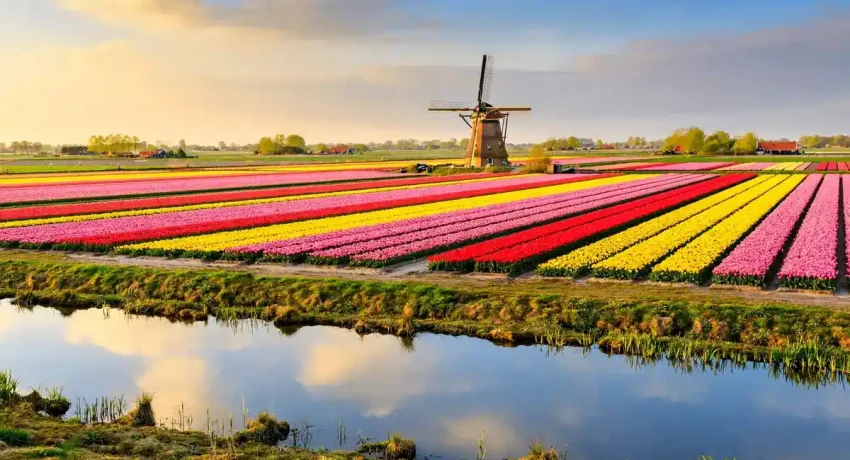
Keukenhof is the most famous flower garden in the world. It opens for only eight weeks a year. The Netherlands tulip season 2026 runs from March 19 to May 10. The garden is open daily from 8 am to 7 pm. It sits in Lisse, in the Bollenstreek, the bulb-growing region between Amsterdam and The Hague.
About 7 million bulbs bloom across 32 hectares. Tulips, daffodils, hyacinths, and crocuses fill the beds in waves. The best time to visit is between April 15 and May 5. Tulips before April 10 are often not yet in bloom. Peak bloom usually falls in the last two weeks of April.
How much do Keukenhof tickets cost in 2026?
Keukenhof tickets 2026 cost about €21.50 for an adult online. At the gate, the same ticket costs around €25, if any are left. Children aged 4 to 17 pay about €10 online or €14 at the gate. Under-4s enter free. Tickets are date and time specific. You pick an arrival slot when you book. The park is fully cashless, so bring a bank card.
Parking costs about €9 online. A whisper boat ride through the fields costs around €11 for adults. The Flower Parade, the Bloemencorso, rolls through the region on April 18, 2026. It is the busiest day of the season. Book at least two weeks ahead if you want to go that weekend.
How do you reach Keukenhof without a car?
Take a bus from Amsterdam RAI, Schiphol Airport, or Leiden. Combi tickets that include the bus and entry cost around €33.50 to €38.50 for adults. The ride from Amsterdam RAI takes about 35 minutes. For the real flower fields, rent a bike in Lisse or Haarlem. Cycle the Bollenstreek between Lisse, Hillegom, and Noordwijkerhout. Never walk into the fields. They are working farms, not photo sets, and your feet damage the bulbs.
What can you see in The Hague besides politics?
The Hague is the seat of the Dutch government and the royal family. It is also a city of art, beaches, and quiet streets. The train from Rotterdam takes about 30 minutes, and Amsterdam is around 50 minutes away.
The Hague Mauritshuis is the city’s best museum. It is small, calm, and full of masterpieces. Vermeer’s Girl with a Pearl Earring hangs here. So does his View of Delft and Rembrandt’s The Anatomy Lesson of Dr. Nicolaes Tulp. Entry costs around €20, though prices vary by seller, so check before you go. Book a time slot online to skip the queue.
Is Scheveningen worth a beach day?
Yes. Scheveningen is The Hague’s seaside district. It has a long sandy beach, a pier with a viewing wheel, and beach clubs that open in summer. The water is cold, even in July. Most people come for the sand, the food, and the sunset. A tram from the city centre takes about 20 minutes.
Walk the Binnenhof, the old parliament complex around a pond. It is one of the oldest parliament buildings still in use in the world. The Peace Palace, home of the International Court of Justice, sits in a quiet park nearby. You can visit its visitor centre, but the palace itself is only open on rare guided days.
Why is Delft the prettiest small city in the Netherlands?
Delft Netherlands is a small city between Rotterdam and The Hague. It takes about 15 minutes by train from Rotterdam. The city is famous for two things: the painter Johannes Vermeer and Delft Blue pottery. Both still shape the city today.
The old town is a postcard. Canals, leaning houses, and the tall Nieuwe Kerk tower frame the market square. Climb the tower for the best view in town. The Vermeer Centrum Delft tells the story of the painter’s life. It is not a museum of originals, but it explains his work better than any other place in the country.
Should you buy Delft Blue pottery?
Real Delft Blue is hand-painted. It is made by Royal Delft, the last factory in the city. A small tile costs a few euros. A large vase costs hundreds. Cheap copies are everywhere. If you want the real thing, buy at the factory shop or a certified dealer. The factory offers tours that show how the pottery is painted and fired.
What is Leiden like, and why do students love it?
Leiden is a university city with canals, old bridges, and leafy streets. It is about 35 minutes from Amsterdam by train. The university was founded in 1575, making it the oldest in the Netherlands. Students give the city its energy. Cafés, bookshops, and bike traffic fill the centre.
Leiden is also the birthplace of Rembrandt. A small museum marks the house where he was born. The Hortus Botanicus, the botanical garden, is one of the oldest in the world. It opened in 1590. The tulip first bloomed in the Netherlands here, grown from bulbs sent from the Ottoman Empire.
Walk the Leiden canals at night. Leiden lights its bridges and buildings after dark. The city is quiet, safe, and easy to explore on foot. It is a good base for Keukenhof, which is only 20 minutes away by bus.
Is Haarlem the best day trip from Amsterdam?
A Haarlem day trip from Amsterdam takes only 15 to 20 minutes by train. Many travellers say it is the best day trip from the capital. It has everything Amsterdam has — canals, old streets, museums, cafés — with a fraction of the crowds.
The Grote Markt is the main square. The St. Bavo church dominates it, with a tall tower you can climb in summer. The Frans Hals Museum holds the largest collection of the painter’s work. The Teylers Museum is the oldest museum in the Netherlands. It opened in 1784 and still looks like a museum from that era, with old instruments, fossils, and drawings.
Haarlem is also a good place to sleep. Hotels cost less than in Amsterdam, and the train runs late. If you want a quiet base with easy access to the capital, stay here.
How do you visit the windmills of Kinderdijk?
Kinderdijk is a village with 19 windmills in a row. It is a UNESCO World Heritage Site. The Kinderdijk windmills were built around 1740 to pump water out of the low land. They still work, though modern pumps do most of the job now.
The site is about 15 kilometres from Rotterdam. Take a bus or a waterbus from Rotterdam. Walking the paths between the windmills is free. Two of the mills are open as museums. Entry to a museum mill costs a few euros. The best light is early in the morning or late in the afternoon, when the mills reflect in the canals.
Come in spring, when the fields are green and the skies are wide. Kinderdijk is flat, open, and windy. Bring a jacket, even in summer. The wind off the river is cold.
What is Zaanse Schans, and is it too touristy?
Zaanse Schans is an open-air museum near Zaandam, about 20 minutes from Amsterdam Centraal. Working windmills, wooden houses, and small workshops line the river Zaan. You can watch cheese being made, clogs being carved, and cocoa being ground.
Yes, it is touristy. Tour buses arrive all day. But it is still worth a visit, especially early in the morning before the crowds. The Zaanse Schans windmills are real and working. Some still grind spices, oil, and paint pigments, just as they did 300 years ago.
The village itself is free to walk around. Individual windmills and workshops charge a few euros each. A museum card covers some of them. If you only want windmills and have limited time, choose Kinderdijk for the views or Zaanse Schans for the workshops.
Why does Maastricht feel like a different country?
Maastricht Netherlands sits in the far south, in the province of Limburg. It is about 2.5 hours from Amsterdam by train, and a ticket costs around €28. The city feels more Belgian and French than Dutch. The streets are narrow, the cafés spill onto the squares, and the hills around the city are the only real hills in the Netherlands.
The Romans founded the city as Trajectum ad Mosam, a crossing over the river Maas. The Vrijthof square is the heart of the old town. Two churches stand on it, and cafés fill the space between them. Underground, the caves of St. Pietersberg run for kilometres. They were dug for marlstone over hundreds of years. Guided tours take you through the tunnels, where you can see old drawings and fossils in the walls.
Maastricht is also a food city. The region has its own dishes, like vlaai, a fruit pie, and zuurvlees, a sweet-sour beef stew. The city hosts a famous food festival and a Christmas market that fills the Vrijthof in December.
Should you visit Texel Island?
Texel Island Netherlands is the largest of the Dutch Wadden Islands. It sits off the north coast, reached by ferry from Den Helder. The crossing takes about 20 minutes. The island has long sandy beaches, rolling dunes, green meadows, and small villages.
Texel is a nature island. Seals rest on the sandbanks. Sheep outnumber people. The dunes are home to birds, wild orchids, and quiet walking paths. Rent a bike at the ferry terminal and cycle the whole island in a day. The island is flat, and the bike paths are excellent.
Stay overnight in a village like De Koog or Den Burg. The island is quiet after dark, and the stars are bright. The best months are May to September. In winter, the island is cold and windy, and many places close.
What is Hoge Veluwe National Park, and why go there?
Hoge Veluwe is one of the largest nature reserves in the Netherlands. It covers forests, heathlands, and sand drifts in the centre of the country. Deer, wild boar, and foxes live in the park. The park is famous for its free white bikes. You pick one up at the entrance and cycle the paths for free.
The Kröller-Müller Museum sits inside the park. It holds one of the largest Van Gogh collections in the world, plus works by Picasso, Monet, and Mondriaan. The sculpture garden around the museum is one of the best in Europe.
Entry to the park costs a few euros, and the museum ticket is separate. Come in autumn, when the heather turns purple and the forests turn gold. The park is about an hour from Amsterdam by car or bus.
When is the best time to visit the Netherlands?
The Netherlands has a mild, changeable climate. Rain can fall in any month. Spring is the most popular season, because of the tulips. Summer is the warmest and the busiest. Autumn brings colour and lower prices. Winter is cold, dark, and quiet.
| Month | Weather | What is good |
|---|---|---|
| March | 5–12°C, changeable | Keukenhof opens March 19, early spring flowers |
| April | 8–15°C, sunny spells | Peak tulip bloom, King’s Day April 27, Flower Parade April 18 |
| May | 11–18°C, mild | Keukenhof until May 10, long days, fewer crowds |
| June | 14–21°C, warm | Longest days, beach season starts, festivals begin |
| July | 16–23°C, warmest | Beaches, outdoor cafés, busiest month |
| August | 16–23°C, warm | Summer festivals, Texel and Scheveningen at their best |
| September | 13–19°C, mild | Warm days, fewer tourists, good light for photos |
| October | 9–15°C, cool | Autumn colour in Hoge Veluwe, quiet cities |
| November | 5–10°C, grey | Lowest prices, museums without queues |
| December | 2–7°C, cold | Christmas markets, Maastricht and Amsterdam light festivals |
| January | 0–6°C, coldest | Cheapest month, cosy cafés, ice skating if it freezes |
| February | 1–7°C, cold | Quiet cities, early spring light, good hotel deals |
Spring in the Netherlands is very different from spring in America. If you want to compare seasons, read our US spring guide. Autumn is just as different — our US fall guide shows how the two countries change colour in different ways. Even February has its own charm here, as our February guide explains.
What is happening in the Netherlands in 2026?
The Dutch calendar is full of festivals. These are the biggest dates to plan around in 2026.
| Date in 2026 | Event | Where |
|---|---|---|
| March 19 – May 10 | Keukenhof tulip season | Lisse |
| April 18 | Flower Parade (Bloemencorso) | Noordwijk to Haarlem |
| April 27 | King’s Day | Nationwide, biggest in Amsterdam |
| May 5 | Liberation Day | Nationwide, festivals in 14 cities |
| June – August | Summer festivals and open-air concerts | Rotterdam, Utrecht, The Hague |
| October | Autumn colour season | Hoge Veluwe, Utrechtse Heuvelrug |
| December | Christmas markets | Maastricht, Amsterdam, Valkenburg |
King’s Day, April 27, is the biggest party in the country. The whole nation wears orange. Streets fill with markets, music, and dancing. Trains are packed, and hotels sell out months ahead. If you want to join, book early. For a quiet day instead, leave the big cities that day.
How do you get around the Netherlands without a car?
Netherlands train travel is among the best in Europe. Trains run often, and most cities are less than an hour apart. You do not need a car. In fact, a car is often slower in the cities, where parking is expensive and scarce.
Buy tickets through the NS app or tap in and out with OVpay, using your bank card or phone. Tap in at the start of every trip and tap out at the end. If you forget to tap out, you can be charged a maximum fare of around €20. Peak trains run full between 06:30 and 09:00 and between 16:00 and 18:30. Travel mid-morning if you can.
How long do the main train trips take?
Amsterdam to Utrecht takes about 27 minutes and costs around €9. The Rotterdam train takes about 40 minutes on the Intercity Direct and costs around €18, plus a supplement of roughly €3. The Hague is about 50 minutes away by train. Maastricht is a longer ride, about 2.5 hours, with tickets around €28. Leiden is about 35 minutes by train.
Bikes are the other way to travel. The country is flat, and cycle paths run everywhere. Renting a bike costs around €8 to €15 a day. Most cities have bike rental shops near the station. Always lock your bike, even for five minutes. Bike theft is the most common crime in the country.
From Amsterdam, you can also reach other countries by train. Paris is about 3 hours 20 minutes away by high-speed train. If you want to extend your trip, read our Paris guide for the best places to see there.
How much does a Netherlands trip cost in 2026?
The Netherlands is not a cheap country. Amsterdam is the most expensive part, with a tourist tax of 12.5% added to every hotel room. The cities in this guide cost less. These are typical ranges, not fixed prices. Check before you book.
| Daily budget | Budget | Mid-range | Comfortable |
|---|---|---|---|
| Hotel or B&B | €40–70 (hostel or dorm) | €90–150 | €180–300 |
| Food and drink | €25–40 | €45–70 | €80–130 |
| Transport | €10–20 (trains and bike) | €20–35 | €35–60 |
| Tickets and activities | €10–20 | €20–40 | €40–80 |
| Total per day | €85–150 | €175–295 | €335–570 |
A backpacker can manage on around €70 to €110 a day in Utrecht, mostly because hostels are expensive. A couple on a mid-range trip should plan for about €150 to €250 a day outside Amsterdam. Spring is the most expensive season, because tulip season pushes hotel prices up. November to February is the cheapest time to visit.
What does a 3-day Netherlands trip look like?
Three days is enough to see the best of the country beyond Amsterdam. Base yourself in Utrecht. It is central, cheaper than Amsterdam, and beautiful at night.
Day one: Utrecht. Climb the Dom Tower in the morning. Walk the Oudegracht canals in the afternoon. Eat dinner at a wharf café by the water. Day two: Rotterdam and Kinderdijk. Take the morning train to Rotterdam. See the Markthal and the Cube Houses. Cross the Erasmus Bridge. In the afternoon, take the waterbus to Kinderdijk and walk between the windmills. Day three: Keukenhof or Giethoorn, depending on the season. In spring, go to Keukenhof for the tulips. For summer or autumn, choose Giethoorn for the canals and the quiet. Both are easy day trips from Utrecht.
If you have five days, add The Hague and Scheveningen on day four, and Delft and Leiden on day five. With a full week, add Maastricht and Texel. The country is small, but it rewards slow travel.
What should you eat in the Netherlands?
Dutch food is simple, filling, and better than its reputation. Start with stroopwafels, thin waffles filled with caramel syrup. Buy them fresh from a market stall, warm and soft. Try bitterballen, deep-fried meatballs served with mustard, in any brown café. Eat raw herring with onions, the Dutch way, from a fish stall. It sounds strange. The flavour is fresh and mild.
Cheese is a national pride. Gouda, Edam, and Leyden are the famous types. Visit a cheese shop and taste before you buy. The Friday cheese market in Alkmaar is a fun show, with carriers in white uniforms. In the south, try vlaai, the fruit pie of Limburg, and zuurvlees, the sweet-sour beef stew of Maastricht.
For a cheap lunch, buy a broodje, a filled roll, from a bakery or a supermarket. Albert Heijn, the main supermarket chain, sells good sandwiches, salads, and snacks for a few euros. A coffee costs around €3 to €4.50 in most cafés.
Is the Netherlands safe for travellers?
Yes. The Netherlands is one of the safest countries in Europe for travellers. Violent crime is rare. The main risks are bike theft, pickpockets in crowded places, and scams aimed at tourists in Amsterdam.
Lock your bike with two locks if you can. Keep your bag in front of you on busy trains and in markets. Do not leave valuables on a café table. At night, the city centres are well lit and busy. Solo women travellers are generally safe, but the usual care applies. Our single woman travel guide has practical tips that work here too. The Netherlands also ranks high on our list of the safest places to visit outside the US.
One local rule matters: cannabis is tolerated in licensed coffee shops, but smoking on the street is banned in parts of Amsterdam. Do not buy drugs on the street. The sellers are often scammers, and the product is often fake.
Frequently Asked Questions
What is the best month to visit the Netherlands?
The best time to visit Netherlands is April for most travellers. The tulips are in bloom, the days are long, and the weather is mild. May is a close second, with fewer crowds and the same green landscapes. September is the best month for good weather without the summer crowds.
How many days do you need in the Netherlands?
Three days cover Utrecht, Rotterdam, and one tulip or village trip. Five days add The Hague, Delft, and Leiden. A week lets you add Maastricht and Texel. Amsterdam needs two or three days of its own, so add those if you want the capital too.
Can you visit the Netherlands without a car?
Yes, easily. Trains connect every city in this guide. Bikes cover the rest. A car is only useful for the countryside and the Wadden Islands, and even there, buses and bikes work well.
Is Keukenhof worth it if you hate crowds?
Go on a weekday, early in the morning, in the first or last week of the season. The garden opens at 8 am. The first hour is quiet. Avoid the Flower Parade weekend, April 18, 2026, unless you love crowds.
What is the cheapest way to travel between Dutch cities?
Book trains in advance through the NS app for the best fares. Tap in and out with OVpay to avoid the €1 paper ticket surcharge. Travel off-peak, between 09:00 and 16:00, when trains are quieter and sometimes cheaper.
Do you need cash in the Netherlands?
Almost never. Cards and phones work everywhere, even for small amounts. Keukenhof is fully cashless. Some small markets and bike rentals still prefer cards. Bring a card that works abroad, and you will be fine.
The Netherlands is a small country with a big variety. You can stand in a tulip field in the morning, climb a medieval tower at lunch, and watch the sun set over a modern port in the evening. Amsterdam is a good start. It is not the whole story. The places in this guide are the rest of it. Pick two or three, take the train, and see the country the Dutch themselves love.