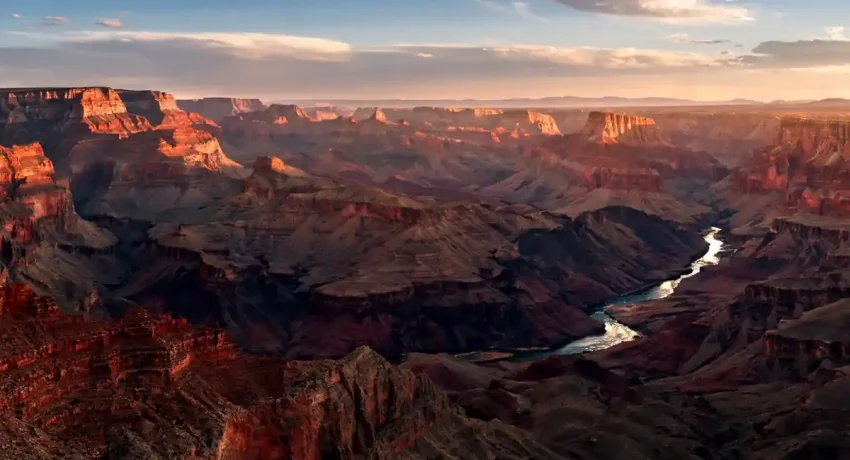

The Grand Canyon does not look real the first time you see it. The rim drops away in front of you, and the rock falls in layer after layer of red, orange and cream until it reaches the Colorado River, a mile below. It is 277 miles long, up to 18 miles wide and about a mile deep. Nearly five million people visit every year. Yet most of them see only one small corner of it. This guide covers the best place to visit at Grand Canyon in 2026, rim by rim, with real prices, real dates and honest warnings about what changed this year.
Here is the short answer. For a first visit, the best place to visit at Grand Canyon is the Grand Canyon South Rim. It stays open all year, it holds the famous viewpoints, and the free shuttles make it easy. For quiet and green forest, the North Rim is better, but 2026 is a recovery year there after a huge wildfire. For a glass bridge and a Las Vegas day trip, Grand Canyon West is the pick. For blue-green waterfalls, Havasu Falls is the dream, but it needs a permit that sells out fast. The rest of this guide helps you find the best place to visit at Grand Canyon for your trip.
Which Part of the Grand Canyon Should You Visit?
| Trip type | Go here | Why it fits |
|---|---|---|
| First visit, 1–2 days | South Rim | Open all year, most viewpoints, free shuttles |
| Quiet and cool forest | North Rim | Fewer crowds, 1,000 ft higher, but limited services in 2026 |
| Las Vegas day trip | Grand Canyon West | About 2 hours from Vegas, Skywalk, no $100 surcharge |
| Serious hiking | South Rim trails | Bright Angel and South Kaibab lead to the river |
| Waterfalls and swimming | Havasu Falls | Blue-green pools, but a $455 permit is required |
| Families with kids | South Rim | Short rim walks, museums, mule rides, easy shuttles |
| Photography at sunset | Hopi Point | West-facing views catch the last light on the buttes |
Why Is Mather Point the Best First Stop at the Grand Canyon?
Mather Point Grand Canyon sits a five-minute walk from the South Rim Visitor Center. It is the most popular viewpoint in the park for a reason. The canyon opens wide here, and you see the full depth in one glance. For most first-timers, the best place to visit at Grand Canyon is right here at Mather Point. Arrive early and you may have it almost to yourself. Arrive at midday and you will share it with a crowd.
Two tips make it better. First, walk a few minutes along the Rim Trail in either direction. The crowds thin fast, and the views stay just as good. Second, come back at sunrise. The light hits the rock in bands of gold and rose, and the air is still cool. The Rim Trail runs for 13 miles along the edge, mostly flat and paved, so you can walk as little or as much as you like.
What Can You Learn at Yavapai Point and the Geology Museum?
Yavapai Point looks east across the canyon, and the Geology Museum there explains what you are seeing. The rock layers span nearly two billion years of Earth history. A timeline trail outside the museum marks each million years with a step, so the scale becomes something you can feel in your legs.
This is the best stop for kids who ask “how” about everything. The exhibits are short and visual. The view from the museum windows is one of the finest on the rim. Allow 30 to 45 minutes. The free Orange Route shuttle stops here, or you can walk from Mather Point in about 20 minutes.
Where Is the Best Sunset at the Grand Canyon?
Hopi Point, on Hermit Road, is the classic sunset spot. The canyon opens to the west here, so the setting sun lights the buttes directly. Pima Point and Mohave Point, further along the same road, are quieter and nearly as good. Hermit Road is closed to private cars from March 1 to November 30, so you ride the free Red Route shuttle. That is a blessing, not a chore. No one has to drive, and everyone can watch the light.
Plan to arrive at least an hour before sunset. The shuttle fills up on the way back, so expect a queue after dark. Bring a layer. The rim sits near 7,000 feet, and the temperature drops fast once the sun goes down. If you want a sunrise instead, try Yaki Point, which faces east and draws far fewer people than Mather Point.
Why Is Desert View Watchtower Worth the Drive East?
Desert View sits 25 miles east of Grand Canyon Village, at the park’s quieter east entrance. The Watchtower there rises 70 feet above the rim. Mary Colter designed it in 1932, and it copies the shape of an ancient Ancestral Puebloan tower. Climb the stairs inside and each level opens a new window on the canyon and the Painted Desert beyond.
The drive itself is part of the reward. Desert View Drive takes about an hour each way, with pullouts at Grandview Point, Moran Point and Lipan Point. Tusayan Ruin, a small archaeological site with a museum, sits along the way. Come here on your arrival or departure day, when you are already driving in from Page or Flagstaff. It is the least crowded corner of the South Rim, and the light in the late afternoon is superb.
How Hard Is the Bright Angel Trail, Really?
Bright Angel is the most forgiving trail into the canyon, and it is still very hard. It starts beside Bright Angel Lodge in the village and drops about 4,400 feet to the Colorado River over roughly 9.5 miles. Most day hikers turn around far sooner. The first tunnel, after about half a mile, gives you a real taste of the inner canyon. Havasupai Gardens, 4.5 miles down, is a shady oasis with water and restrooms in season.
Three facts decide whether your hike goes well. First, the climb back up takes about twice as long as the walk down. Second, the canyon floor runs about 25 degrees hotter than the rim, so a pleasant 80-degree day on top can mean 105 degrees at the bottom. Third, water stations on Bright Angel are seasonal and can be switched off, so check the current status at the visitor center and carry more water than you think you need. The park rescues more than 250 people from the canyon every year, mostly for heat and dehydration. Start before sunrise in summer, carry at least three litres per person, and turn around when your water is half gone.
Is the South Kaibab Trail Better Than Bright Angel?
South Kaibab is steeper, shorter and more exposed than Bright Angel. It drops 4,720 feet in 7.1 miles to Phantom Ranch, with wide-open views the whole way down. Ooh Aah Point, less than a mile in, is one of the best viewpoints in the park. Cedar Ridge, at about 1.5 miles, makes a good turnaround for fit day hikers. The trailhead sits at 7,260 feet, and there is no water and almost no shade anywhere on the trail.
Choose Kaibab for the views and the descent. Choose Bright Angel for the climb back out, because it has shade, rest stops and water in season. Experienced hikers link the two into a loop of about 16.5 to 17.3 miles, down Kaibab and up Bright Angel, with roughly 4,800 feet of climbing. The park strongly advises against hiking to the river and back in a single day. If you try it, go in spring or autumn, start in the dark, and be honest about your fitness. Mules use both trails and always have the right of way, so step to the inside wall when they pass.
What Is the North Rim Like in 2026 After the Fire?
The Grand Canyon North Rim is the quiet side of the canyon, and 2026 is not a normal year there. On July 4, 2025, lightning started the Dragon Bravo Fire. It burned about 145,000 acres and destroyed the historic Grand Canyon Lodge along with roughly 98 other structures. The North Rim reopened for the 2026 season on May 15, but it came back stripped down.
Here is what that means in practice. All paved roads are open, including Highway 67, Cape Royal Road and Point Imperial Road. The big viewpoints, Cape Royal, Point Imperial, Roosevelt Point and Walhalla Overlook, are all reachable. The campground reopened on June 1, 2026, but it has no drinking water and no RV hookups. There is no overnight lodging inside the park on the North Rim in 2026, no restaurant, no visitor center and no drinking water anywhere on the rim. You must carry every drop you need, including at the trailheads.
Bright Angel Point Trail is closed for the 2026 season because of fire damage. The North Kaibab Trail closed on August 29, 2026 after a flash flood in Bright Angel Canyon, and the park had given no reopening date as of late September. That means a rim-to-rim hike is off the table until the park says otherwise.
None of that erases the views. The North Rim sits about 1,000 feet higher than the South Rim, so it is cooler and greener, with ponderosa pine and aspen instead of desert scrub. Only about 10 percent of the park’s visitors ever come here. Treat it as a self-sufficient day trip from Jacob Lake Inn, about 45 miles north, or from Kanab, Utah, about 80 miles north. Bring food, water and fuel, and check the park’s North Rim status page before you drive in. The season runs roughly May 15 to October 15, and services wind down from mid-October.
Is the Grand Canyon Skywalk Worth $99?
Grand Canyon West Rim is not part of the national park. It sits on Hualapai Tribe land, about two hours from Las Vegas, and it runs its own ticket system. Grand Canyon Skywalk tickets come only as part of a pass, and the pass you pick decides what else you can do. The Skywalk is a horseshoe-shaped glass bridge, 10 feet wide, that extends 70 feet out past the rim and 4,000 feet above the canyon floor. It opened on March 28, 2007. There is no Skywalk-only ticket any more.
The All-Access Pass costs $99 plus tax, or $113.85 all in, and it covers the Skywalk, the zipline, all three viewpoints, the hop-on hop-off shuttle, Hualapai-guided tours and exhibits, plus $10 off a meal and $10 off merchandise. A Sunset Pass costs $59 plus tax, or $67.85 all in, for entry after 3:00 p.m. General Admission is $67 plus tax and does not include the Skywalk, so do not buy it by mistake.
Two things make Grand Canyon West different from the national park. First, your National Park pass does not work here, and a West Rim ticket does not work at the South Rim. Second, the $100 non-resident surcharge does not apply here, because the land is tribal, not federal. That makes it the cheapest canyon option for international visitors coming from Las Vegas. For many visitors, the best place to visit at Grand Canyon from Las Vegas is Grand Canyon West. The views are dramatic, but the canyon here is narrower and the experience is more commercial than the South Rim. Go for the Skywalk and the easy Vegas day trip, not for quiet hiking.
How Do You Get a Havasu Falls Permit in 2026?
Havasu Falls is the blue-green waterfall that fills every travel feed, and it is the hardest place in this guide to reach. It sits on Havasupai Tribal land, in a side canyon of the Grand Canyon, and it is not part of the national park. The tribe runs its own permit system, and the rules changed completely for 2026. The old lottery is gone. Early access ran from January 21 to 31, for an extra $40 per person. The general sale opened on February 1 at 8:00 a.m. Arizona time, first come, first served.
A Havasu Falls permit 2026 costs $455 per person for a fixed 3-night, 4-day stay. There are no shorter stays and no day hiking at all. A lodge room costs $2,277 for three nights, sleeping up to four people. Permits are strictly non-transferable and cannot be resold. Cancel 90 days or more ahead and you get a 50 percent refund. Pack mules cost around $400 round trip to carry gear between Hualapai Hilltop and the campground. The hike itself is about 10 miles each way, mostly downhill in and uphill out, with the falls another two miles past the village of Supai. If you want to go in 2027, set a reminder for the January early-access window and the February 1 sale, because the best dates sell out within hours.
What Is Phantom Ranch, and Can You Stay There?
Phantom Ranch Grand Canyon sits at the bottom of the canyon, beside the Colorado River, at about 2,480 feet. It was built in 1922, and it is the only lodging below the rim. Cabins and dorm beds there are booked through a lottery that opens more than a year ahead, and demand far outstrips supply. A stay includes meals served family-style in the canteen, and the ranch is the turnaround point for the great rim-to-river hikes.
Most visitors will never sleep there, and that is fine. You can still touch the river on a day hike and climb back out, or you can camp at Bright Angel Campground nearby with a backcountry permit. One honest warning: the overnight mule rides to Phantom Ranch are cancelled through February 28, 2027 because of trail conditions. The three-hour Canyon Vistas rim ride, the classic Grand Canyon mule ride for day visitors, still runs on the South Rim, from about $100 per person, with a 225-pound weight limit. Check current prices before you book, because they change with the season.
Is the Grand Canyon Railway Worth It?
The Grand Canyon Railway runs 65 miles from Williams, Arizona, to the South Rim, through ponderosa pine forest and high desert. The trip takes two hours and 15 minutes each way. The train leaves Williams at 9:30 a.m. from January to October and returns at 5:45 p.m., which leaves about three hours and 45 minutes at the canyon. There is no regular service on December 25. In 2026 the railway marks its 125th anniversary, with extra steam-powered trips on the first Saturday of each month from March to October.
Grand Canyon Railway tickets start from about $89.98 for Coach, $169.98 for First Class, $199.98 for the Observation Dome and $239.98 for the Luxury Dome and Luxury Parlor, based on gate prices checked in October 2026. Children under two ride free in most classes. The train is the best option if you hate driving, if you want a car-free day, or if you are travelling with kids who will love the onboard musicians and the mock train robbery on the return leg. It is not the best option if you want a full day at the rim, because three hours and 45 minutes only covers the village viewpoints. Drive yourself if you want sunrise and sunset in one day.
How Much Does a Grand Canyon Helicopter Tour Cost in 2026?
Helicopter tours leave from Grand Canyon National Park Airport in Tusayan, just outside the South Rim entrance. They are air-only flights, 25 to 50 minutes long, over the widest and deepest parts of the canyon. Helicopters may not land below the rim inside the national park, so anyone selling a South Rim landing tour is selling something that does not exist.
Grand Canyon helicopter tour price in 2026 runs from $269 to $399 per person. A 30-minute EcoStar flight from Grand Canyon Helicopters starts at $269, and a 50-minute flight costs $399. Papillon runs a 25-minute Canyon Classic from $299 and a 45-minute Grand Kingdom from $354. Maverick flies a 45-minute Canyon Spirit from $399, and its shorter Canyon Dancer from $369. Add fuel surcharges of $15 to $35 and optional front-seat upgrades of $50 to $60. Book the 45-minute flight if you can afford it. The extra time covers the Dragon Corridor, the North Rim and the Desert View Watchtower, which the short flights skip. Morning light is softer and the air is calmer, so take the earliest slot you can get.
From Las Vegas, the maths change. Landing tours that drop to the canyon floor run from about $505 to $739 per person, and they all go to Grand Canyon West, not the national park. They include hotel transfers and a champagne picnic, and they take four to four and a half hours door to door. If you only want to fly over the canyon, the South Rim flights are cheaper and the views are better.
When Is the Best Time to Visit the Grand Canyon?
| Month | What it is like | Who it suits |
|---|---|---|
| March to May | Mild days, cold mornings, wildflowers, thin crowds | Hikers and first-timers |
| June to August | Hot rim, very hot canyon floor, afternoon storms | Families on school holidays, early risers |
| September to October | Warm days, cool nights, golden aspen, fewer crowds | Photographers and hikers |
| November to February | Cold rim, snow possible, quiet trails, possible ice | Budget travellers and solitude seekers |
April, May, September and October are the best time to visit Grand Canyon for most people. The rim sits near 7,000 feet, so summer days reach the low 80s Fahrenheit up top while the canyon floor passes 100 degrees. Winter brings snow and ice to the rim trails, and the North Rim closes entirely. Spring and autumn give you the best balance of weather, light and crowd levels. If you can only go in summer, start hikes before sunrise, rest in the shade at midday, and watch the sky. Summer thunderstorms build fast, and the canyon is the last place you want to be in lightning. The February guide covers winter travel ideas if you are planning a cold-season trip.
How Much Does a Grand Canyon Trip Cost in 2026?
| Item | Cost in 2026 | Notes |
|---|---|---|
| Park entry, private vehicle | $35 for 7 days | Covers everyone in the car |
| Park entry, motorcycle | $30 for 7 days | Per motorcycle |
| Park entry, walk-in or cyclist | $20 per person | Per person, 7 days |
| Non-resident surcharge | $100 per person, 16 and over | On top of entry, at 11 parks |
| America the Beautiful pass | $80 resident, $250 non-resident | Covers entry and surcharge |
| Skywalk All-Access Pass | $99 plus tax | Grand Canyon West, not the park |
| Helicopter, South Rim | $269 to $399 per person | 25 to 50 minutes, air only |
| Grand Canyon Railway | From $89.98 round trip | Coach class, Williams to South Rim |
| Havasu Falls permit | $455 per person | 3 nights, fixed, no day hiking |
| Mule ride, Canyon Vistas | From about $100 per person | 3-hour rim ride, check current price |
The Grand Canyon entrance fee 2026 is $35 per vehicle, but the big change for 2026 is the non-resident surcharge. Since January 1, 2026, every non-U.S. resident aged 16 and over pays an extra $100 per person to enter 11 of the most visited national parks, including the Grand Canyon. The surcharge sits on top of the standard $35 vehicle fee, so two non-resident adults in one car pay $235 at the gate. It is not waived on fee-free days, and it does not apply at Grand Canyon West. The $250 non-resident America the Beautiful pass waives the surcharge and covers everyone in your private vehicle, so it pays for itself on your second surcharge park. The same $100 rule applies at Rocky Mountain National Park, as the Colorado guide explains. Green card holders count as residents and do not pay. Children under 16 are exempt.
Is the Grand Canyon Safe for Kids and Solo Travellers?
The Grand Canyon is safe for families and for solo travellers, and these Grand Canyon safety tips cover both. A Grand Canyon with kids trip starts with one rule: there are no guardrails along most of the Rim Trail, so hold small children by the hand and keep them off the rocks at the edge. The drop is about a mile, and every year people die from falls. Stay behind the stone walls at the viewpoints.
Heat is the bigger danger. The canyon floor runs about 25 degrees hotter than the rim, and the climb out is long and steep. Give each child their own water bottle and a salty snack, and turn around when the water is half gone. The Rim Trail, the museums and the shuttle buses are all easy for kids, and the Junior Ranger programme gives them a mission for the day. For a family beach break after the desert, the Florida beaches guide is a good next stop.
Solo travellers have nothing special to fear beyond the same heat and edge rules. The South Rim is busy, the shuttles are free, and the trails are well travelled, so you are rarely alone for long. Tell someone your hiking plan, carry a charged phone, and do not hike below the rim alone in summer heat. The single woman travel guide has practical solo-travel tips that work just as well at the canyon. If the desert heat makes you dream of the ocean instead, the Hawaii guide covers the islands that pair well with a Southwest road trip.
What Is the Best 3-Day Grand Canyon Itinerary?
Day one of this Grand Canyon itinerary 3 days plan is for the South Rim viewpoints. Arrive by late morning, park at the Visitor Center, and walk Mather Point and the Rim Trail to Yavapai Point. Ride the Red Route shuttle to Hopi Point for sunset. Eat in the village and sleep at Maswik Lodge or Bright Angel Lodge, or in Tusayan just outside the park if the lodges are full. Book in-park lodging months ahead, because it sells out.
Day two is for going below the rim. Start before sunrise on the Bright Angel Trail, hike to the first tunnel or to Havasupai Gardens, and climb back out before the heat peaks. Rest in the afternoon at the Geology Museum and the historic El Tovar hotel, which opened in 1905. In the evening, drive Desert View Drive to the Watchtower and watch the light change on the Painted Desert.
Day three is for something different. Take the morning helicopter flight from Tusayan, or ride the Grand Canyon Railway from Williams. If you have a fourth day, drive to Horseshoe Bend and Antelope Canyon near Page, about two and a half hours away. For a romantic sunset to end the trip, Hopi Point at dusk is hard to beat, and the summer honeymoon guide has ideas for turning a canyon trip into a honeymoon. The Grand Canyon also belongs on any list of the most interesting places in the world, and it earns its place there.
Frequently Asked Questions
How many days do you need at the Grand Canyon?
Two full days cover the South Rim viewpoints and one hike below the rim. Three days let you add a helicopter flight, the railway or Desert View Drive without rushing. One day is enough for the viewpoints and a short rim walk, but you will leave wishing you had stayed longer.
Can you visit the South Rim and North Rim in one day?
No. The rims sit only about 10 miles apart as the crow flies, but the drive between them is 215 miles and takes four and a half to five hours. Choose one rim per trip. In 2026 the North Rim is a day trip only, with no in-park lodging.
Do you need a reservation to enter Grand Canyon National Park?
No. Entry is first come, first served at the gate, and no timed-entry reservation is needed for 2026. Helicopter tours, mule rides, Phantom Ranch and Havasu Falls all need bookings, sometimes months ahead.
Is the Grand Canyon free on fee-free days in 2026?
The standard $35 vehicle fee is waived on fee-free days for U.S. residents, but the $100 non-resident surcharge is not waived. Check the park’s fee-free calendar before you go, because the dates change every year.
What should you wear to the Grand Canyon?
Layers, always. The rim is cool in the morning and warm by midday, and the canyon floor is far hotter. Wear a hat, sunscreen and sturdy shoes with grip. In winter, bring traction devices for icy rim trails.
Is the Grand Canyon open in winter?
The South Rim is open all year, with snow and ice on the trails in winter. The North Rim closes for winter, roughly mid-October to mid-May. Grand Canyon West stays open year-round, with shorter winter hours.
The best place to visit at Grand Canyon in 2026 is the South Rim for most people, the North Rim for quiet if you come prepared, and Grand Canyon West for a fast trip from Las Vegas. Whatever you choose, book lodging and tours early, carry more water than you think you need, and give the canyon more than one day. It took the Colorado River millions of years to carve this place. It deserves more than a quick photo stop.