
Type a company name into a search box and you expect a website, an address, and a list of services. Sometimes you get none of those. That is what happened with the name behind this guide. “Ozlem Yilmaz Innova Logistics” sounds like a logistics firm. No such firm shows up in any public record. The name Ozlem Yilmaz does exist in the logistics world, but not as a company. She is a researcher at Bilkent University in Ankara, Turkey, in the Department of Industrial Engineering. Her 2025 paper in the journal Sustainability reviews inventory pooling, a real technique for cutting stock while keeping service levels high. She also works at ASELSAN, the Turkish defence electronics company. No public record links her to any company called Innova Logistics.
The name Innova points somewhere else. The best-known Innova in Turkey is İnnova Bilişim, an IT company based in Maslak, Istanbul. It builds software, system integration, and telecom solutions. Logistics is not its business. Other firms share the name too. There is a trading company called Innova LLC in Kyiv, Ukraine. Istanbul also has an Innova Makina that builds conveyor systems. None of them is a freight or supply chain company called Innova Logistics. So this guide does the honest thing. It does not invent a company profile. Instead, it answers the real question behind the title. How do global supply chains deliver precision and speed in 2026, and how do you pick a partner who can actually do it?
That question matters more now than it did five years ago. Global supply chains used to run on habit. A buyer ordered from the same supplier, on the same lane, at the same price, year after year. Then came a pandemic, a blocked canal, a war, and a wave of tariffs. Habit stopped working. The companies that coped best were the ones that could see trouble early and move fast. In 2026, precision and speed are no longer nice extras. They are the whole game.
What Does Precision and Speed Actually Mean in 2026?
People use the words loosely. A logistics salesperson will promise both in the same breath. But each word has a hard meaning in this industry. Precision means the right goods arrive at the right place, in the right condition, on the promised day. Speed means the time between order and delivery is short and steady. A fast shipment that arrives three days late is not precise. A precise shipment that takes eight weeks is not fast. You need both, and you need proof of both.
Buyers measure them with a small set of numbers. The most common is OTIF, which stands for on time in full. It counts the share of orders that arrive complete and on the promised date. A supplier at 95 percent OTIF is good. At 80 percent, you will feel the problem every month. Lead time is the second number. It runs from the day you place an order to the day the goods reach your dock. Short lead times let you hold less stock. Long ones force you to buy early and guess more. Forecast accuracy is the third. It measures how close your demand forecast came to real sales. Better forecasts mean fewer stockouts and less dead stock. Cost per shipment is the fourth. It is the full landed cost, not just the freight rate. Surcharges, storage, demurrage, and rework all count.
| Measure | What it tells you | What good looks like |
|---|---|---|
| OTIF (on time in full) | Share of orders complete and on the promised date | 95 percent or higher |
| Lead time | Days from order to delivery at your dock | Short and steady, not just short |
| Forecast accuracy | How close demand forecasts came to real sales | Improving quarter by quarter |
| Cost per shipment | Full landed cost, including surcharges and storage | Visible in writing, no surprise add-ons |
| Exception closure time | How fast problems get fixed when things go wrong | Hours, not days, with a named owner |
Ask any logistics partner for these five numbers before you sign. A serious partner will have them. A partner who only talks about low rates probably does not. Rates are easy to quote. OTIF is hard to fake.
Why Did Supply Chains Get So Hard to Run?
For thirty years, global supply chains ran on a simple model. Make goods where labour is cheapest, ship them by sea in huge volumes, and hold just enough stock to cover the next order. It worked while trade rules were stable and fuel was cheap. Then the model broke in several places at once.
Geopolitics changed first. Trade policy is now the top supply chain trend for 2026, according to the Association for Supply Chain Management (ASCM). Tariffs shift with little warning. Sanctions lists grow. Some governments now push companies to build at home or near home. The old “China plus one” sourcing plan has grown into something wider. Companies now spread production across several regions at once, in Mexico, Vietnam, Eastern Europe, and parts of Africa. That spreads risk, but it also adds complexity. Every new country means new customs rules, new paperwork, and new failure points.
Shipping itself got less predictable too. The Red Sea crisis pushed many carriers around the Cape of Good Hope, adding days to Asia-Europe voyages. The Suez Canal saw fewer transits. Port congestion still flares up, and carriers cancel sailings when demand dips. Drewry counted 44 blank sailings across weeks 43 to 47 of 2026, about 6 percent of planned East-West departures. A blank sailing means your container simply does not move that week. If your plan assumed it would, you are already late.
Customers changed as well. Online buyers now expect same-day or next-day delivery as normal. That expectation has crept into business buying too. A buyer who gets a parcel in two hours at home wonders why a business order takes three weeks. The answer is that business freight is harder. It crosses borders, clears customs, and moves in bulk. But the pressure is real. Speed is now a promise your customers can check, not a slogan on your website.
What Is Changing in Global Supply Chains in 2026?
Five forces are doing most of the work this year. They lead every supply chain trends 2026 roundup worth reading. None of them is new. All of them are now too big to ignore. Together, they explain why some supply chains feel fast and precise while others feel stuck.
How Is AI Changing the Supply Chain?
Artificial intelligence is the top trend on ASCM’s 2026 list, and for good reason. It has moved from experiments to daily use. AI in supply chain work now covers planning, warehousing, and transport in one sweep. Machine learning now reads real-time market data, weather, port congestion, and order patterns together. That makes forecasts sharper and plans steadier. In warehouses, AI picks the fastest route for each order. On the road, it adjusts delivery routes as traffic and weather change.
The newest step is agentic AI logistics. These systems do not just suggest a change. They make small decisions on their own, like rerouting a truck or shifting stock between warehouses. Humans still set the rules and watch the results. But the routine choices happen faster than any person could make them. The catch is that AI tools are not flawless. Companies that pair AI with real human oversight get the best results. Those that trust the software blindly get surprises.
What Does Warehouse Automation Actually Do?
Warehouses are where speed is won or lost. A manual warehouse depends on people walking miles a day between shelves. An automated one uses robots, smart conveyors, and automated storage systems to bring goods to the picker. Picking robots and autonomous mobile robots now handle much of the repetitive work. Labour shortages and rising delivery expectations are pushing this change faster. New distribution centres are now built with automation in mind from day one, with high power capacity and layouts that suit robots. The result is faster fulfilment and fewer errors. It also cuts the cost of each order. But automation is not magic. A badly designed automated warehouse is just an expensive slow one. Layout, software, and maintenance matter as much as the robots.
Why Does Visibility Matter So Much?
You cannot manage what you cannot see. Supply chain visibility is the foundation of all of it. That old line is now literal. Modern supply chains use IoT sensors, real-time tracking, and control towers to watch every shipment. A control tower is a single screen that shows all your freight, all your stock, and all your delays in one place. When a port closes or a truck breaks down, you see it at once. You can then act before the customer notices. A digital twin supply chain model takes this further.
It is a live virtual copy of your whole supply chain, fed by real data. Managers can test a change in the twin before they try it in the real world. What happens if we move this stock to Mexico? Or if the Suez route closes again? The twin gives an answer in minutes. ASCM calls digital twins the main tool for agility and resilience in 2026. Visibility also helps with traceability. When a product is recalled, you can trace every batch to its source. That saves money and protects your brand.
What Is Nearshoring, and Does It Work?
Nearshoring means moving production closer to your customers. A US company might shift some work from China to Mexico. A European company might move some to Eastern Europe or North Africa. The idea is simple. Shorter distances mean shorter lead times and fewer border crossings. They also mean less exposure to distant disruptions. Dual sourcing is a related move. Instead of one supplier for a key part, you keep two in different regions.
If one fails, the other keeps you running. These moves cost money up front. New factories, new contracts, and new quality checks all take time. But many companies now see that cost as insurance. The risk of a single distant supplier has grown too large to ignore. Nearshoring is not right for every product. Cheap, light, high-volume goods may still suit long ocean routes. Heavy, urgent, or sensitive goods usually do not. That is what a resilient supply chain looks like in practice.
Is Sustainability Still a Priority?
Yes. Supply chain sustainability is now a commercial issue, not just a moral one. Customers ask for carbon numbers. Regulators ask for proof. Large buyers now score suppliers on emissions and packaging waste. Logistics is a big part of that score. Route optimisation cuts fuel use. Better packaging cuts waste. Circular supply chains take back used products and reuse the materials. Digital product passports track each item through its life, which helps with recycling and recalls. Companies that can report lane-level emissions have an edge in tenders. Those that cannot are starting to lose deals. Sustainability and speed often pull in the same direction. A shorter route burns less fuel and arrives sooner. A fuller truck costs less per unit and emits less per unit. The two goals are not enemies. They are often the same choice.
How Does Freight Actually Move?
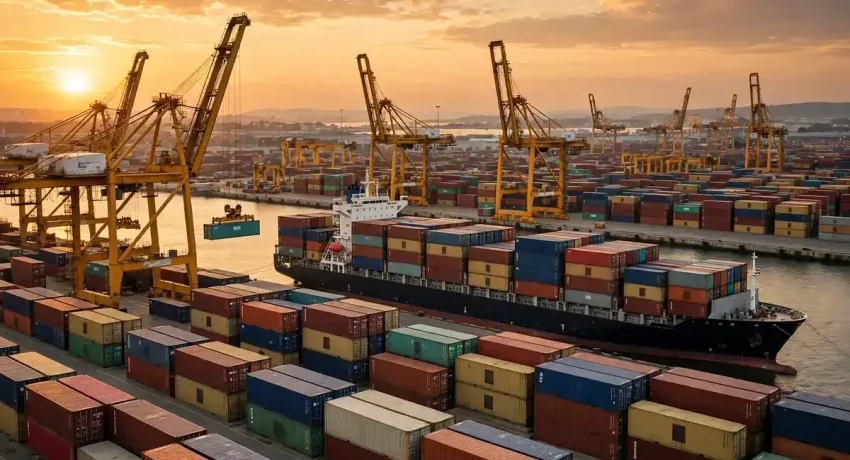
Most goods travel by one of four modes, and most international shipments use at least two. Ocean freight carries the bulk of world trade. It is cheap per unit and slow. A container from Shanghai to Los Angeles takes about two weeks at sea, plus port and inland time. Air freight is fast and dear. It suits small, light, urgent, or high-value goods. Road freight is the workhorse of domestic and regional delivery. Rail sits between road and ocean on cost and speed, and it suits long inland routes. The skill is matching the mode to the cargo. A fashion launch needs air. A bulk commodity needs ocean. A regional restock needs road.
| Mode | Best for | Speed | Cost |
|---|---|---|---|
| Ocean | Bulk, heavy, low-urgency goods | Slow (weeks) | Lowest per unit |
| Air | Urgent, light, high-value goods | Fast (days) | Highest per kilo |
| Road | Regional and last-mile delivery | Fast (hours to days) | Medium |
| Rail | Long inland routes, heavy loads | Medium (days) | Low to medium |
Three kinds of company move your freight, and the difference matters. A freight forwarder organises transport end to end. It books space, handles documents, arranges customs brokerage, and tracks the shipment. Ships and planes are usually owned by carriers, not by the forwarder. An NVOCC, short for non-vessel operating common carrier, acts like a carrier for ocean freight without owning vessels. It buys space from vessel operators, consolidates cargo, and issues its own house bill of lading. A carrier owns or operates the vessel, aircraft, or trucks, and moves the shipment on its own network.
A forwarder can act as a light 3PL for some lanes. The 3PL vs 4PL choice comes down to scope. A 3PL, or third-party logistics provider, handles warehousing and distribution as well as transport. A 4PL goes further and manages the whole supply chain on your behalf. Before you sign, ask who issues the bill of lading and who you call at 6 p.m. when a truck misses its pickup. Vague answers mean you are talking to a quote generator, not a partner.
What Does Precision Look Like in Practice?
Big ideas only help if they change daily work. Four practices do most of the heavy lifting in a precise supply chain.
How Does Demand Forecasting Work?
Forecasting used to mean looking at last year’s sales and adding a guess. That no longer works. Demand now shifts with social media trends, weather, promotions, and politics. Modern forecasting feeds all of that into a model. It reads sales history, market signals, and external events together. The output is a range, not a single number. A good forecast says demand will land between 8,000 and 9,500 units, with the most likely value near 8,800. Planners then stock for the likely value and hold a small buffer for the top of the range. The result is fewer stockouts and less dead stock. No forecast is perfect. The goal is to be wrong by less, and to spot the error sooner.
What Is Inventory Pooling?
Inventory pooling is a simple idea with a strong payoff. Instead of holding separate safety stock at every warehouse, you hold a shared pool in fewer places. Demand spikes at one location get covered from the pool. The maths behind it is real. When demand varies across locations, a shared pool needs less total stock than separate piles. Ozlem Yilmaz, the Bilkent University researcher named in the old title of this post, reviewed fourteen years of studies on this technique in 2025. Her review found that pooling cuts costs and lifts service levels in healthcare, retail, and transport and logistics. Hospitals pool blood supplies. Retailers pool stock across stores. Logistics firms pool pallets. The lesson is the same in each case. Shared stock beats scattered stock, as long as you can move it fast when it is needed.
How Do Warehouses Get Faster?
Speed in a warehouse comes from layout and flow, not just effort. Fast-moving goods sit near the packing area. Slow goods sit further back. Orders get picked in waves, so one trip covers many orders. Automated storage systems bring shelves to the picker instead of sending the picker to the shelves. Smart conveyors sort parcels by destination without a human touch. Each step shaves seconds. Seconds add up to hours across a thousand orders. The best warehouses also measure everything. They track picks per hour, error rates, and dock-to-stock time. When a number slips, they fix the process, not the person.
Why Is the Last Mile So Hard?
Last mile delivery is the final leg from a local hub to the customer’s door. It is the most expensive part of delivery, often more than half the total cost. The reason is simple. A truck that carries a thousand parcels across a country is efficient. A van that carries twenty parcels across a city is not. Traffic, failed deliveries, and narrow time windows all add cost. Companies now fight back with route software, parcel lockers, and micro-fulfilment centres inside cities. Drones and autonomous vans are starting to help in some areas. But the human part still matters. A driver who knows the area beats a perfect route plan that ignores a closed road. Last-mile success needs both the software and the driver.
What Does Shipping Cost in 2026?
Ocean freight rates move every week, so any figure here is a snapshot, not a promise. The benchmark most shippers watch is Drewry’s World Container Index. It tracks spot rates on eight major East-West lanes. On 29 October 2026, the composite index stood at $4,429 per 40-foot container, down 3 percent on the week. The Shanghai to Los Angeles lane was $7,514 per 40-foot box, down 6 percent. Shanghai to New York was $9,631. Rotterdam came in at $3,686, and Genoa at $4,151. A week earlier, on 22 October, the composite had been $4,585, its highest in 15 weeks. Rates had roughly doubled from an April low of $2,309. That swing shows why timing matters. The same container can cost twice as much in October as it did in April.
| Lane (per 40ft container) | 29 October 2026 | Weekly change |
|---|---|---|
| Shanghai to Los Angeles | $7,514 | Down 6% |
| Shanghai to New York | $9,631 | Down 5% |
| Shanghai to Rotterdam | $3,686 | Up 1% |
| Shanghai to Genoa | $4,151 | Stable |
| Drewry composite index | $4,429 | Down 3% |
Source: Drewry World Container Index, 29 October 2026, via FreightWaves and Forwarder News.
The headline rate is only part of the bill. Surcharges add a lot. Panama Canal surcharges of $100 to $130 per TEU still apply on some routes. Fuel surcharges move with oil prices. Terminal handling, documentation, and customs fees all stack up. GoFreight, a freight software firm, reports that quotes for the same lane often vary by 30 to 60 percent between forwarders. The lowest quote also tends to close 15 to 30 percent higher than the winning number, because assumed surcharges reset upward on the invoice. That is why smart buyers compare total landed cost, not headline rates. Get the full quote in writing, with every surcharge named.
How Do You Choose a Logistics Partner?
Knowing how to choose a logistics partner is the most important skill in this whole guide. A good partner makes your supply chain faster and cheaper. A bad one makes every shipment a gamble. Here is how to choose well.
Start with a portfolio, not a single provider. Logistics Concepts, a freight consultancy, suggests a split. Core partners should carry 60 to 80 percent of your volume on your main lanes. Secondary partners take 15 to 30 percent for peak cover and alternate routes. Specialists take 5 to 15 percent for hard jobs like temperature control, dangerous goods, or oversize cargo. Keep 10 to 20 percent of volume open for spot bookings. That mix gives you price tension and a backup plan at the same time. One provider for everything is a risk. Ten providers with no plan is chaos.
Then check six things on every shortlisted partner. First, network fit. Do they have real capacity on your lanes, not just a map with dots? Ask how many containers or air tonnes they move on your lane each month. Second, operational skill. Ask about cut-offs, transit reliability, exception handling, and claims. Third, commercial honesty. Are surcharges governed in writing? Can you audit an invoice? Fourth, data and visibility. Do they offer milestone tracking, EDI or API links, and clean documents? Fifth, compliance. Do they hold customs licences in-house? Does the partner screen for sanctions? Can they handle dangerous goods? Sixth, financial strength. A partner who goes bust mid-season leaves your cargo stranded. Ask for trade references and years in operation.
Before you sign, ask these questions. Who issues the bill of lading? And who is my contact at 6 p.m. when a truck misses pickup? What is your filing accuracy rate over the last twelve months? How do you handle a claim? What are your service levels, in writing, with penalties? A partner who answers clearly is worth more than a partner who quotes low. Put service levels and key metrics into the contract. OTIF, lead time, exception closure time, and invoice accuracy should all have numbers attached. Review them every quarter. A contract without numbers is a wish, not a deal.
What Are the Red Flags?
Some signs should make you walk away. A quote far below every other bidder usually hides surcharges that appear later. Vague answers about who handles customs or who owns a delay are a warning. No tracking system in 2026 is a warning too. A partner who cannot show you where your freight is cannot manage it. No insurance or no clear claims process is another. So is a company that will not name references on your lane. Finally, watch for single-person dependency. If only one person at the firm knows your account, your supply chain depends on their holiday plans. Good partners have teams, systems, and cover.
Frequently Asked Questions
What is a freight forwarder?
A freight forwarder is a company that arranges and manages transport on your behalf, usually across borders and across several carriers. It books space, handles documents, arranges customs clearance, and tracks the shipment. Ships and planes belong to carriers, not to the forwarder. Its value is coordination, not assets.
What is the difference between a 3PL and a 4PL?
A 3PL, or third-party logistics provider, handles transport, warehousing, and distribution for you. A 4PL goes further. It manages your whole supply chain, including other 3PLs, and acts as your logistics department. Small firms usually start with a forwarder or a 3PL. Large firms with complex networks sometimes move to a 4PL.
How much does it cost to ship a container in 2026?
It depends on the lane and the week. Drewry’s World Container Index put the Shanghai to Los Angeles spot rate at $7,514 per 40-foot container on 29 October 2026, and Shanghai to Rotterdam at $3,686. Surcharges, handling, and customs add more. Get a full written quote for your lane before you budget.
What is inventory pooling?
Inventory pooling means holding shared safety stock in fewer places instead of separate piles at every warehouse. Demand spikes at one location get covered from the shared pool. Research reviewed by Ozlem Yilmaz of Bilkent University in 2025 shows pooling cuts costs and lifts service levels in healthcare, retail, and logistics.
Is nearshoring always cheaper?
No. Nearshoring cuts lead times and risk, but unit costs can be higher than in distant low-cost regions. It suits heavy, urgent, or sensitive goods best. Cheap, light, high-volume goods may still suit long ocean routes. Compare total landed cost, not just the factory price.
How do I know if my logistics partner is good?
Check the numbers. OTIF above 95 percent, steady lead times, fast exception closure, and accurate invoices are the signs of a good partner. Ask for the data before you sign, and review it every quarter. A partner who shares numbers openly is usually a partner you can trust.
Sources: ASCM Top 10 Supply Chain Trends for 2026 (via MHL News); Middlebank Consulting Group eight tech trends for 2026 (via Transporttalk); Supply Chain Channel 2026 predictions; GoFreight Ultimate Guide to Freight Forwarders 2026; Logistics Concepts key carriers and forwarders guide; Siam Shipping Freight Forwarder Selection Guide 2026; Drewry World Container Index, 29 October 2026; Yilmaz, O., “A Literature Review on Inventory Pooling with Applications”, Sustainability, 2025, 17(2), 797.