
Most people have never heard of Komyo Logistics. Yet if you drive a Honda in the United States, its work has probably touched your car. Komyo is the third-party logistics arm of Honda Logistics North America, and it moves the parts, crates, and inventory that keep Honda’s American supply chain running. It also sells the same service to companies that have nothing to do with Honda.
So what is Komyo Logistics, exactly? How does it work, and who should consider it? This guide answers those questions with verified facts: the company’s Honda roots, its four warehouses, its patented reusable crates, and the technology behind it. It also puts Komyo in the wider global supply chain 2026 picture, so you can judge any 3PL partner with the same lens.
What Is Komyo Logistics?
Komyo Logistics is a third-party logistics (3PL) provider and a subsidiary of Honda Logistics North America, Inc. A 3PL is a company that handles warehousing, distribution, and related logistics work on behalf of other businesses. Komyo’s home turf is the automotive and power equipment industries, where it stores finished goods, picks and packs orders, and ships them to dealers, distributors, and end customers.
The name itself comes from Japanese. Komyo translates to “bright light,” “hope,” or “a promising future,” and the company leans into that meaning in its own hiring and brand messages. Behind the name sits a serious operation: large warehouses, a web-based warehouse management system, and a crate program that has been running for years inside Honda’s own network.
| Fact | Detail |
|---|---|
| Company type | Third-party logistics (3PL) provider |
| Parent company | Honda Logistics North America, Inc. |
| Core industries | Automotive and power equipment |
| 3PL services launched | 2012, at Modex in Atlanta |
| Warehouse locations | Chino, CA; Troy, OH; Loudon, TN; China Grove, TX |
| Warehouse system | Logiwa web-based WMS, with EDI support |
| Signature program | Patented reusable shipping crates (“green logistics”) |
| Experience | Nearly 20 years, per its Fulfill.com profile |
One thing to note early: Komyo does not publish prices. Rates are quoted per client, based on order volume, storage needs, and services. That is normal for a 3PL of this type, but it means you cannot compare Komyo on price without talking to the company first.
Where Did Komyo Logistics Come From?
Komyo grew out of Honda’s own parts business. Honda Komyo was created to sell and ship aftermarket parts to American Honda’s distribution centers, which in turn supply Honda dealers. By 2009, it was already running three large US warehouses for Honda Logistics, ranging from 500,000 to 800,000 square feet each. The operation was built to serve one customer: Honda.
That changed around 2012. In January of that year, Komyo Logistics officially launched its 3PL services at Modex 2012 in Atlanta, offering warehousing, distribution, crate manufacturing and management, and transportation management to outside companies. Gregory Healy, then a vice president at Komyo, put the pitch plainly: “Outsourcing logistics enables companies, especially small to mid-sized ones without established distribution networks, to grow considerably faster than they otherwise could.” The point was that Komyo could lend smaller firms the same networks Honda had built for itself.
At the time, the parent company set a clear goal. Honda Komyo was told to expand beyond Honda customers, with the new channel eventually making up half of its sales. That goal explains much of what Komyo looks like today: a Honda-backed operator that actively courts mid-sized companies in automotive and power equipment, rather than a captive warehouse arm.
What Services Does Komyo Logistics Offer?
Komyo’s service list is narrower than a generalist 3PL, and that is deliberate. It does a small set of things for a specific set of industries. Here is what the company lists. Automotive logistics is the core business, and power equipment logistics runs a close second.
How Does Komyo Handle Warehousing and Distribution?
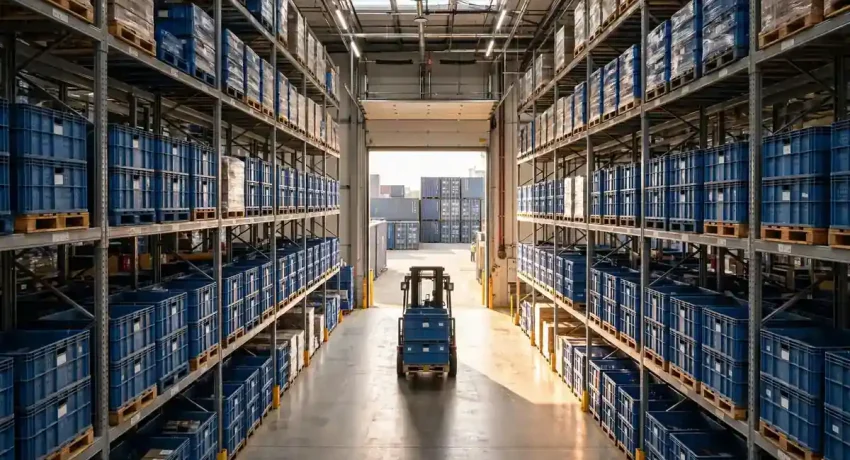
Warehousing is the core. Komyo stores finished goods, manages inventory, and runs distribution out of its four US warehouses. The focus is automotive and power equipment products: parts, accessories, and finished goods that need careful handling and accurate picking. Distribution runs both to dealers and direct to customers, depending on the client’s model.
The warehouses sit near Honda’s own network for a reason. The distribution center Troy Ohio hub is the Midwest base, next to Honda’s parts operations. Chino, California, anchors the West Coast. Loudon, Tennessee, covers the Southeast, and China Grove, Texas, covers the South Central region. Together, the four sites give Komyo coverage across the continental United States.
What Is Lean Processing in a Komyo Warehouse?
Komyo lists lean processing among its services. In a warehouse, lean processing means cutting waste out of every step: fewer touches per order, shorter travel paths for pickers, and tighter inventory control. Honda’s manufacturing system is famous for lean thinking, and Komyo inherited that discipline from its parent. For a client, the practical result is fewer errors and faster turns, not a slogan on a wall.
What Light Assembly and Kitting Work Does Komyo Do?
Light assembly and kitting are value-added services that go beyond pick, pack, and ship. Kitting means grouping separate items into one ready-to-ship package, such as a parts kit or a promotional bundle. Light assembly covers simple build steps, like fitting components together before dispatch. Komyo also handles labeling, relabeling, and repackaging. These services matter most to automotive and power equipment clients, whose products often ship as kits rather than single items.
What Is Komyo’s Crate Manufacturing and Management Program?
The crate program is Komyo’s signature. The company designs, makes, and manages patented reusable shipping crates, a service it calls “green logistics.” The idea is simple: a durable crate that survives many trips replaces cardboard and single-use packaging, cutting both waste and damage. Komyo’s crates are built around the inside dimensions of a 53-foot trailer, so they pack the trailer as tightly as possible.
Crates are not a side business for Komyo. They are the thread that runs through its Honda history, and they deserve a closer look.
Does Komyo Offer Transportation Management?
Yes. Transportation management is part of the service list, covering the planning and coordination of freight movement. Komyo’s public profiles say less about this than about warehousing, so the detail is thinner. The company’s strength, on the available evidence, is the warehouse and crate operation, with transport arranged around it.
What Makes Komyo’s Reusable Crates Different?
Reusable crates sound ordinary until you look at the numbers. Komyo’s crates are slim metal cages built to stack and collapse. As many as 160 collapsed crates fit in a single trailer load, so empty crates cost almost nothing to send back. That changes the economics of returnable packaging, which usually fails on the cost of the return trip.
The system grew out of Honda’s West Coast Hub in Chino, California. The hub was set up as the central distribution point for Japanese-made parts. Containers arrived daily from Japan, and parts were either stored in Chino or sent on to as many as 14 other facilities across the United States and Canada. To manage that flow, Komyo America introduced returnable slim metal cages that maximized trailer capacity and cut shipping damage.
At the time, more than 20,000 of these crates were circulating inside the American Honda system. Every crate was bar-coded and scanned each time it moved between locations, using a tracking system supplied by Vestigo Corporation of Guelph, Ontario. The tracking gave Honda total inventory control over the crates themselves, not just the parts inside them. Honda later laid plans to extend the returnable system in Europe and Asia, and to expand crate use to its manufacturing facility in Mexico.
For a prospective client, the crate program is the clearest sign of what Komyo is. This is a company that thinks about packaging as part of the supply chain, not as an afterthought. The sustainability claim is real, but the business case is cost: fewer damaged goods, fewer packaging purchases, and trailers that cube out properly.
Where Are Komyo Logistics’ Warehouses?
Komyo Logistics warehouses number four in the United States. Each one serves a region, and together they cover the country.
| Location | Region served | What we know |
|---|---|---|
| Chino, CA | West Coast | West Coast Hub for Japanese-made parts; containers received daily from Japan |
| Troy, OH | Midwest | Large warehouse beside Honda’s parts operations; a reported 500,000-square-foot facility |
| Loudon, TN | Southeast | Active distribution facility; hiring warehouse associates across all shifts in 2026 |
| China Grove, TX | South Central | Listed as a warehouse location; little public detail available |
Troy deserves a little more detail. Honda’s parts business has operated there since 1986, and the town is a hub for the company’s US distribution. American Honda’s Midwestern Consolidation Center in Troy is a 549,000-square-foot facility that opened in 2007 after an $89 million investment. It supplies Honda’s nine other parts distribution centers across the United States, which in turn ship to roughly 1,300 Honda and Acura dealers nationwide. More than 530 Honda suppliers in 33 states feed parts into that network. Komyo’s Troy warehouse sits beside this operation, which is exactly where you would expect a Honda-backed 3PL to be.
One honest gap: public detail on the China Grove, Texas, site is thin. It appears on Komyo’s location list, but little else is published about it. That is worth knowing if Texas coverage is your main need. Ask Komyo directly what the site handles before you assume it fits.
What Technology Runs a Komyo Warehouse?
A modern warehouse runs on software as much as on forklifts. Komyo uses Logiwa, a web-based warehouse management system (WMS), to run receiving, inventory, picking, and shipping. Clients can view and manage their inventory through a secure internet connection, with event-based tracking that shows what happened to each order and when.
Komyo also supports EDI connections for retail and wholesale compliance, and it says it can integrate with various eCommerce platforms. That matters because a 3PL that cannot talk to your store, your ERP, or your marketplace creates manual work at every step. The Logiwa setup is not the newest or flashiest system on the market, but it is a real, named platform with a clear job: give the client visibility without a phone call.
Visibility is the theme of 2026 logistics. Simple tracking is no longer enough. Shippers now expect early warnings, scenario modeling, and automated exception handling when something goes wrong. A provider that only offers a dashboard and a weekly report will struggle against one that shares live data through APIs. When you evaluate Komyo, or any 3PL, ask how its system connects to yours. The answer tells you more than any brochure.
How Big Is the 3PL World Komyo Works In?
Komyo is a small player in a very large market. Mordor Intelligence puts the 3PL market size 2026 at USD 1.22 trillion, heading toward USD 1.57 trillion by 2031. Estimates differ by research firm, so treat any single figure as directional. The direction, though, is clear: more companies are outsourcing logistics, and the market keeps growing.
Demand is driven by online ordering. The US Census Bureau reported retail e-commerce sales of $326.7 billion in the first quarter of 2026, or 16.9 percent of total retail sales. That was up 9.8 percent from a year earlier, while total retail grew only 3.9 percent. Every one of those online orders needs a warehouse, a picker, and a carrier. That is the demand Komyo and its rivals are chasing.
The relationship is changing, too. The 31st annual Third-Party Logistics Study, released in October 2026 by Penske Logistics and NTT DATA, found that shippers tie 39 percent of their outsourced logistics spend to strategic partnerships with providers, while 3PLs say 54 percent of their revenue comes from such relationships. In plain terms, both sides now treat the 3PL contract as a partnership, not a purchase order. Price still matters, but it is only one input.
That shift shows up in what buyers ask for. Data from FulfilQ, a logistics matching platform, found that only 19 percent of e-commerce brands named price as their primary deciding factor in late 2026. Instead, 68 percent asked providers about guaranteed capacity and dispatch performance during peak season. Returns mattered, too: 54 percent of apparel and footwear brands asked specifically about returns processing times. Brands asked four operational questions on average before mentioning cost at all.
How Do You Choose a 3PL Like Komyo?
Logistics partner selection is a strategy call, not a price comparison. A 2025 study in the International Journal of Production Economics reviewed 121 research papers on 3PL outsourcing and identified 1,662 provider selection criteria. The findings point to five key areas: business reputation, service quality, cost, technology, and sustainability. Here is how to apply them, with two more checks that matter in 2026.
Can the Provider Show You Your Inventory in Real Time?
Supply chain visibility is the baseline in 2026. Ask whether the provider offers AI-driven visibility, real-time data sharing, and API-based integration with your ERP and WMS. A proprietary dashboard is not enough. You want your systems talking to theirs, with machine learning flagging patterns and risks before a disruption hits. Komyo’s Logiwa WMS gives clients web-based inventory views and event-based tracking, which covers the basics. Ask how deep the integration goes before you sign.
How Does the Provider Protect Your Data?
Cybersecurity is now a supply chain risk. Shipment data, device serial numbers, routing information, and customer details all flow through logistics platforms. A credible partner must show encrypted data exchange, strict access controls, continuous monitoring, and a documented incident response plan. If a provider cannot explain how it protects data across physical and digital touchpoints, that is a material risk, not an IT detail.
Can the Provider Adapt When Conditions Change?
Flexibility outweighs network size in 2026. Component shortages, geopolitical shifts, and demand swings disrupt supply chains without warning. The right partner can adapt routes, modes, and inventory strategies quickly, present alternative scenarios, and rebalance capacity without dropping service levels. Look for evidence of how the provider handled disruption in practice, not just how big its footprint looks on a map. Komyo’s Honda heritage is relevant here: it was built inside a network that lives with disruption.
What Is the Provider’s Reputation With Customers Like You?
Business reputation is one of the five key selection areas, and it is the hardest to fake. Ask for references from clients with a product profile like yours. Komyo’s public record has a gap here: its Fulfill.com profile shows no public client reviews, and the company is small enough that independent reviews are scarce. That is not a negative signal on its own, but it means you should ask for references directly and call them.
What Does the Service Actually Cost?
Cost matters, but the cheapest quote often becomes the most expensive decision. A low-cost provider with weak visibility costs you more in expedited freight, stockouts, and staff time than the discount saves. Weigh transparency and integration above the lowest rate. Komyo quotes per client, so insist on a full cost breakdown: storage, pick and pack, kitting, returns, and any surcharges. Compare total landed cost, not the headline rate.
Does the Provider Take Sustainability Seriously?
Sustainability is now a selection criterion, not a marketing line. Komyo’s reusable crate program is a genuine example: returnable packaging that cuts waste and damage at the same time. Ask any provider what it does beyond a policy page. Crates, route optimization, and warehouse energy use are concrete answers. Vague promises are not.
What Should You Ask Before You Sign With a 3PL?
Before you commit, run a short pilot and ask hard questions. Start small: a limited set of SKUs or one region, measured against contract KPIs for a full quarter, and scale only when the numbers hold. During the pilot, ask these questions and write down the answers.
- How often do operations leaders meet with customers, and who owns escalations?
- What gets shared when something goes wrong, and how fast?
- How does your WMS integrate with our ERP, store, or marketplace?
- What is the full cost breakdown, including storage, pick and pack, kitting, and returns?
- Can you guarantee capacity and dispatch performance during peak season?
- How fast are returns processed, and when does stock go back on sale?
- What is your incident response plan for a data breach or a shipment failure?
- Can you provide references from clients in automotive or power equipment?
Vague answers tell you how the relationship will run. A provider that answers clearly during the sales process usually answers clearly during a crisis, too.
Who Is Komyo Logistics the Right Fit For?
Komyo fits a specific profile. Mid-sized companies in automotive and power equipment fit best: firms that need warehousing, distribution, and kitting, and that value a Honda-grade quality system over a generalist provider. Companies already in Honda’s orbit fit too: suppliers, dealers, and aftermarket brands whose products move through the same channels Komyo already serves.
Outside those industries, the fit is weaker. An apparel brand or a food company will find providers with deeper experience in their product type. It is also a weaker fit if you need published pricing to compare vendors quickly, since Komyo quotes per client. And if your main need is Texas coverage, confirm what the China Grove site actually handles before you commit.
What Are Komyo’s Limits?
An honest guide names the limits. Komyo does not publish pricing, so comparison takes a conversation. It has almost no public client reviews, so reputation checks depend on references you request yourself. Its public detail on the Texas warehouse is thin, and its transportation management service is described in less detail than its warehousing. None of this makes Komyo a bad provider. It makes it a provider you should evaluate with a pilot and direct questions, not with a brochure.
There is also the question of scale. Komyo is a focused operator, not a global giant. Its four warehouses cover the United States, but it does not offer the worldwide network of a large freight forwarder. If your supply chain spans continents, you will likely pair Komyo with other partners rather than using it alone.
Frequently Asked Questions
What is Komyo Logistics?
Komyo Logistics is a third-party logistics 3PL, and a subsidiary of Honda Logistics North America, Inc. It specializes in warehousing, distribution, packaging, and light assembly for the automotive and power equipment industries, with four warehouses in California, Ohio, Tennessee, and Texas.
Is Komyo Logistics part of Honda?
Yes. Komyo is a subsidiary of Honda Logistics North America, Inc., and it grew out of Honda’s own parts distribution business. It now serves outside companies as well, with a goal set in the early 2010s of making non-Honda business a large share of its sales.
Where are Komyo Logistics’ warehouses?
Komyo lists warehouses in Chino, California; Troy, Ohio; Loudon, Tennessee; and China Grove, Texas. Troy is the Midwest base, next to Honda’s parts operations. Chino serves as the West Coast Hub for Japanese-made parts.
What are Komyo’s reusable crates?
Komyo makes patented reusable shipping crates, mostly slim metal cages built around the inside dimensions of a 53-foot trailer. As many as 160 collapsed crates fit in one trailer load. More than 20,000 crates circulated inside the American Honda system, each bar-coded and scanned at every move.
How much does Komyo Logistics cost?
Komyo does not publish prices. Rates are quoted per client based on order volume, storage needs, and services. Ask for a full breakdown covering storage, pick and pack, kitting, and returns before you compare it with other providers.
How do I choose a 3PL like Komyo in 2026?
To see how to choose a 3PL in 2026, weigh visibility, technology integration, cybersecurity, flexibility, reputation, total cost, and sustainability, then run a small pilot against contract KPIs for a full quarter. Price is only one input, and the cheapest quote often costs more once peak season, stockouts, and expedited freight are counted.
Sources: Fulfill.com Komyo Logistics profile; Supply & Demand Chain Executive, “Komyo Logistics to Officially Launch at Modex 2012”; TruckNews, “Total Inventory Control”; InformationWeek, “Honda Logistics Adds SaaS Link to Supply Chain”; American Journal of Transportation, “What logistics leaders should ask before outsourcing to a 3PL in 2026”; EE Times, “Seven Criteria to Help Choose the Right Logistics Partner in 2026”; FinancialContent, FulfilQ peak-season data, October 2026.