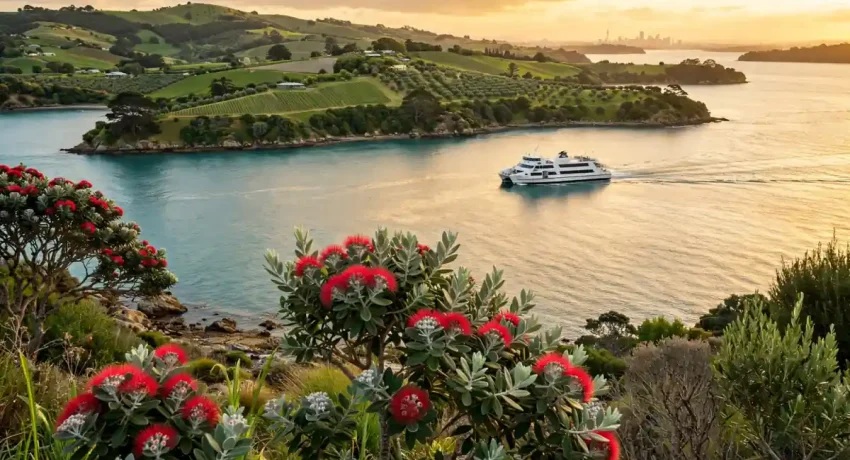

Auckland is the best base camp in New Zealand. The city sits on a narrow strip of land between two harbours, and within a few hours in almost any direction you can reach a wine island, a volcano, a black sand beach, a movie set, a glowworm cave, and a steaming geothermal valley. Some of these places to visit near Auckland New Zealand take forty minutes by ferry. Others need a full day and a car. All of them are worth the trip.
This guide ranks the twelve best places to visit in New Zealand near Auckland by how well they actually work in a single day. It gives honest drive times from central Auckland, 2026 prices, and the traps to avoid. The biggest trap is treating Rotorua or the Bay of Islands like a quick outing. They are three hours away. You can do them in a day, but you will enjoy them far more with an overnight stay.
New Zealand’s North Island runs on a different rhythm from the rest of the world. Summer is December to February. Winter is June to August. The best time to visit Auckland New Zealand is late summer and autumn, from February to May, when the sea is warm, the crowds thin out, and the weather settles. March to May is the sweet spot for the Coromandel coast. Travellers planning a northern hemisphere spring trip can compare notes with our US spring guide. December and January are the busiest months of the year.
Which Day Trip From Auckland Suits You Best?
| Traveller | Best pick | Why it fits |
|---|---|---|
| First-time visitor | Hobbiton and Waitomo | Two icons in one long day |
| Wine lover | Waiheke Island | Vineyards forty minutes by ferry |
| Family with kids | Rangitoto Island | Volcano walk, ferry ride, no car needed |
| Beach lover | Piha and the Waitakere Ranges | Wild black sand, forty-five minutes away |
| Culture and nature | Rotorua | Geothermal parks and Māori culture |
| Photographer | Cathedral Cove | Rock arch, white sand, late light |
| Birdwatcher | Tiritiri Matangi Island | Rare native birds, pest-free sanctuary |
How Far Is Each Place From Auckland?
| Destination | Travel time from central Auckland | Best as |
|---|---|---|
| Waiheke Island | 40-minute ferry | Half day or full day |
| Rangitoto Island | 25-minute ferry | Half day |
| Piha Beach | About 45 minutes by car | Half day |
| Matakana | About 1 hour by car | Half day or full day |
| Hamilton Gardens | About 1.5 hours by car | Half day |
| Hobbiton Movie Set | About 2 hours by car | Full day |
| Waitomo Glowworm Caves | About 2.5 hours by car | Full day |
| Coromandel and Cathedral Cove | 2.5 to 3 hours by car | Full day |
| Rotorua | About 3 hours by car | Overnight preferred |
| Bay of Islands | About 3 hours by car | Overnight preferred |
| Great Barrier Island | 4.5-hour ferry or 30-minute flight | Overnight |
Why Is Waiheke Island the Easiest Day Trip From Auckland?
Waiheke Island is the most popular day trip from Auckland for a reason. The ferry takes about forty minutes from the Downtown Ferry Terminal, and the island packs vineyards, beaches, olive groves, and art galleries into a small space. Fullers360 runs up to fifty sailings a day between Auckland and Matiatia Wharf, from early morning until midnight.
The Waiheke Island ferry price in 2026 is NZ$65 for a standard adult return, with an off-peak adult return at NZ$48.50 if you leave Auckland from 1pm. Children pay NZ$29 return, and a family return costs NZ$138. A second operator, Island Direct, charges NZ$59 return. Book the off-peak sailing and you save real money.
Start at Oneroa Beach, the village beach near the ferry terminal. Then take the island bus or a wine tour to the vineyards on the northern slopes. Mudbrick, Cable Bay, and Te Whau are the big names, and their terraces look straight across the Hauraki Gulf. Onetangi Beach, on the northern coast, is the island’s longest white sand beach and a good place for a swim in summer. If island beaches are your thing, Hawaii offers a warmer Pacific alternative in the northern hemisphere winter.
Waiheke works without a car. Buses meet the ferries at Matiatia, and the main beaches and wineries are on the bus routes. If you want freedom, hire a bike or a scooter. Give the island a full day if you can. A half day only shows you the ferry terminal end of it.
What Makes Rangitoto Island So Different?
Rangitoto Island is a volcano sitting in Auckland’s harbour. It erupted about six hundred years ago, which makes it the youngest and largest volcano in the Auckland volcanic field. Auckland itself is built on an active basaltic volcanic field, the only city in the world built on one, and Rangitoto is its most visible child.
The Rangitoto Island ferry takes about twenty-five minutes from downtown Auckland. Fullers360 charges NZ$63 for an adult return, NZ$28.50 for a child, and NZ$149 for a family return. Bookings are essential, and the ferry leaves from piers thirteen and fourteen at the Auckland Ferry Terminal.
The summit walk takes about an hour each way through black lava fields and pohutukawa forest. At the top, 259 metres above the sea, you get a full circle view of the Hauraki Gulf and the Auckland skyline. There are no shops on the island and no drinking water, so carry everything you need. Wear sturdy shoes. The lava rock is sharp and uneven.
Rangitoto is a genuine half-day trip. Pair it with a Devonport visit on the way back, or with an afternoon in the city, and you have a full day that costs very little.
Why Do Locals Love Piha Beach?
Piha Beach Auckland is the city’s wild west coast. Black volcanic sand, pounding surf, and the Lion Rock standing in the sea make it one of the most photographed beaches in New Zealand. It is about forty-five minutes west of central Auckland by car, through the Waitakere Ranges rainforest.
Piha is a surf beach, not a swimming beach. The waves are strong and the rips are dangerous. Swim only between the flags when lifeguards are on duty, and never turn your back on the sea. The beach has claimed lives, and locals take the warnings seriously.
Walk up Lion Rock for the view, then follow the coastal track to the rock pools at low tide. The Waitakere Ranges around Piha hold waterfalls, kauri forest, and short bush walks. Karekare Beach, ten minutes south, is quieter and just as dramatic. It appeared in the film The Piano.
Go early on summer weekends. The car park fills up, and the road through the ranges is narrow and winding. On a wet day, skip the beach and drive the Scenic Drive through the rainforest instead. The forest looks its best in the rain.
Where Can You Taste Wine Near Auckland?
Matakana sits about an hour north of Auckland, and it has become the city’s favourite wine country escape. The Matakana wineries number more than thirty, and they cluster around the village, along with a Saturday farmers’ market that draws crowds from the city. The market runs on Saturday mornings and sells local cheese, bread, oysters, and craft beer.
Taste at a few cellar doors, then drive on to Tāwharanui Regional Park. The park is a pest-free peninsula with white sand beaches, coastal walks, and native birdlife. It is one of the best places near Auckland to see the coast without the crowds.
Matakana works well as a half-day trip, and it pairs nicely with a beach stop at Omaha or Snells Beach on the way home. If you plan to drink, book a tour or a driver. New Zealand’s drink-driving limits are strict, and the police run checkpoints on the main roads.
Is Hobbiton Movie Set Worth the Trip From Auckland?
Yes, if you love The Lord of the Rings or The Hobbit films. Hobbiton Movie Set sits on a sheep farm near Matamata, about two hours south of Auckland. The guided tour lasts two and a half hours and walks you through the Shire itself: hobbit holes, gardens, the mill, the double-arched bridge, and the Green Dragon Inn, where every tour ends with a complimentary drink.
Hobbiton Movie Set tickets cost around NZ$120 for an adult in 2026, so check the official site before you book, as prices move with the season. The set is a working film location, not a theme park. The gardens are real, the hedges are trimmed by hand, and the detail is remarkable. Even people who have never seen the films enjoy the craft of it.
Book ahead. Hobbiton sells out in summer, at weekends, and on public holidays. Tours run on fixed times, and you cannot wander the set on your own. Arrive thirty minutes early. The drive from Auckland passes through the Waikato countryside, and the town of Tirau, the corrugated iron capital, makes a fun photo stop on the way.
Hobbiton pairs naturally with Waitomo. The two are about forty-five minutes apart, and many tours combine them into one very long day. If you drive yourself, leave Auckland by 7am to fit both in comfortably.
What Is It Like Inside the Waitomo Glowworm Caves?
The Waitomo Glowworm Caves are one of New Zealand’s most famous sights. You walk through limestone caves past stalactites and stalagmites, then sit in a small boat and drift silently through the Glowworm Grotto. Thousands of glowworms light the cave roof like stars. Photography is not allowed on the boat, and the silence is part of the experience.
A Waitomo Glowworm Caves tour costs NZ$85 for an adult in 2026, with the guided tour lasting about forty-five minutes. The caves are about two and a half hours south of Auckland, or 150 kilometres by road. Organised day tours from Auckland cost NZ$195 to NZ$285 per person, including transport and cave entry. Self-driving saves a lot of money.
Book a timed slot in advance. The caves cap visitor numbers, and peak season runs from December to February, when you should book four to six weeks ahead. May to August brings smaller crowds and lower tour prices, often twenty to thirty percent cheaper.
Adventurous travellers can try black-water rafting: floating down an underground river in a wetsuit and inner tube, past the same glowworms, from a completely different angle. It is cold, wet, and unforgettable. Ruakuri Cave, nearby, offers a longer underground walk with fewer crowds.
Should You Do Rotorua as a Day Trip From Auckland?
Rotorua is about three hours southeast of Auckland, and a Rotorua day trip from Auckland is the hardest call on this list. The city sits on a volcanic caldera, and steam rises from drains in the street. It is the centre of Māori culture in New Zealand and home to the country’s best geothermal parks. You can do it in a day, but it makes a twelve to thirteen hour day, and an overnight stay is better.
The Auckland to Rotorua distance is roughly 230 kilometres by road, mostly on State Highway 1. Guided tours from Auckland cost around NZ$288 to NZ$449 per person, depending on what is included. Self-driving costs far less, but you lose six hours to the road.
Te Puia is the best single stop. The guided Te Rā experience costs NZ$105 for an adult and covers the Whakarewarewa geothermal valley, where Pōhutu Geyser erupts. Pōhutu is the largest active geyser in the Southern Hemisphere. Te Puia also holds the New Zealand Māori Arts and Crafts Institute, where carving and weaving students train in front of visitors, and a kiwi house where you can see the national bird.
Wai-O-Tapu Thermal Wonderland sits about twenty-seven kilometres south of Rotorua. Adult admission is NZ$47, children pay NZ$17, and a family pass costs NZ$115. The Champagne Pool, the Artist’s Palette, and the Lady Knox Geyser, which erupts every morning, are the highlights. The park is cashless, so bring a card.
If you only have one day, choose Te Puia or Wai-O-Tapu, not both, and add a walk around Lake Rotorua and the Government Gardens. The lakefront is free, the gardens are beautiful, and the Rotorua Museum building is a fine piece of Edwardian architecture. Skip the luge and the gondola unless you have a spare afternoon.
Is Cathedral Cove Open in 2026?
Yes. The Cathedral Cove track open status is good news: the main Mautohe Cathedral Cove Track reopened on 30 January 2026 after storm repairs, and it was open as at 31 August 2026. The track closes during and after heavy rain because of landslide risk, so check the Department of Conservation website on the morning you go. An orange or red weather warning for Hahei also closes it.
Cathedral Cove sits near Hahei on the Coromandel Peninsula, about two and a half hours from Auckland. The walk takes about forty-five minutes each way from the Grange Road trailhead, or ninety minutes return, with a climb of about 316 metres. There is no parking at Grange Road. Park at the free Hahei Visitor Car Park and take the shuttle, which runs every ten to fifteen minutes from 9am to 6pm in summer, or walk from the paid Cathedral Cove Gateway Trail at 150 Lees Road.
The cove itself is a huge white rock arch opening onto a beach, with Te Hoho Rock standing in the water. Go late in the day for the best light and thinner crowds. The beach is not patrolled by lifeguards, and the archway becomes impassable at higher tides, so watch the tide and do not get cut off.
Pair Cathedral Cove with Hot Water Beach, fifteen minutes away. At Hot Water Beach you dig your own hot pool in the sand, but only within two hours either side of low tide. Time the tide first, then plan Cathedral Cove around it. The Coromandel Peninsula day trip works best from March to May, when the sea is warm and the crowds are gone.
What Awaits on Tiritiri Matangi Island?
Tiritiri Matangi Island is a wildlife sanctuary in the Hauraki Gulf, and it is one of the best birdwatching trips in New Zealand. The island was cleared of pests and replanted with native forest, and rare birds now live there in numbers found almost nowhere else. Kōkako, saddlebacks, stitchbirds, and takahē all live on the island.
Ferries run from downtown Auckland and from Gulf Harbour, and the crossing takes about an hour. Guided walks run from the wharf, and the island’s lighthouse, built in 1865, is one of the oldest in New Zealand. Book ahead in summer, as ferry places are limited.
Tiritiri Matangi is a day trip for people who like walking and listening. The forest is quiet, the birds are loud, and the views back to Auckland are superb. Carry water and food. There are no shops on the island.
Why Is Great Barrier Island So Wild?
Great Barrier Island sits about one hundred kilometres northeast of Auckland in the Hauraki Gulf. It is the largest island in the gulf, and it feels like another world. There is no mains power on much of the island, no street lights, and the night sky is one of the darkest in New Zealand. The island is an International Dark Sky Sanctuary.
The Great Barrier Island ferry takes about four and a half hours from Auckland, and flights take about thirty minutes. This is not a day trip. Come for two or three nights, walk the tracks, swim at Kaitoke Beach, and look up at the stars. The island rewards slow travel and punishes rushing.
Great Barrier suits travellers who have already seen the easy day trips and want something wilder. Book accommodation early in summer, and carry cash. Card payment is not universal on the island.
Are Hamilton Gardens Worth the Drive?
Hamilton Gardens sits about an hour and a half south of Auckland, and it is one of the most surprising gardens in the world. The garden is built as a series of themed rooms: an Italian Renaissance garden, a Japanese garden, a Tudor garden, a Māori garden, and more. Each one is a different world, built with extraordinary care.
Entry to the gardens is free, which makes this one of the cheapest day trips from Auckland. The enclosed gardens have a small entry charge, so check the current price at the gate. Hamilton itself is a pleasant river city, and the Waikato River walk is a good way to stretch your legs after the drive.
The gardens pair well with Hobbiton, which is about forty-five minutes away. Do the gardens in the morning and Hobbiton in the afternoon, or the other way around, and you have a full day that mixes film magic with garden design.
Should the Bay of Islands Be a Day Trip or an Overnight Stay?
The Bay of Islands is about three hours north of Auckland, and it is the one destination on this list where an overnight stay is almost essential. It holds 144 islands, historic towns, and some of the best sailing in New Zealand. Paihia is the main base, Russell is the historic town across the water, and Kerikeri holds the country’s oldest buildings.
A day trip from Auckland gives you about four hours in the bay, which is enough for a boat cruise past the Hole in the Rock and a quick look at Russell. That is a fine day, but it misses the point. Stay a night, take a sailing trip, walk the coastal tracks, and eat fish and chips on the Paihia waterfront.
Cape Reinga, at the far north, is six hours from Auckland and should never be attempted as a single day trip. It needs an overnight in the Bay of Islands first. The lighthouse at the meeting of two seas is worth the journey, but only with time to enjoy it.
When Is the Best Time to Visit Places Near Auckland?
| Month | What it is like | Best for |
|---|---|---|
| December to February | Warmest, longest days, busiest | Beaches, swimming, festivals |
| March to May | Warm sea, thinner crowds, settled weather | Coromandel, Waiheke, walking |
| June to August | Cool, wet, cheapest prices | Geothermal parks, Hobbiton, Waitomo |
| September to November | Spring, warming up, lambing season | Gardens, wine, coastal walks |
Auckland’s summer highs sit around 23 to 25 degrees Celsius, and winter highs around 14 to 15 degrees. Rain can fall in any month, so pack a rain jacket whatever the season. The school summer break runs from mid-December 2026 until schools return between 28 January and 3 February 2027, and Auckland Anniversary weekend falls on 30 January to 1 February 2027. Those are the busiest times on the roads and at the beaches.
How Much Does a Day Trip From Auckland Cost?
| Style | Cost per person per day | What it covers |
|---|---|---|
| Budget | NZ$80 to NZ$130 | Self-drive, free sights, picnic food |
| Mid-range | NZ$150 to NZ$250 | One paid attraction, café meals, fuel |
| Comfortable | NZ$280 to NZ$450 | Guided tour, winery lunch, both entries |
These are typical ranges, not fixed prices, and the Auckland day trip cost depends mostly on how you travel. Fuel, ferry fares, and entry tickets are the big costs. A self-drive day to Piha or Matakana can cost under NZ$100 per person. A guided Hobbiton and Waitomo day from Auckland costs NZ$350 to NZ$495 per person. Booking direct with the operator is usually cheaper than booking through a reseller.
How Do You Get Around Auckland’s Day Trip Destinations?
A rental car is the best tool for day trips from Auckland and for a wider New Zealand North Island road trip. It gives you freedom on the Coromandel, in the Waitakere Ranges, and on the road to Rotorua. New Zealand drives on the left, speed limits are strictly enforced, and many rural roads are narrow and winding. Allow more time than the map suggests.
Ferries cover the Hauraki Gulf. Fullers360 runs the Waiheke and Rangitoto services from the Downtown Ferry Terminal on Quay Street. Book the Rangitoto ferry in advance, as places are limited. The Waiheke walk-up ferry needs no booking, but the off-peak fare saves money.
Guided tours make sense for Hobbiton, Waitomo, and Rotorua. The driving is long, the parking is tight, and the tour includes entry tickets. For Waiheke, Rangitoto, Piha, and Matakana, go on your own. Public buses reach Piha and the Waitakere Ranges, but they are slow and infrequent.
New Zealand’s main roads are good, but the country is bigger than it looks. A two-hour drive on the map can take three hours on a holiday weekend. Leave early, fill the tank before you leave the city, and download offline maps. Mobile signal drops out in the ranges and on Great Barrier Island.
What Does a Perfect Three-Day Auckland Itinerary Look Like?
Day one of this Auckland New Zealand itinerary is the harbour. Take the morning ferry to Waiheke Island, taste wine at two vineyards, swim at Onetangi Beach, and catch the late ferry home. Have dinner on the Viaduct Harbour waterfront, where the restaurants look out over the marina.
Day two is the big inland day. Leave at 7am, drive to Hobbiton for the morning tour, then on to Waitomo for the afternoon glowworm cave tour. You will be back in Auckland by about 8pm, tired and happy. Book both tours in advance and buy the combination ticket if one is offered.
Day three is the west coast and the volcano. Drive to Piha in the morning, walk up Lion Rock, and have lunch at the Piha café. In the afternoon, take the ferry to Rangitoto Island and climb to the summit for sunset views over the city. End the day with fish and chips in Devonport, a twelve-minute ferry ride from downtown.
If you have a fourth day, spend it in Rotorua or the Coromandel. Both deserve a full day of their own, and both are better with an overnight stay than with a rushed return drive.
Is It Safe to Travel Around Auckland?
New Zealand is one of the safest countries in the world for travellers, but the outdoors demands respect. The sea is the biggest risk. Swim only at patrolled beaches, check the tide before coastal walks, and never walk under cliffs after rain. Cathedral Cove, Piha, and the Coromandel coast all have real hazards.
Geothermal areas are dangerous off the paths. The ground at Rotorua and Wai-O-Tapu can be thin and boiling hot underneath. Stay on the marked tracks, keep children close, and never step over a barrier. The parks are safe if you follow the rules.
Driving is the other risk. New Zealand roads are narrow, winding, and often single-lane each way. Fatigue causes accidents, especially on the long drive to Rotorua or the Bay of Islands. Take breaks every two hours, and never drive after a big winery lunch.
Sunburn is a real problem in New Zealand. The sun is strong, even on cloudy days, and the UV index is high in summer. Wear sunscreen, a hat, and sunglasses. The weather can change fast, especially in the Waitakere Ranges and on the Coromandel, so carry a rain jacket and a warm layer. Women travelling alone will find New Zealand welcoming and easy to navigate; our single woman travel guide has more practical tips.
What Should You Eat Near Auckland?
Start with fish and chips, the classic New Zealand meal. Auckland’s waterfront and the beach towns all do it well, and it tastes best eaten outside with salt air in the air. Green-lipped mussels, Bluff oysters, and snapper are local favourites.
Waiheke Island is a food destination in its own right. The vineyards serve long lunches with local olive oil, artisan cheese, and fresh seafood. Matakana’s Saturday market sells oysters, honey, bread, and craft beer from the surrounding farms.
In Rotorua, try a hāngī, the traditional Māori meal cooked in an earth oven. Several cultural experiences include a hāngī feast with a haka performance. It is the best way to taste Māori culture as well as see it.
Coffee culture is strong in Auckland and in the beach towns. Flat whites are the local standard, and the cafés in Devonport, Matakana, and Paihia are worth a stop on their own.
Frequently Asked Questions
How many days do you need in Auckland?
Three full days cover the best day trips from Auckland: one day for Waiheke, one day for Hobbiton and Waitomo, and one day for Piha and Rangitoto. Add a fourth day for Rotorua or the Coromandel, and a fifth for the Bay of Islands.
Can you do Rotorua as a day trip from Auckland?
Yes, but it is a twelve to thirteen hour day with six hours on the road. Guided tours run daily and cost around NZ$288 to NZ$449 per person. An overnight stay in Rotorua is much better, and it lets you see both Te Puia and Wai-O-Tapu without rushing.
Is Waiheke Island worth visiting?
Yes. It is the easiest and most rewarding day trip from Auckland, with vineyards, beaches, and art galleries forty minutes by ferry. The off-peak return ferry costs NZ$48.50, and the island works well without a car.
Do you need a car for day trips from Auckland?
You need a car for Hobbiton, Waitomo, Rotorua, the Coromandel, and Matakana. Ferries cover Waiheke, Rangitoto, and Tiritiri Matangi. Guided tours are a good alternative for the long drives, and they include entry tickets.
What is the best month to visit Auckland?
March and April are the best months. The sea is still warm, the summer crowds have gone, and the weather is settled. February is the warmest month, and December is the busiest. Winter is quiet and cheap, but the sea is too cold for swimming.
Is Cathedral Cove open in 2026?
Yes. The main Mautohe Cathedral Cove Track reopened on 30 January 2026 after storm repairs. It closes during and after heavy rain, so check the Department of Conservation website on the morning you go. Go around low tide for the best beach access.
Why Is Auckland the Best Base in New Zealand?
Auckland gives you more in a day than almost any other city in the world. You can cross the harbour to a wine island in the morning, climb a volcano in the afternoon, and eat dinner on a marina in the evening. The next day you can walk through the Shire, drift under glowworms, or stand in a steaming geothermal valley.
The trick is to be honest about distances. Waiheke, Rangitoto, Piha, and Matakana are easy half-day trips. Hobbiton, Waitomo, and the Coromandel are full days. Rotorua and the Bay of Islands deserve a night away. Plan that way, and every day feels full without feeling rushed.
Start with Waiheke. It is the trip that shows you what the Hauraki Gulf is all about, and it sets the tone for everything else. If New Zealand whets your appetite for the wider region, our Australia first-timers guide covers the next stop across the Tasman Sea. Then pick your icons, book them early, and leave room for the unexpected. A black sand beach, a glowworm cave, and a volcano are waiting within a few hours of the city.