
Spain is one of the easiest countries in Europe for a first trip. The trains are fast. The food is cheap and good. The cities are walkable. And every region feels different from the last.
This guide covers the best places to visit in Spain for first timers. It has 12 places, from Barcelona to Bilbao. Real 2026 ticket prices, the best months to go, and a 7-day plan are inside too.
Think of it as your Spain first time travel guide 2026. Pick two or three bases. Do not try to see everything in one week. Spain rewards slow travel more than rushing.
Which Spanish City Should You Visit First?
Start with the city that matches your style. Art lovers should start in Madrid. Architecture fans should start in Barcelona. Food lovers should start in San Sebastián. History lovers should start in Seville or Granada.
| Traveller type | Best first city | Why it fits |
|---|---|---|
| Art lovers | Madrid | The Prado, Reina Sofía, and Thyssen in one walk |
| Architecture fans | Barcelona | Gaudí buildings on almost every street |
| History lovers | Seville | Moorish palaces, a Gothic cathedral, and old streets |
| Food lovers | San Sebastián | Pintxo bars packed into one old town |
| Beach lovers | Valencia or Málaga | City beaches with real culture behind them |
| First trip, one week | Madrid and Barcelona | Two cities, one fast train, zero stress |
| Slow travellers | Granada | The Alhambra, the Albaicín, and mountain air |
When Is the Best Time to Visit Spain?
The best time to visit Spain is April to June or September to October. Temperatures sit around 15 to 25°C in most cities. Crowds are thinner than in summer. Prices are lower too.
Spain in spring 2026 is a strong pick. April brings Holy Week and the Seville fair. May brings warm days and long evenings. June is hot in the south but lovely in the north.
July and August are the hardest months inland. Seville regularly passes 40°C. Córdoba is just as hot. The coasts are packed. The north stays cooler and greener.
| Month | Madrid | Barcelona | Seville | Best for |
|---|---|---|---|---|
| March | 15°C days | 16°C days | 20°C days | Valencia Fallas, quiet cities |
| April | 18°C days | 19°C days | 23°C days | Holy Week, Seville fair |
| May | 21°C days | 22°C days | 26°C days | Walking, festivals, long days |
| June | 27°C days | 25°C days | 32°C days | Beaches, the north, late sunsets |
| July | 31°C days | 28°C days | 36°C days | Coasts, islands, the Pyrenees |
| August | 30°C days | 27°C days | 36°C days | Beaches, festivals, the north |
| September | 25°C days | 25°C days | 32°C days | Warm sea, fewer crowds |
| October | 19°C days | 21°C days | 26°C days | Walking, wine harvest, mild south |
Winter is the cheapest season. Madrid nights drop near freezing. Andalusia still sees sunny days of 15 to 18°C. The Canary Islands stay mild all year.
Why Start in Barcelona?
Barcelona is the city most first timers picture when they think of Spain. Gaudí towers rise over the streets. The old town smells of bread and coffee. The beach sits ten minutes from the centre.
Give Barcelona three days. One day goes to Gaudí. The next covers the old town and the beach. The third is for food, markets, and a slow evening.
What Should You See in Barcelona First?
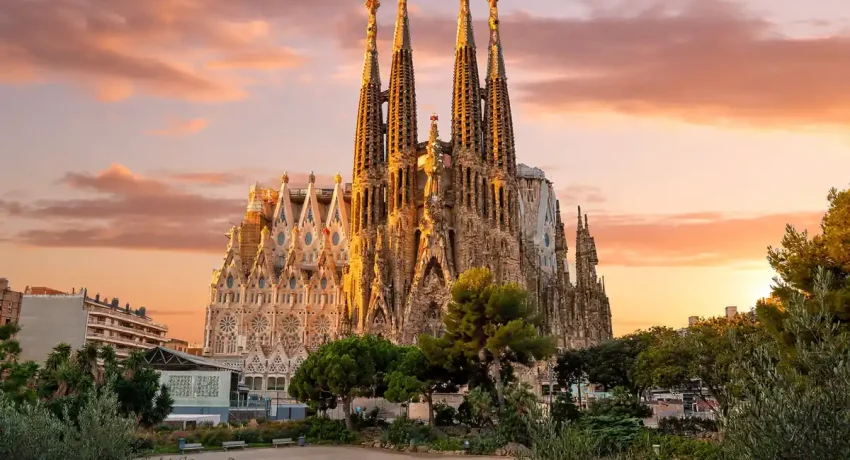
Start with the Sagrada Família. It is the most visited sight in Spain. Construction began in 1882. It is still going. In 2026 it became the tallest church in the world.
The Tower of Jesus Christ reached 172.5 metres. Its exterior was finished on 20 February 2026. Pope Leo XIV blessed it on 10 June 2026. Work still goes on inside the tower and on the Glory façade.
Barcelona Sagrada Familia tickets 2026 cost €26 for the basic ticket. That includes the audio guide app. A ticket with one tower costs €36. A guided tour costs €30. Add a tower and the price rises to €40. Children under 11 go free.
Book online at sagradafamilia.org. There is no ticket office on site. Tickets sell out days ahead in 2026. The Gaudí centenary is driving record demand. Gaudí died in 1926. This is the 100th year.
Hours change by season. November to February, the basilica opens 9:00 to 18:00. March and October, it opens 9:00 to 19:00. April to September, it opens 9:00 to 20:00. Sunday opens at 10:30. Saturday always closes at 18:00.
Next, walk to Park Güell. Gaudí built it as a garden suburb. It became a public park. The mosaic dragon stairway is the famous photo spot. The serpentine bench looks over the whole city.
Park Güell costs €18. Tickets are online only. You pick a 30-minute entry slot. The park covers 12 hectares. Only about 1,400 visitors enter per hour. Book at least a week ahead.
Casa Batlló sits on Passeig de Gràcia. Its roof looks like a dragon. Tickets start from €29. The price changes by date. Book early for the lower price. Casa Milà, known as La Pedrera, starts from €29 too. It stands two blocks away.
Finish the day in the Gothic Quarter. The streets are narrow and cool. The cathedral square fills with people at dusk. La Boqueria market sells fruit, cheese, and jamón. Go early in the morning. It gets crowded by noon.
Barceloneta beach is a short walk from the old town. The sand is city sand, not paradise sand. The sea is warm from June to September. The promenade is good for an evening walk.
What Makes Madrid Worth Three Days?
Madrid is the capital. It is also the best base in Spain. High-speed trains leave from here to almost every city in this guide. The art is world class. The food scene runs late into the night.
Start at the Prado Museum. The museum opened in 1819. Its collection ranks among the finest in Europe. Velázquez, Goya, and El Greco all hang here. Las Meninas is the painting everyone stops for.
Madrid Prado Museum tickets cost €15 for general admission. The reduced ticket is €7.50. Entry is free for under-18s and for students aged 18 to 25. The last two hours of every day are free for everyone too. That is 18:00 to 20:00 Monday to Saturday, and 17:00 to 19:00 on Sundays.
Hours are Monday to Saturday 10:00 to 20:00. Sunday hours are 10:00 to 19:00. The museum closes on 1 January, 1 May, and 25 December. A special exhibition on Christina of Sweden runs from 6 October 2026 to 7 February 2027.
The Paseo del Arte Card covers the Prado, the Reina Sofía, and the Thyssen. The card costs about €35. It pays off if you plan to visit all three. The Reina Sofía holds Picasso’s Guernica. The Thyssen fills the gaps between the other two.
Walk west to the Royal Palace. This is the largest royal palace in Western Europe by floor area. The building covers about 135,000 square metres and holds 3,418 rooms. The Spanish royal family does not live here now. The palace is used for state ceremonies.
Tickets cost €18 for standard admission. The reduced ticket is €9. Summer hours are Monday to Saturday 10:00 to 19:00. Sunday hours are 10:00 to 16:00. Winter hours close one hour earlier on weekdays.
Retiro Park is Madrid’s green heart. Rent a rowboat on the lake. Walk under the trees. The Crystal Palace sits inside the park. Entry to the park is free. It is the best free afternoon in Madrid.
Eat late in Madrid. Dinner starts around 21:00. Tapas bars fill up after 22:00. Try the Mercado de San Miguel near Plaza Mayor. It is busy and a little pricey. The side streets nearby are cheaper and just as good.
Why Is Seville the Soul of Andalusia?
Seville is the city most travellers fall in love with. Orange trees line the streets. Flamenco spills out of small bars. The light in the evening turns everything gold.
Start at the Royal Alcázar. The palace still serves as a working royal residence. UNESCO lists it as a World Heritage site. The tilework and gardens are some of the finest in Spain. Fans of Game of Thrones will know it as Dorne.
Seville Alcazar tickets 2026 cost €15.50 for general admission. The reduced ticket is €8. The ticket also covers the Antiquarium and the Triana Ceramic Center. Royal Apartments cost €5.50 extra. Free entry runs on Mondays at 18:00 and 18:30 with an online reservation.
Next door stands the cathedral. This is the largest Gothic cathedral in the world. The tomb of Christopher Columbus sits inside. The Giralda tower was once a minaret. You climb it on ramps, not stairs. The view from the top covers the whole city.
Cathedral tickets cost €13 online or €14 at the door. The price includes the Giralda and the Salvador Church. Children under 13 go free. The reduced ticket is €7.
Walk to Plaza de España. It was built for the 1929 Ibero-American Exposition. The semicircular plaza has tiled alcoves for every Spanish province. Entry is free. Rowboats on the canal cost about €6. Go at sunset for the best light.
Cross the river to Triana. This is the old pottery quarter. The streets are quieter here. The flamenco is more real. The Ceramic Center tells the story of the craft.
Climb the Metropol Parasol, known as Las Setas. It is a giant wooden structure in the old town. Tickets cost €16 for adults. Students pay €13. The rooftop walkway gives a wide view over Seville.
Seville is hot in summer. Daytime highs pass 40°C in July and August. Couples love the city too — our summer honeymoon guide has more romantic ideas. Plan your sightseeing for the morning. Rest in the afternoon. Come out again after 19:00. That is how locals live.
Is the Alhambra Worth the Booking Hassle?
Yes, without doubt. The Alhambra is the most visited monument in Spain. The complex is a palace, a fortress, and a garden in one. It sits above Granada with the Sierra Nevada behind it.
Alhambra Granada tickets 2026 cost €22.27 for the General Day Visit. That covers the Nasrid Palaces, the Generalife Gardens, and the Alcazaba fortress. The Gardens ticket costs €12.73. It skips the Nasrid Palaces. The night visit to the Nasrid Palaces costs €12.73. Children under 12 go free.
Book on the official site, tickets.alhambra-patronato.es. Tickets sell out one to two months ahead in peak season. The Nasrid Palaces entry is timed to the half-hour. Miss your slot and you cannot enter the palaces that day. There are no refunds.
Winter hours run from 15 October to 31 March. The complex opens daily from 08:30 to 18:00. It closes on 25 December and 1 January. Night visits run on Fridays and Saturdays from 20:00 to 21:30 in winter.
The Alcazaba reopened on 23 September 2026. It had closed for five weeks after the Granada earthquakes of 15 and 18 August. The visitor route has minor changes. Check the morning of your visit.
Walk down into the Albaicín after the Alhambra. This is the old Moorish quarter. The streets are steep and whitewashed. The Mirador de San Nicolás gives the classic view of the Alhambra. Go at sunset. Musicians often play there.
The Granada Card costs €50 for 24 hours. The 48-hour card costs €55. The 72-hour card costs €60. Both include the Alhambra and city transport. Do the maths before you buy it. It only pays off if you visit a lot.
Granada is cheaper than Madrid or Barcelona. Tapas often come free with a drink. Order a beer and a tapa arrives with it. This is a Granada tradition. It makes the city very kind to a budget.
What Should You Do in Valencia?
Valencia is Spain’s third city. The city feels calmer than Barcelona and warmer than Madrid. A futuristic arts complex, a historic old town, and a real city beach all sit here.
The Valencia City of Arts and Sciences is the star. Santiago Calatrava designed it. The white curves look like a spaceship landed in a riverbed. The complex holds a science museum, an oceanarium, and an opera house. The Oceanogràfic is the largest aquarium in Europe.
Walk through the old town after that. The Silk Exchange is a UNESCO site. The Central Market is one of the largest covered markets in Europe. The Torres de Serranos gate opens the old city walls to visitors.
Valencia invented paella. Eat it here, at lunch, in a restaurant full of locals. Paella is a lunch dish in Valencia, not a dinner dish. A good seafood paella costs around €20 to €25 per person. Order it for the table, not for one.
Las Fallas is Valencia’s great festival. It runs from 15 to 19 March. The city builds hundreds of huge sculptures. They burn them on the last night, La Cremà. Fireworks run daily. The opening ceremony, La Crida, happens on 23 February 2026.
Valencia is about two hours from Madrid by high-speed train. Two days suit Valencia well. The city also works as a beach break between Barcelona and Andalusia.
Why Visit Córdoba for One Day?
Córdoba was once one of the largest cities in Europe. Its mosque-cathedral is one of the most beautiful buildings in the world. The old Jewish quarter is a maze of white streets and flower pots.
Cordoba Mezquita tickets cost €15 for general admission. The price rose from €13 on 1 April 2026. Reduced tickets cost €12 for over-65s and students aged 15 to 26. Children under 10 go free.
There is a free window every morning. Entry is free Monday to Saturday from 8:30 to 9:30. Arrive by 8:15 to get in. You see the full interior, including the forest of 856 columns. The Patio de los Naranjos, the orange courtyard, is free at any time.
Hours are Monday to Saturday 10:00 to 19:00 from March to October. Sunday hours are 8:30 to 11:30 and 15:00 to 19:00. The bell tower costs €4 extra. The night visit costs €25.
A fire in August 2025 damaged the roof of the Almanzor Chapel. Restoration runs through mid-2026. The monument is fully open. The prayer hall, the mihrab, and the bell tower are unaffected.
The Mezquita drew 2,191,731 visitors in 2025. That was a new record. Come early or late in the day. Midday is the busiest time.
Córdoba sits between Madrid and Seville by train. It makes a perfect half-day stop. Walk the Roman Bridge at sunset. Eat in the Judería. Then take the evening train onward.
Can You Do Toledo as a Day Trip from Madrid?
Yes, and you should. A Toledo day trip from Madrid is one of the easiest in Spain. The high-speed train takes roughly 30 minutes. Leave Madrid after breakfast and you are back in time for dinner.
Toledo was the capital of Spain before Madrid. Three cultures lived here together: Christian, Jewish, and Muslim. The old town sits on a hill above the Tagus River. The whole city is a UNESCO World Heritage site.
Walk the old town on foot. The streets are steep and narrow. Visit the cathedral. It is one of the great Gothic cathedrals of Spain. See the El Greco paintings in the Church of Santo Tomé. The Burial of the Count of Orgaz hangs there.
Cross the river to the Parador viewpoint. The view back over Toledo is one of the best in Spain. Go in the late afternoon. The stone turns gold in the low sun.
Buy a Toledo bracelet ticket if you plan to visit several sites. It covers the main monuments at a discount. Check the current price at the tourist office. Prices change by season.
Toledo is small. One full day is enough for a first visit. Two days lets you slow down. Stay overnight if you want the old town to yourself after the day trippers leave.
Is Segovia Worth a Day Trip Too?
Segovia is another easy day trip from Madrid. The high-speed train takes roughly 30 minutes. The city is small, beautiful, and full of history.
The Roman aqueduct is the first thing you see. Romans built it around 2,000 years ago. The structure still stands in the centre of the city. Water flowed through it into Segovia until the 19th century. Few Roman aqueducts survive in such good shape.
Walk up to the Alcázar. The castle looks like something from a fairytale. Disney’s Snow White castle took inspiration from it. The views from the tower cover the plains around Segovia.
Eat cochinillo, roast suckling pig. It is the famous dish of Segovia. Restaurants in the old town serve it for lunch. A full meal costs around €25 to €35 per person.
Segovia and Toledo both work as day trips. Choose one if your time is short. Toledo wins for history and art. Segovia wins for the aqueduct and the castle.
Why Do Food Lovers Go to San Sebastián?
San Sebastián sits on the Basque coast. The bay here ranks among the most beautiful in Europe. The city also holds more Michelin stars per person than almost anywhere on earth.
San Sebastian pintxos are the reason most people come. Pintxos are small bites on bread. They sit on the bar counter. Point at what you want, then pay per piece. A pintxo costs around €2 to €4.
Start in the Parte Vieja, the old town. The bars are packed shoulder to shoulder. Order a txakoli, the local white wine. Try the gilda, an olive, anchovy, and chilli pepper skewer. It is the classic Basque bite.
Walk La Concha beach in the morning. The bay curves like a shell. The water is calm and cold. The promenade is one of the finest in Spain. Climb Monte Igueldo for the view. The funicular takes you up.
San Sebastián is about five and a half hours from Madrid by train. South West France sits just across the border, an easy next stop. It suits a longer trip. Pair it with Bilbao. The two cities are about an hour apart by bus.
The Tamborrada festival runs on 20 January. Drummers march through the city for 24 hours. It marks the feast of Saint Sebastian. Book hotels early if you go then.
Is the Guggenheim Bilbao Worth the Trip North?
Yes. The Guggenheim changed Bilbao. The titanium building by Frank Gehry opened in 1997. It turned an industrial city into an art destination. The building itself is the main exhibit.
Guggenheim Bilbao tickets cost €12 for adults on the official site. Students aged 18 to 26 pay €6. Seniors over 65 pay €6. Children under 18 go free. A combo with the Fine Arts Museum costs €16.
Resellers online often charge €15 or more for the same ticket. Buy on the official site, guggenheim-bilbao.eus. Hours are Tuesday to Sunday 10:00 to 19:00. The museum closes on 25 December and 1 January.
Outside, Jeff Koons’ Puppy greets you. It is a giant dog made of flowers. Louise Bourgeois’ Spider stands by the river. The riverside walk is free and lovely at dusk.
Bilbao’s old town is a short walk from the museum. The Seven Streets are full of pintxo bars. The food here is cheaper than in San Sebastián. The city is a good base for the Basque Country.
What Should You Do in Málaga?
Málaga is the gateway to the Costa del Sol. It is also a real city with real history. Picasso was born here. The old town is compact and lively. The beach is a ten-minute walk from the centre.
Visit the Alcazaba. It is a Moorish fortress above the old town. The views over the port are excellent. The Roman Theatre sits at its foot. Both are in the heart of the city.
The Picasso Museum holds works from every stage of his life. It sits in a 16th-century palace. Picasso was born in Málaga in 1881. The museum is small and well done. Give it two hours.
Málaga is about two hours and 45 minutes from Madrid by high-speed train. It is the easiest beach city to reach from the capital. The airport also connects to most of Europe.
Use Málaga as a base for the coast. Ronda is a day trip away. The white villages of Andalusia sit inland. The beaches east of the city are quieter than the resort strips to the west.
Why Is Ronda the Best Day Trip in Andalusia?
Ronda sits on the edge of a deep gorge. The Puente Nuevo bridge spans it. The gorge drops about 120 metres. The view from the bridge is one of the most photographed in Spain.
The old town is small and whitewashed. The new town sits across the gorge. The bullring in Ronda is one of the oldest in Spain. It opened in 1785. Today it works as a museum.
Ronda is about an hour and a half from Málaga by bus. It is also reachable from Seville by train and bus. The journey takes about two hours. Go early in the day. The light is best in the morning.
Walk down into the gorge if you are fit. The path is steep. The view up at the bridge is worth the climb. Wear good shoes. The stones are slippery.
Ronda pairs well with the white villages. Grazalema and Zahara de la Sierra sit nearby. They are quiet, white, and beautiful. A car makes this trip much easier.
How Do You Get Around Spain?
Trains are the best way to travel in Spain. The AVE high-speed network is one of the largest in the world. It connects Madrid with Barcelona, Seville, Valencia, Málaga, and Granada.
The AVE train Madrid Barcelona route is the busiest in the country. It covers about 621 kilometres. The fastest trains take around 2 hours 30 minutes. Speeds reach 310 km/h.
Three operators run the route. Renfe runs the AVE. Ouigo is the low-cost option. Iryo sits in the middle. Advance fares start from about €9 on Ouigo, €15 on Iryo, and €17 on Renfe AVE. Closer to departure, expect €30 to €70 or more.
Speed restrictions are in place in 2026. They follow the Adamuz derailment in January 2026. Journeys take about 25 minutes longer than normal. Budget closer to three hours. The restrictions run until 13 December 2026.
Book trains early for the best prices. Spanish train fares work like airline fares. Early booking means low prices. Last-minute booking means high prices.
City travel is easy too. Madrid and Barcelona have good metros. Buses fill the gaps. Walking is the best way to see the old towns. Most historic centres are car-free or nearly so.
Flying inside Spain is rarely faster than the train. Airports sit outside the cities. Security and boarding add hours. The train takes you from city centre to city centre.
How Much Does a Trip to Spain Cost?
Spain is one of the cheapest countries in Western Europe. Food and transport cost less than in France or Italy. Hotels cost less too, outside the peak summer weeks.
Spain travel cost per day depends on your style. Budget travellers spend around €60 to €80 per day. Mid-range travellers spend around €100 to €150 per day. Comfortable travellers spend €200 or more per day.
| Style | Per day | What it covers |
|---|---|---|
| Budget | €60–€80 | Hostel, market food, walking, free sights |
| Mid-range | €100–€150 | Hotel, restaurant meals, paid sights, trains |
| Comfortable | €200+ | Boutique hotel, fine dining, guides, taxis |
Ticket prices add up fast. A week of big sights can cost €100 to €150 in entry fees alone. Use the free hours. The Prado is free in the evening. The Mezquita is free in the early morning. The Alcázar is free on Monday evenings.
Eat where locals eat. A menú del día, the lunch set menu, costs around €12 to €18. Three courses and a drink usually come with it. No other meal in Spain gives better value. Dinner is more expensive. Tapas are cheaper than full meals.
Hotels cost the most in Barcelona and San Sebastián. They cost the least in Granada and Córdoba. Book early for April, May, and September. Prices rise fast once the good rooms go.
What Are the Big Spain Festivals in 2026?
Spain has more festivals than almost any country in Europe. Plan your trip around one if you can. Book hotels early. Prices double during the big festivals.
Spain festivals 2026 start with Las Fallas in Valencia, 15 to 19 March. The city burns hundreds of sculptures on the last night. Holy Week runs 1 to 5 April. Seville has the most famous processions. Holy Thursday is 2 April. Good Friday is 3 April. Easter Sunday is 5 April.
| Festival | 2026 dates | Where | What happens |
|---|---|---|---|
| Las Fallas | 15–19 March | Valencia | Giant sculptures, fireworks, La Cremà burning |
| Semana Santa | 1–5 April | Seville | Holy Week processions, the Madrugá night |
| Feria de Abril | 21–26 April | Seville | 1,000+ casetas, flamenco, horse parades |
| San Fermín | 7–14 July | Pamplona | Running of the bulls, street parties |
| La Tomatina | 26 August | Buñol | 20,000 people, 120 tonnes of tomatoes |
| La Mercè | 20–24 September | Barcelona | Human towers, fire runs, giant parades |
The Feria de Abril runs 21 to 26 April 2026. It takes place two weeks after Easter. The fairground sits in Los Remedios. More than 1,000 casetas line the streets. People dance sevillanas and drink rebujito. Most casetas are private. Visitors can still enjoy the fairground, the rides, and the public tents.
La Tomatina happens on the last Wednesday of August. In 2026 that is 26 August. About 20,000 people throw around 120 tonnes of tomatoes in one hour. Buñol sits near Valencia. Tickets are limited. Book well ahead.
San Fermín runs 7 to 14 July in Pamplona. The running of the bulls starts at 8:00 every morning. It is dangerous. People are injured every year. Watch from a balcony if you go. Do not run unless you know the risks.
What Should You Eat in Spain?
Spanish food is simple and regional. Each place has its own dishes. Eat what the region is known for. That is the rule.
In Barcelona, try pa amb tomàquet, bread rubbed with tomato. Try calcots in spring, grilled spring onions with romesco sauce. Save room for crema catalana for dessert. It is like crème brûlée with a Catalan twist.
In Madrid, try cocido madrileño, a chickpea stew. Order a bocadillo de calamares, a squid sandwich from Plaza Mayor. Then try churros with chocolate for breakfast. The classic spot is Chocolatería San Ginés. It opens all night.
In Seville, try salmorejo, a thick cold tomato soup. Order espinacas con garbanzos, spinach with chickpeas. Then try pescaíto frito, small fried fish. Eat in Triana for the most local feel.
The Basque Country means pintxos. Valencia means paella at lunch. Granada gives a free tapa with every drink. Galicia serves octopus and seafood. Asturias pours cider from a height.
Meal times are late in Spain. Lunch runs from 14:00 to 16:00. Dinner starts at 21:00. Restaurants fill up after 22:00. Plan your sightseeing around this. Eat a big lunch. Snack in the evening. Eat dinner late.
Is Spain Safe for First Timers?
Spain is one of the safest countries in Europe for tourists. For a wider picture, see our guide to the safest places to visit outside the US. Violent crime is rare. The main risk is petty theft. Pickpockets work the crowded sights in Barcelona and Madrid.
Keep your bag in front of you on the metro. Do not leave your phone on a café table. Use a cross-body bag in crowded places. Leave your passport in the hotel safe. Carry a copy instead.
Barcelona has the worst pickpocket problem in Spain. The Ramblas and the Sagrada Família area are the hotspots. Be extra careful there. Madrid is safer but not immune. The Sol area and the metro need the same care.
Solo travellers do well in Spain. The cities are walkable at night. Our single woman travel guide has more tips for travelling alone. The streets stay busy late. Restaurants welcome single diners. Tapas bars are made for eating alone at the counter.
Emergency number in Spain is 112. It works for police, ambulance, and fire. Pharmacies have a green cross sign. Most pharmacists speak some English. Tap water is safe to drink in most cities.
What Does a 7-Day Spain Itinerary Look Like?
This Spain itinerary 7 days first time plan covers the three classic cities. Trains carry you the whole way. The pace leaves room to breathe. Most first timers enjoy this route more than any other.
| Day | Where | What to do |
|---|---|---|
| Day 1 | Madrid | Arrive, Retiro Park, tapas in La Latina |
| Day 2 | Madrid | Prado in the morning, Royal Palace, Plaza Mayor |
| Day 3 | Toledo | Day trip, old town, cathedral, back to Madrid |
| Day 4 | Seville | Morning train, Alcázar, cathedral, Triana evening |
| Day 5 | Seville | Plaza de España, Metropol Parasol, flamenco show |
| Day 6 | Barcelona | Morning train, Sagrada Família, Gothic Quarter |
| Day 7 | Barcelona | Park Güell, La Boqueria, Barceloneta beach, depart |
Have ten days instead of seven? Add Granada between Seville and Barcelona. Two days in Granada covers the Alhambra and the Albaicín. The train from Seville to Granada takes about three hours.
Have fourteen days? Add Valencia and the Basque Country. Valencia sits between Barcelona and Madrid by train. San Sebastián and Bilbao need two or three days. The north is a different Spain. It is green, cool, and full of good food.
First trip to Spain tips: book the big tickets before you fly. The Alhambra, the Sagrada Família, and the Alcázar all sell out. Book trains early for low fares. Pack light. You will walk a lot. Bring good shoes. The old towns are made of stone and hills.
Where Should You Go After Spain?
Spain pairs well with its neighbours. Paris is a short flight from Barcelona or Madrid. The French capital has its own first-timer magic. Nice on the French Riviera is even closer to Barcelona by train.
If you loved the palaces of Spain, Versailles is the next step. The palace near Paris is the grandest in Europe. It makes a perfect day trip from the French capital.
Spain also suits a longer first-timer journey. Australia is a very different first trip. Its cities, coasts, and wildlife feel like another world. Our Australia first-timers guide helps there too, just as this one helps in Spain.
Whatever you choose next, Spain will pull you back. Most first timers return within a few years. Second trips go deeper. Travellers visit the north, the islands, or the small towns they missed.
Frequently Asked Questions
How many days do you need for a first trip to Spain?
Seven days covers Madrid, Barcelona, and Seville. Ten days adds Granada. Fourteen days adds Valencia and the Basque Country. Less than five days means picking one city and enjoying it properly.
Do you need a car in Spain?
No, not for the big cities. Trains and metros cover them well. A car helps for the white villages, the Pyrenees, and rural Andalusia. Rent one only for those days. City driving is stressful and parking is expensive.
Is Spain expensive for first timers?
Spain is cheaper than France, Italy, or the UK. Budget travellers manage on €60 to €80 per day. Mid-range travellers spend €100 to €150 per day. The big costs are hotels in Barcelona and San Sebastián, and the main attraction tickets.
What is the best month to visit Spain for the first time?
May is the best single month for most first timers. The weather is warm across the country. The days are long. The summer crowds have not arrived. September is the second-best choice, with warm seas and fewer people.
Do people speak English in Spain?
English is widely spoken in hotels, restaurants, and tourist sights. It is less common in small towns and local bars. Learn a few Spanish phrases. Hello, please, thank you, and the bill, please, go a long way.
Is tap water safe to drink in Spain?
Yes, tap water is safe in almost all Spanish cities. Madrid has some of the best tap water in Europe. Some coastal towns have a slight taste. Bottled water is cheap everywhere if you prefer it.
Spain is ready for you. Book the big tickets early. Pack light. Eat late. Walk everywhere. Your first trip will not be your last.