
Most people come to Mont-Saint-Michel for one photo. They cross the bridge, climb the abbey steps, take the picture, and leave. That is a mistake. The bay around the rock holds some of the best places to visit near Mont St Michel, and most of them sit within an hour of the abbey. There are walled corsair towns, medieval streets, oyster ports, manuscript museums, and a wild island archipelago that only appears at low tide.
This guide covers twelve places to visit near Mont St Michel in 2026. It starts with the abbey itself. Then it moves through the towns and coast around the bay, with verified 2026 prices, tide dates, and a working three-day plan. Every price here was checked against 2026 sources. Where prices vary, the article says so.
Which Place Near Mont St Michel Suits You Best?
Not every traveller wants the same trip. Use this table to find your match before you read further.
| Traveller | Start here | Why it fits |
|---|---|---|
| First-timers | The abbey and Saint-Malo | The two icons, done properly in two days |
| Food lovers | Cancale and Granville | Oysters at the harbour, seafood on the coast |
| History buffs | Avranches, Dinan, Fougères | Manuscripts, ramparts, and a great fortress |
| Families | Saint-Malo and Pontorson | Beaches, walls to walk, easy bases |
| Nature lovers | Îles Chausey and Tombelaine | Wild islands, birds, and huge tides |
| Slow travellers | Dinan and Dol-de-Bretagne | Quiet streets, markets, and old stone |
| Day-trippers from Paris | The abbey, then Saint-Malo | One long day, two very different places |
What Does the Abbey Cost in 2026?
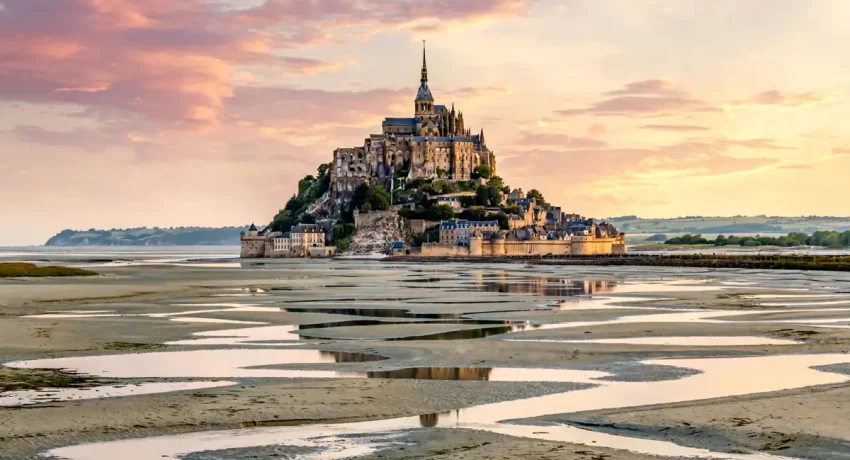
The abbey is the reason the bay exists on every bucket list. It crowns a rocky island in the middle of vast tidal flats. Benedictine monks built it over centuries, starting after Bishop Aubert of Avranches dreamed of the Archangel Michael in the year 708. The abbey became a UNESCO World Heritage site in 1979. Around 2.8 million people visit the site each year, and almost all of them funnel through one narrow street.
Mont Saint-Michel abbey tickets 2026 follow a simple seasonal split. From 1 April to 30 September 2026, an adult ticket costs €16. In the quiet months, from 1 October 2026 to 31 March 2027, it costs €13. Entry is free for visitors under 18, and for EU residents aged 18 to 25. Everyone enters free on the first Sunday of the month from November to March. Book online on the official Centre des Monuments Nationaux site. Tickets go on sale about a month ahead, and popular slots sell out in summer.
The abbey opens from 9 am to 7 pm from 1 May to 31 August. From 1 September to 30 April, it opens from 9:30 am to 6 pm. Last entry is one hour before closing. The abbey is closed on 1 January, 1 May, and 25 December. The climb to the top is about 350 steps. Go early or late in the day. Between 11 am and 4 pm in high season, the single main street, the Grande Rue, is packed shoulder to shoulder.
The village itself is free to enter at all times. It is a real commune, not a museum. You only pay for the abbey at the top. That distinction surprises many first-timers. Walk the ramparts in the evening, after the day-trippers leave, and the whole place feels different. The light turns gold. The crowds thin. The abbey glows above you.
How Does the Mont Saint-Michel Shuttle Bus Work?
No cars have reached the island since 2014. You park on the mainland, about 2.5 kilometres away, and finish the trip on foot or by shuttle. The Mont Saint-Michel shuttle bus, called Le Passeur, is free. Its cost is covered by your parking ticket. The ride takes about 12 minutes. It drops you about 350 metres from the island entrance, and you walk the last stretch across the footbridge.
The walk takes 35 to 45 minutes on flat ground. It is the better choice on a clear day. The abbey grows in front of you with every step. In rain or strong wind, take the shuttle. The shuttle runs from early morning to late evening, with longer hours in July and August. At night, transport runs on demand by phone.
Mont Saint-Michel parking sits in numbered lots from P2 to P13 behind the visitor village. The first 30 minutes are free. A full day costs roughly €15 to €20 in high season, and less in the quiet months. The exact tariff changes by season, so check the board at the entrance. Do not plan around the old horse-drawn Maringote carriage. It no longer runs. Build your plan around the shuttle and the walk.
Why Do the Tides Decide Everything Here?
The Bay of Mont-Saint-Michel has the largest tidal range in continental Europe. The difference between high and low water can reach about 14 metres. At low tide, the sea retreats up to 15 kilometres. When the tide turns, it rushes back faster than a person can walk. The bay is beautiful and dangerous in equal measure.
Mont Saint-Michel tides run on a coefficient scale from 20 to 120. A coefficient above 90 means a spring tide. At 95 and above, the change becomes dramatic. In 2026, there are 48 days with a coefficient of 95 or higher. The highest coefficient of the year is 105, on 18 April.
On a handful of days, the sea closes all the way around the rock. The Mont becomes a true island again. In 2026, those island days are 21 March (morning high tide at 08:39), 14 August (evening high tide at 21:28), and 12 September (evening high tide at 21:02). Arrive two hours before the peak. Park early, walk the footbridge, and watch from the bay wall as the water rises.
| Island day 2026 | High tide | What to expect |
|---|---|---|
| Saturday 21 March | 08:39, morning | Spring equinox tide, coefficient above 100 |
| Friday 14 August | 21:28, evening | Sunset island, the most photographed moment of the year |
| Saturday 12 September | 21:02, evening | Autumn equinox tide, quieter crowds |
Never cross the bay on foot alone. The sands hide quicksand. The tide moves faster than it looks. Guided walks across the flats are the only safe way. A certified guide reads the tide tables for your exact date before taking your money. If a guide will not do that, pick another one.
Is Saint-Malo the Best Day Trip from the Mont?
Yes, for most people. Saint-Malo sits about 55 kilometres west of the Mont, roughly 50 to 60 minutes by car. It is a walled corsair city on the Emerald Coast of Brittany. Privateers once sailed from here with the king’s blessing. The city was almost completely destroyed in the Second World War. It was rebuilt stone by stone, so well that you would never know.
A Saint-Malo day trip starts on the ramparts. The full loop runs about 1.75 kilometres around Intra-Muros, the old walled city. Walking it is free. The views change at every turn: beaches below, granite forts offshore, and the old town’s slate roofs behind you. Enter through the Porte Saint-Vincent, the main gate. Go early in the morning or late in the afternoon, when the light is soft and the crowds are thin.
At low tide, walk out to Fort National. The fort was built in 1689 to the plans of Vauban, to protect the port. It opens when the French flag flies above it. Entry costs €5 for adults and €3 for children aged 6 to 16. Bring cash, because cards are often not accepted. The fort is open every day from 1 June to 30 September, and during school holidays. The visit takes about 30 minutes, and the guided tour runs every half hour or so.
Grand Bé and Petit Bé are the two small tidal islets off the beach. You can walk to Grand Bé at low tide. The writer Chateaubriand is buried there, facing the sea. Check the tide times before you set out. The sea returns fast, and the causeway disappears under it.
Saint-Malo is also the setting of the bestselling novel All the Light We Cannot See. Fans of the book walk the same ramparts and beaches. The old town holds crêperies, biscuit shops, and bookshops in granite lanes. The beach below the walls, the Plage de l’Éventail, fills with swimmers in summer. Stay for dinner inside the walls. The city feels different after the day-trippers leave.
Why Is Dinan the Prettiest Medieval Town Nearby?
Dinan sits about 30 minutes from Saint-Malo, inland on the River Rance. It is one of the best-preserved medieval towns in Brittany. Half-timbered houses lean over cobbled lanes. The ramparts run for about 2.6 kilometres around the old town, with ten towers and four fortified gates. Walking them is free, and the views over the Rance valley are the best in town.
The Dinan medieval town experience starts at the Château de Dinan. The castle was built in 1382 and 1383 for John V, Duke of Brittany. Its keep is made of two great round towers joined together. Adult entry costs €8, with a reduced ticket at €5. Children under six go free. A combined ticket with the clock tower costs about €10. Allow one to one and a half hours inside, plus time on the ramparts.
Then walk down the Rue du Jerzual. It is steep, cobbled, and lined with artists’ workshops. The street drops from the old town to the river port below. The port is the prettiest corner of Dinan, with cafés along the water and boats tied up below the old stone bridge. Climb back up slowly. There are plenty of places to rest.
Dinan’s market runs on Thursday mornings. The town also hosts the Fête des Remparts, a medieval festival held every two years. The next editions fill the streets with costumed parades, markets, and music. Check the dates before you plan around it. Dinan works best as a slow half day. Arrive in the late afternoon, walk the walls, eat by the river, and stay for the golden light.
Where Do You Eat the Best Oysters in France?
In Cancale. The small fishing port sits about 20 minutes east of Saint-Malo, on the bay side. It calls itself the oyster capital of Brittany, and nobody argues. The town has farmed oysters since Roman times. The beds stretch across the bay at low tide, in neat rows that vanish under the sea.
Cancale oysters are sold at the Marché aux Huîtres, the oyster market at the far end of the harbour. Producers open them in front of you. In summer 2026, a dozen standard oysters costs roughly €6 to €10, depending on size and variety. A dozen medium oysters costs about €8. Buy a lemon, a baguette, and a bottle of white wine. Sit on the dock and shuck your own. There is no cover charge and no fuss.
If you prefer a table, the restaurants along the harbour serve oysters with butter, rye bread, and white wine from the Loire. The Pointe du Grouin, a wild headland just past the town, gives the best walk in the area. Cliffs, seabirds, and a view back across the bay to the Mont. The coastal path, the GR34, runs through here. It is one of the great walking routes in France.
Cancale is a half-day stop. Come for lunch, walk the point, and move on. Or come for a whole slow afternoon. The oysters taste better with no hurry.
What Is the Scriptorial, and Why Should You Go?
Avranches is the town where the Mont-Saint-Michel story begins. Bishop Aubert, the bishop of Avranches, dreamed of the Archangel Michael in 708 and built the first church on the rock. Avranches sits about 30 to 40 minutes from the Mont by car. Its Saturday market fills the old streets, and its ramparts look out over the bay.
The Avranches Scriptorial museum is the reason to come. It opened in August 2006, inside the town walls. No other museum in France is dedicated to medieval manuscripts. Its collection comes from the monks of Mont-Saint-Michel, who copied books in the abbey’s scriptorium from the 10th century onwards. The museum holds about 199 manuscripts, most made at the Mont between the 10th and 13th centuries.
Only twelve manuscripts are shown at a time. They rotate every three months, so 48 can be seen in a year. The building itself is part of the visit. Its ramps climb gently toward the Treasure Room, echoing the climb to the abbey. The museum is closed on Mondays. Allow one and a half to two hours. Most explanations are in French, with some English support, but the manuscripts themselves need no translation.
Pair the Scriptorial with the abbey. See the building first, then come here to see the books its monks made. The two visits explain each other.
Is Granville Worth the Drive South?
Yes, especially if you want the sea without the crowds. Granville Normandy sits about an hour south of the Mont by car. It is a working fishing port and a seaside town, with a walled old town on a headland. The Haute Ville, the upper town, holds granite lanes, a lighthouse, and views across the bay. The town held out against a royalist siege in 1793, and the walls still show the scars.
Granville is also the gateway to the Channel Islands. Ferries run to Jersey in about one hour and 20 minutes in season, from April to September. Guernsey takes about two hours. Both are foot-passenger services, run by Manche Iles Express. Check the live timetable before you plan, because sailings are seasonal and vary by week.
The Christian Dior museum sits in the designer’s childhood home, the Villa Les Rhumbs, above the town. Dior was born in Granville in 1905. The villa and its garden are a quiet stop, far from the abbey crowds. Granville’s Saturday market is one of the biggest in Normandy. Come for the market, walk the old town, and eat seafood at the harbour.
Should You Take the Ferry to the Îles Chausey?
If you have a full day, yes. The Îles Chausey are a granite archipelago off Granville, about 17 kilometres out to sea. At high tide, 52 islets show above the water. When the sea goes out, more than 300 appear. It is the largest archipelago in Europe, and one of the wildest places on the French coast.
The Îles Chausey ferry runs year-round from Granville, operated by the Jolie France company. The crossing takes 45 minutes to one hour, depending on the weather. The fare is about €33.50 per person. Departure times change every day with the tides, so book ahead and arrive 45 minutes before sailing. Parking at the Granville ferry terminal is free.
Only the Grande Île, the main island, can be visited. There are no cars, no noise, and no crowds. You can walk around the island in under two hours. A small shop, a bar, and a hotel restaurant sit at the top of the island. The restaurant serves blue lobster, and its first menu costs about €33. Book ahead in high season. Bring a picnic if you prefer. The beaches are white sand, and the water is clear.
One odd sight on the island is a small castle, restored by the industrialist Louis Renault, who fell in love with the place. It is private property and cannot be visited. The old fort, built in 1866, is also closed. The island itself is the attraction. Come for the silence, the light, and the feeling of being at the edge of the map.
What Makes Fougères Castle So Big?
Fougères castle is one of the largest medieval fortresses in Europe. It sits in a valley below the town of Fougères, about an hour and a half from the Mont by car. Thirteen towers ring its walls. The castle was built to guard the border between Brittany and France, and it changed hands many times over the centuries.
The setting is the surprise. Most castles crown a hill. Fougères sits low, in a marshy valley, with the town rising above it. Walk down from the old town to see it properly. The view from the ramparts above, across the rooftops to the towers, is one of the great sights in Brittany.
The town itself is worth an hour. Half-timbered houses, a medieval quarter, and a public garden with views over the fortress. Fougères is a good stop on the drive between the Mont and Rennes, or on the way to Vitré, another medieval town nearby. There is no need to book ahead. Check the opening hours and ticket price at the gate before you go.
Is Dol-de-Bretagne Worth a Stop?
Yes, for an hour on the road between the Mont and Saint-Malo. Dol-de-Bretagne is a small old town with a great cathedral. The Dol-de-Bretagne cathedral, the Cathédrale Saint-Samson, is a Gothic church from the 13th century. Its tall tower rises over the rooftops, and its porch is one of the finest in Brittany.
The town sits on the edge of the marshes of the bay. It was once a port, before the sea retreated. The old streets hold granite houses, a market square, and a quiet pace. Dol is also a stop on the Tro Breizh, the old Breton pilgrimage route that links seven cathedral towns. Pilgrims still walk it today.
Do not plan a whole day here. Plan a coffee, a walk around the cathedral, and a look at the market square. Then drive on. Dol is the kind of place that rewards a short stop more than a long one.
Why Stay in Pontorson?
Pontorson is the gateway town to the Mont. It sits about 10 kilometres away, on the road from the mainland. Most visitors drive straight through it. That is a mistake. Pontorson is the cheapest and easiest base in the area, and the most practical one.
The Pontorson gateway town holds the nearest train station to the Mont. From June to the end of September, a direct NOMAD train runs from Paris Montparnasse to Pontorson. A single fare costs €29 one way, with the shuttle included. The rest of the year, you travel via Rennes. From the station, a shuttle bus runs directly to the Mont. The ride costs €3.10, and it is included in some train tickets.
Pontorson has hotels, restaurants, and a Wednesday market. Prices are lower than on the island or at the mainland visitor village. The town also has a small museum about the bay and its tides. Stay here, take the shuttle in the morning, and come back for dinner in a town where locals outnumber tourists.
Can You Walk Across the Bay to Tombelaine?
Not on your own, and not to Tombelaine itself. The Tombelaine island is a small rocky islet in the bay, about three kilometres north of the Mont. It is a bird sanctuary. Landing is not allowed. The island is a sight to look at, not a place to visit. Seals rest on the sandbanks around it at low tide, and birdwatchers come for the waders and gulls.
The Bay of Mont Saint-Michel guided walk is the way to experience the sands safely. Certified guides lead small groups across the flats at low tide. The walk usually runs from the Mont toward Tombelaine and back, or from the mainland to the island. It takes two to three hours. You walk barefoot through sand, mud, and shallow channels. The guides explain the tides, the quicksand, and the history of the bay as you go.
Book a guided walk for your first morning or your last afternoon. It changes how you see the whole place. The abbey looks different from the middle of the bay, with nothing but sand and sky around you. Wear clothes you do not mind getting muddy. Bring water and sun protection. And never, ever cross the bay without a guide. The tide comes in faster than a person can run.
Should You Add Bayeux and the D-Day Beaches?
If you have a third day, yes. Bayeux sits about one hour and 25 minutes from the Mont by car. It is a small Norman town with a great treasure: the Bayeux Tapestry. The tapestry is about 70 metres long, embroidered in the 11th century. It tells the story of the Norman Conquest of England in 1066, scene by scene. The museum that holds it is one of the most visited in Normandy.
From Bayeux, the D-Day landing beaches run along the coast. Omaha Beach, Utah Beach, and the American Cemetery at Colleville-sur-Mer sit within a short drive. The cemetery holds more than 9,000 white crosses and Stars of David, looking out over the sea. It is a quiet, moving place. Allow half a day for the beaches and the cemetery, and a morning for the tapestry and the town.
Bayeux is also a good base for the night. Its old town is pretty, its restaurants are good, and its hotels cost less than the ones near the Mont. If your trip is about the bay, keep Bayeux as a bonus. For a Normandy trip, make it a full day.
How Do You Get Here from Paris?
A Mont Saint-Michel day trip from Paris is possible, but it is a long day. The Mont sits about 360 kilometres from Paris. By car, the drive takes about four hours each way, via the A11 or A13 motorways. The train route runs by TGV from Paris Montparnasse to Rennes, about one hour and 30 minutes. Then a connecting coach runs from Rennes to the Mont, about one hour and 15 minutes. The total trip takes three hours and 45 minutes to four hours and 30 minutes each way. A round trip costs about €80 to €140 per person, depending on how early you book the TGV.
Buses offer a cheaper option. FlixBus and BlaBlaCar Bus run direct from Paris to the Mont car park, in about four hours and 40 minutes. Tickets start from about €25 to €30 one way, booked in advance. These lines run mainly from June to early September. Organised coach day trips from Paris take ten to eleven hours in total, with transport and often the abbey ticket included. They remove the planning, but they leave little time for anything except the abbey.
If you can, stay one night. The best moments at the Mont come early in the morning and late in the evening, when the day-trippers are gone. Base yourself in Pontorson, Saint-Malo, or the mainland village. Then the bay becomes a trip, not a race.
For the Paris leg of your trip, our guide to the best places to visit in Paris covers the city with the same verified 2026 prices. If you want more of France after the bay, our guides to the places near the Palace of Versailles, the top places to visit in Nice France, and the best places to visit in South West France complete the route.
When Is the Best Time to Visit Mont Saint-Michel?
The best time to visit Mont Saint-Michel is late April to early June, and mid-September to October. The weather is mild. The crowds are manageable. The light is at its best. May, June, and September give the best balance of all three. July and August are the warmest months, but also the busiest. Parking lots fill by 10 am in August. Winter is quiet and atmospheric, but the weather is unpredictable and some restaurants on the island close.
| Month | Weather | Crowds | Good for |
|---|---|---|---|
| March | Cool, 8–13°C, windy | Low | Spring tides, empty streets |
| April | Mild, 10–16°C | Moderate | First warm days, equinox tides |
| May | Pleasant, 13–19°C | Moderate | Best all-round month |
| June | Warm, 16–22°C | High | Long days, gardens in bloom |
| July | Warm, 18–24°C | Very high | Evening light, full services |
| August | Warm, 18–24°C | Very high | Island tide day on 14 August |
| September | Mild, 15–21°C | Moderate | Equinox tide, golden light |
| October | Cool, 11–17°C | Low | Quiet walks, autumn colour |
| November–February | Cold, 4–11°C, wet | Very low | Storm light, empty bay |
Weather figures are typical values, not guarantees. The Normandy coast changes fast. Bring a light waterproof jacket even in summer. The wind off the bay makes the island feel cooler than the mainland. Check the tide calendar before you pick your dates. A spring-tide day transforms the visit.
How Much Does a Trip Near Mont St Michel Cost?
Costs around the bay are lower than in Paris, but they are not cheap in high season. The table below gives typical daily costs per person, including a mid-range bed, food, and local transport. Treat every figure as a range and check before you book.
| Style | Typical day (per person) | What it buys |
|---|---|---|
| Budget | €70–120 | Hostel or budget hotel, bakery meals, bus and shuttle |
| Mid-range | €130–200 | Good hotel, restaurant dinner, abbey and one museum |
| Comfortable | €220–350 | Island or seafront hotel, seafood dinners, guided walks |
The abbey ticket is €13 to €16. A dozen oysters in Cancale costs about €8. The Chausey ferry costs about €33.50. Fort National costs €5. Dinan castle costs €8. Parking costs roughly €15 to €20 a day in high season. Add the train or bus from Paris, and a three-day trip runs about €400 to €700 per person at mid-range, before flights. Book hotels early for spring-tide weekends and for August. Rooms on the island itself sell out weeks ahead.
Which Base Suits Your Trip Best?
Where to stay near Mont Saint-Michel depends on your budget and your pace. The island itself holds a handful of small hotels, including the famous Mère Poulard inn. Staying on the island means the abbey after dark, with almost no one around. It also means the highest prices, the smallest rooms, and booking weeks ahead.
The mainland visitor village at La Caserne, about 2.5 kilometres from the rock, holds modern mid-range hotels. You walk or shuttle to the island in minutes. There is no shuttle-timing pressure, because the walk is flat and short. This is the best choice for most travellers.
Pontorson is the budget base. It is cheaper, it has the train station, and it has restaurants where locals eat. Saint-Malo is the best base for a longer trip. It has the most hotels, the best food, and the most to do in the evening. Bayeux works if you are adding the D-Day beaches. Book early for May, June, September, and any spring-tide weekend.
What Should You Eat Around the Bay?
The bay eats from the sea and the salt marshes. Oysters lead the list, in Cancale and all along the coast. Mussels, scallops, and sole follow. The salt-marsh lamb, the agneau de pré-salé, grazes on the salty grasses of the bay. Its meat tastes of the sea. It costs more than ordinary lamb, and it is worth trying once.
Crêpes and galettes are the everyday food of Brittany. A galette is a savoury buckwheat pancake, filled with ham, cheese, egg, or mushrooms. A crêpe is sweet, with salted caramel, lemon and sugar, or chocolate. Cider comes with both, served in a bowl, not a glass. The Mère Poulard omelette, served on the island, is famous and expensive. It is a show as much as a meal. Eat it once if you like, but the best food in the area sits in the small restaurants of Saint-Malo, Cancale, and Pontorson.
How Do You Plan 3 Days Around the Bay?
Day one starts at the Mont. Arrive early, before 9 am. Walk the causeway or take the shuttle. Visit the abbey first, before the crowds. Walk the ramparts. Eat lunch in the village or back on the mainland. In the afternoon, drive to Avranches for the Scriptorial. Come back to the Mont for sunset. Watch the tide if the coefficient is high.
Day two belongs to Saint-Malo. Walk the ramparts in the morning. Visit Fort National at low tide. Eat lunch inside the walls. In the afternoon, drive to Cancale for oysters and the Pointe du Grouin. Come back to Saint-Malo for dinner. If the weather is good, swim at the beach below the walls.
Day three is for Dinan and the coast. Spend the morning in Dinan, walking the ramparts and the Rue du Jerzual down to the port. Eat lunch by the river. In the afternoon, choose one more place: Dol-de-Bretagne for a quiet hour, Granville for the old town and the sea, or the Îles Chausey if you booked the ferry. End the day in Pontorson or Saint-Malo, with a last seafood dinner.
If you have a fourth day, add Bayeux and the D-Day beaches. With only one day, do the abbey in the morning and Saint-Malo in the afternoon. Skip the rest. The bay rewards a slow trip more than a fast one.
Is the Bay Safe for Solo Travellers?
Yes. The bay is one of the safest corners of France for a solo trip. The towns are small. The streets stay busy in the day and quiet at night. The trains and buses are simple. France ranks among the safest countries in Europe for visitors, and the villages around the bay are calmer than Paris.
The real risks here are natural, not criminal. The tide is the danger. Never cross the bay alone. Do not trust a shortcut across the sands. Check the tide times every morning. Keep your bag zipped in the abbey crowds, as you would anywhere busy. Pickpockets work the Grande Rue in summer, like any famous street.
Women travelling alone will find the area easy. The towns are walkable, the restaurants welcome tables for one, and the transport is straightforward. Our guide to the best places to visit for single woman travellers covers solo trips in depth, and our guide to the safest places to visit outside the US ranks France among the calm choices for 2026. The Mont itself belongs on any list of the most interesting places in the world to visit, and it is one of the easiest of them to reach alone.
Frequently Asked Questions
How many days do you need near Mont St Michel?
Two days cover the abbey and Saint-Malo properly. Three days add Dinan, Cancale, and Avranches. Four days add the Îles Chausey or Bayeux. One day works only for the abbey itself, and it feels rushed.
Do you need to book abbey tickets in advance?
Yes, in summer. Tickets go on sale about a month ahead on the official site. Popular slots sell out in July and August. In winter, you can usually buy on the day. The village is always free, with no booking needed.
Can you visit Mont St Michel at high tide?
Yes. The footbridge stays open, and the shuttle keeps running. On the strongest spring tides, the water can cover the lowest part of the path, and the Mont becomes a true island for a few hours. Check the tide times before you go, and arrive early on island days.
Is the bay walk safe?
Only with a certified guide. The sands hide quicksand, and the tide moves faster than a person can walk. Guided walks are the only safe way across the flats. Never cross alone, even at low tide.
What is the best base for the area?
Pontorson for budget and trains. La Caserne for closeness to the island. Saint-Malo for food, hotels, and evening life. The island itself for one special night, booked well ahead.
Can you do Mont St Michel as a day trip from Paris?
Yes, but it is a long day. The trip takes about four hours each way by train and coach, or by organised bus. You get about four hours at the Mont. Staying one night is far better, and it costs little extra.
Why Does the Bay Stay With You?
The abbey is the photo. The bay is the memory. The tide comes in and the rock becomes an island. Then the tide goes out and the sea becomes a desert of sand. The towns around it have kept their walls, their markets, and their oysters for centuries. Give the bay three days. Walk the ramparts of Saint-Malo at dawn. Eat oysters in Cancale at noon. Stand on the sands at sunset, with the abbey behind you and nothing but sky ahead. That is the trip most visitors miss. Now you know how to take it.