Your car does not send you a calendar invite when something is about to wear out. It just gets a little louder, a little slower, or a little less reliable, until one morning it refuses to start. A good car maintenance schedule by mileage is what stops that slow slide. It tells you what to check, what to change, and when — before small wear turns into a large bill.
This guide does two things. First, it clears up the name in the title. Then it gives you the full picture: what a full-service auto repair shop should cover, the complete maintenance schedule from 5,000 to 120,000 miles, and how to tell whether the work was actually done properly. Think of the schedule below as your car maintenance checklist for the next 120,000 miles.
What Is Valle Alto Auto Service, Really?
Let us start with an honest answer. Valle Alto Auto Service is not one verifiable business. That name belongs to a neighbourhood in El Paso, Texas. Searches for a shop called exactly “Valle Alto Auto Service” turn up no official website, no listed address, no phone number, and no verified reviews.
Similar names do exist, and they are easy to confuse with it. El Valle Auto Repair is an independent shop in the San Antonio area that says it has served drivers since 2000. Valley Automotive Service is a shop in Henderson, Nevada. Vale Auto Repairs operates in Novato, California. None of these is Valle Alto Auto Service, so none of their details belong in an article about it.
What the name points to is a real question, though. Drivers want a full-service auto repair shop they can trust with everything from oil changes to diagnostics. That is what this guide covers: the complete car maintenance schedule by mileage, what a full service includes, and how to check the work once it is done. Use it with any shop, wherever you live.
What Does a Full-Service Auto Repair Shop Actually Do?
Full service auto repair means one shop handling routine maintenance and complex repairs under the same roof. That is the whole point of the word “full”. You should not need one garage for oil and another for brakes.
Here is what a genuine full-service shop covers:
| Service area | What it includes |
|---|---|
| Routine maintenance | Oil and filter changes, fluid top-ups and flushes, tyre rotation and balancing |
| Engine diagnostics | Check-engine light diagnosis, OBD-II scanning, sensor and timing work |
| Brake service | Pads, rotors, callipers, brake lines and full hydraulic system checks |
| Steering and suspension | Shocks, struts, control arms, tie rods and wheel alignment |
| Transmission | Fluid service, diagnostics and repair for automatic and manual gearboxes |
| Electrical and battery | Battery testing and replacement, starters, alternators and wiring faults |
| Heating and air conditioning | Leak diagnosis, compressor replacement and system recharging |
| Exhaust and emissions | Muffler and pipe repair, catalytic converter work and emissions diagnostics |
| Tyres | Replacement, rotation, balancing and tread-depth checks |
Together, these auto repair shop services are what separate a full-service shop from a quick-lube. If a shop only does oil changes and tyres, it is a quick-lube or tyre shop, not a full-service shop. That is fine for those jobs. It is not the place to take a car with a transmission fault or a suspension knock.
A proper visit also includes a multi-point inspection. During one, a technician walks around the car, checks fluids, belts, hoses, brakes, tyres, lights and the battery, and writes down what they find. You should get that report in writing, with anything urgent clearly marked.
What Does a Full Car Service Include?
Not every service is the same size. Most shops work in three tiers, and knowing them stops you paying for a major service when you only need an interim one.
What does an interim service cover?
An interim service is the light one, usually every six months. It covers an oil and filter change, fluid top-ups, a visual check of brakes and tyres, and a diagnostic scan for stored fault codes. This tier suits low-mileage drivers who still want a regular professional eye on the car.
What does a full service cover?
A full service is the annual one, usually every twelve months or 12,000 miles. It includes everything in the interim service, plus a deeper inspection of the brake system, steering, suspension, exhaust and underbody. Filters get checked properly. The battery gets tested. Lights get tested one by one.
What does a major service cover?
A major service is the big one, usually every two years. It adds replacement parts to the full-service checks: air filter, spark plugs on many cars, and a closer look at the drive belts. Coolant and brake fluid often get changed at this level too. Your owner’s manual, not the shop’s calendar, decides which tier your car needs and when.
What Is the Complete Car Maintenance Schedule by Mileage?
Most manufacturers build their schedules around the same framework: a minor service every 5,000 to 7,500 miles, then bigger milestones at 30,000, 60,000, 90,000 and 120,000 miles. Mechanics know this pattern as the 30-60-90 maintenance schedule. Exact items vary by make and model, so treat this table as the baseline and check your owner’s manual for your car.
| Mileage | What to do |
|---|---|
| Every 5,000–7,500 miles | Change engine oil and filter (synthetic oil); check and top up all fluids; inspect tyre pressure and tread |
| Every 6,000–8,000 miles | Rotate tyres so they wear evenly; check wheel alignment if the car pulls to one side |
| Every 15,000–30,000 miles | Replace engine air filter and cabin air filter; inspect belts and hoses for cracks |
| At 30,000 miles | Replace filters; flush brake fluid; inspect fuel system and fuel filter; full brake and tyre inspection |
| At 60,000 miles | Flush engine coolant; service transmission fluid; replace spark plugs on many cars; check brake pads and rotors |
| At 90,000 miles | Replace spark plugs if not done at 60,000; inspect or replace timing and serpentine belts; refresh power steering fluid |
| At 120,000 miles | Flush coolant again; inspect shocks and struts; check oxygen sensors; inspect the chassis for rust |
| Every 3–5 years | Replace the battery, even if it still starts the car; test the charging system at the same time |
Time matters as well as mileage. Oil degrades sitting in an engine. Brake fluid absorbs moisture from the air. Rubber belts and hoses age even on a car that barely moves. If you drive very little, follow the time interval in your manual — usually every six or twelve months — rather than waiting for the mileage number.
How Do Normal and Severe Driving Change the Schedule?
Your owner’s manual almost certainly has two schedules: normal and severe. Most drivers should follow the severe one. That surprises people, but “severe” does not mean off-roading. It means everyday driving in difficult conditions.
Short trips where the engine never fully warms up count as severe. Stop-and-go traffic counts. Hot weather counts. Towing counts. Dusty roads count too, and together these are severe driving conditions. If most of your driving is short hops around town in summer heat, your oil, transmission fluid and brakes are all working harder than the normal schedule assumes.
Severe driving shortens every interval. Oil that would last 10,000 miles on long highway runs may need changing at 5,000. Transmission fluid that would last 60,000 miles may need attention sooner. Match the schedule to how you actually drive, not to how the dealer markets the car.
Which Fluids Matter Most, and When Should They Change?
Fluids are the cheapest maintenance on a car and the most expensive thing to neglect. Each one has a job, and each one wears out on its own clock.
When should engine oil be changed?
The oil change interval is the heartbeat of the whole schedule. Most cars today use synthetic oil, which safely lasts 5,000 to 10,000 miles. Conventional oil needs changing around 5,000 miles. Oil that stays in too long turns dark and thick, and it stops protecting the moving parts inside the engine. Check the dipstick once a month. Low oil or gritty oil means a visit to the shop, not a wait for the next milestone.
When should coolant be flushed?
Coolant stops the engine overheating in summer and freezing in winter. It also stops rust forming inside the cooling system. A flush is usually due around 60,000 miles, then again at 120,000. Old coolant turns acidic and starts eating the parts it is meant to protect.
When should brake fluid be changed?
Brake fluid absorbs moisture from the air, and wet brake fluid boils at a lower temperature. That can make the brake pedal feel soft on a long downhill drive. Most schedules call for a flush every 20,000 to 45,000 miles, or every two years, whichever comes first.
When should transmission fluid be serviced?
Transmission fluid cools and lubricates the gearbox. A transmission fluid change is usually due around 60,000 miles, sooner under severe driving. Some cars have sealed transmissions with no dipstick, which makes a professional service the only way to check it. A slipping gear or a delayed shift is a warning sign, not a quirk to live with.
What about power steering and washer fluid?
Power steering fluid is refreshed around 75,000 to 90,000 miles on cars that still use hydraulic steering. Many newer cars use electric steering and have no fluid at all. Washer fluid is the one fluid you can top up yourself in a minute, and you should, because a dirty windscreen is a safety problem.
How Do You Know When Brakes, Tyres and the Battery Need Attention?
These three systems keep you safe and moving. Each one gives clear warnings before it fails, if you know what to listen and look for.
What are the signs of worn brakes?
Squealing when you brake usually means the pads are thin. Grinding means metal is touching metal, and the rotors are being damaged. A pulsing brake pedal often means a warped rotor. Brake pads typically last 15,000 to 31,000 miles depending on driving style, with city driving wearing them faster. A brake inspection at every service catches wear before it becomes a safety issue.
When should tyres be rotated or replaced?
The tire rotation schedule is simple: rotate every 6,000 to 8,000 miles so the front and rear wear evenly. Front tyres wear faster on most cars because they steer and, on many cars, drive. Check tread depth with a coin or a gauge, and look for cracks in the sidewalls, which age even when tread remains. Uneven wear often points to an alignment problem rather than a tyre problem.
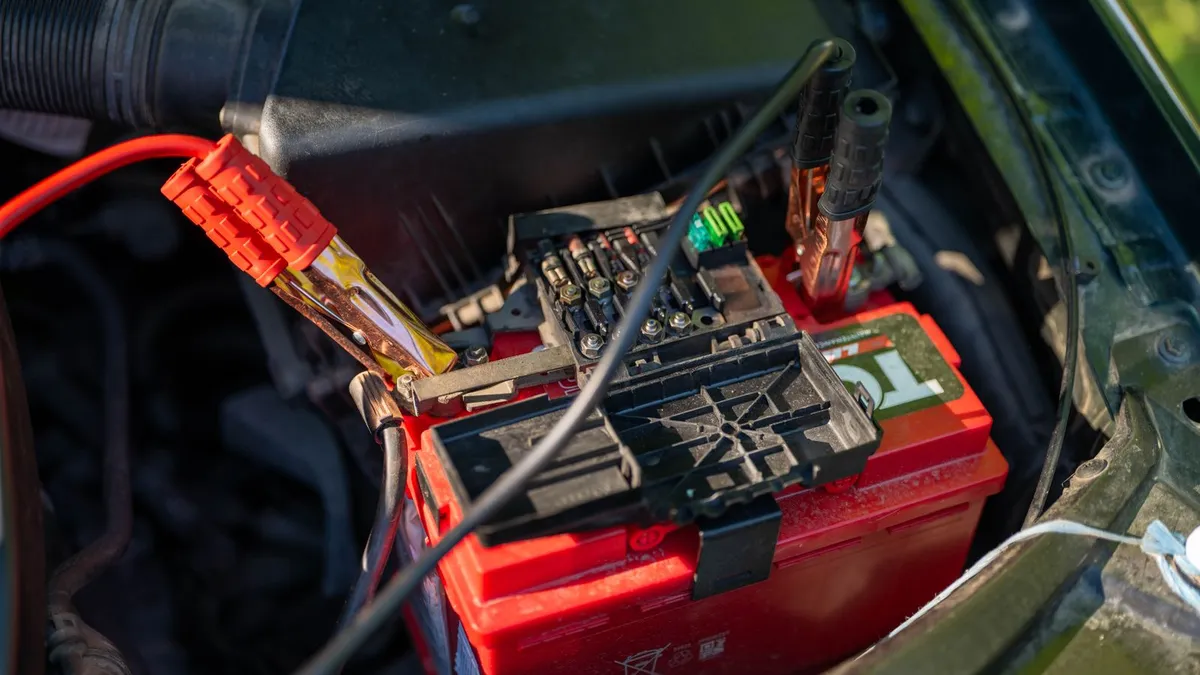
How long does a car battery last?
Most car batteries last three to five years. Heat shortens battery life more than cold does, which is why batteries often fail in summer. Slow cranking on a cold morning is the classic warning sign. A battery test takes a few minutes at a service visit and tells you the real state of charge, Car battery replacement is a quick job, and doing it on your terms beats doing it in a car park.
What About Belts, Hoses, Filters and Spark Plugs?
These are the quiet wear items. They rarely make a noise until they fail, and when they fail the repair is usually much bigger than the part.
When should the timing belt be replaced?
The timing belt keeps the engine’s valves and pistons moving in sync. Most manufacturers set the timing belt replacement interval between 60,000 and 100,000 miles, though some engines need it sooner. If a timing belt snaps on an interference engine, the pistons hit the valves and the engine can be wrecked. This is one interval never to stretch. Your owner’s manual gives the exact number for your car.
What do the serpentine belt and hoses do?
The serpentine belt drives the alternator, the air conditioning compressor and the power steering pump. Hoses carry coolant around the engine. Both are rubber, and rubber cracks with heat and age. A technician checks them at every service by squeezing and flexing them. Replace any hose that feels brittle or any belt with visible cracks before it breaks.
When should filters be changed?
The engine air filter keeps dust out of the engine, and it is usually due every 15,000 to 30,000 miles. Inside the car, the cabin filter cleans the air you breathe, and it is usually due every 15,000 to 20,000 miles. A clogged cabin filter makes the air conditioning weak and the windows fog up. Both filters are cheap, and a dirty one is easy to spot.
When should spark plugs be replaced?
Spark plugs ignite the fuel in the engine. Standard plugs last around 30,000 miles, while iridium and platinum plugs last much longer, often to 60,000 or 90,000 miles. Worn plugs cause rough idling, poor fuel economy and hard starting. Spark plug replacement is a routine job that restores how the engine should feel.
How Can You Tell the Shop Actually Did the Work?
This is the part most guides skip, and it is the part that saves you money. You cannot see most maintenance work, so you need proof.
Ask for the multi-point inspection report before you pay. It should list what was checked, what was measured, and what was replaced, with the old and new readings where they matter. Brake pad thickness, tyre tread depth and battery voltage are all numbers a good shop records.
Ask to see the old parts. A replaced filter, a worn brake pad or a cracked belt should be in a box waiting for you. Shops that throw parts away before you arrive are asking you to take their word for it.
Check the fluid levels yourself before you leave. Pop the bonnet and look at the oil on the dipstick. Fresh oil is amber and clean. If it looks black after an oil change, ask why.
Take the car for a short test drive before you leave the area. Listen for new noises. Feel for vibrations. Check that the warning lights are off. A good shop expects this and will happily take the car back if something feels wrong.
Keep the itemised invoice. It should name every part and every labour charge separately. That invoice is your maintenance record, and it is also your evidence if a warranty claim ever comes up.
How Do You Pick a Shop to Do All This Maintenance?
A maintenance schedule is only as good as the shop that follows it. Look for a shop that explains the work before it starts, shows you the inspection report, and gives you a written estimate with parts and labour separated. Certifications help too: ASE-certified technicians and AAA-approved facilities both have to meet published standards.
For the full checklist of what to verify before you hand over the keys — certifications, labour rates, estimates, warranties and the red flags that mean walk away — read our guide on how to choose an auto repair shop. It covers the questions to ask and the answers that should worry you.
One more habit matters: use the same shop for your maintenance. A shop that knows your car’s history spots changes faster than a new shop reading a blank file. That continuity is worth more than a small saving on a single oil change.
What Is Different About EV and Hybrid Maintenance?
Electric cars change the schedule, but they do not erase it. The EV maintenance schedule is shorter, but it is not empty. An EV has no engine oil, no spark plugs, no timing belt and no exhaust system. That removes several of the biggest items from the table above.
What remains still matters. Tyres wear faster on many EVs because the battery pack makes the car heavy and the torque is instant. Brake pads last longer because regenerative braking does much of the slowing, but the brake fluid still absorbs moisture and still needs changing. The cabin filter, the suspension, the steering and the 12-volt battery all still need attention.
Hybrids sit in between. The petrol engine runs less, so oil changes can stretch further, but the engine still needs oil, coolant and spark plugs on schedule. Meanwhile, the hybrid battery itself is usually covered by a long manufacturer warranty, and it is not a routine service item. Whatever you drive, the owner’s manual is the authority, not a generic chart.
Which Seasonal Checks Should You Never Skip?
Summer heat and winter cold attack different parts of the car, so a quick seasonal check is worth the few minutes it takes.
Before summer, check the air conditioning, the coolant level and the battery. Heat is the battery’s worst enemy, and a weak air conditioning system only gets worse in a heatwave. Check tyre pressure too, because hot roads raise it and under-inflated tyres wear fast.
Before winter, check the heater, the wipers and the lights. Wiper blades that streak in light rain will be useless in a storm. Test the battery, since cold weather exposes a weak one. Keep the washer fluid topped up with a winter mix that will not freeze.
In dusty or coastal areas, check the air filter more often. Dust clogs it, and salt air speeds up rust on the underbody. A quick underbody rinse after coastal driving costs little and protects a lot.
Which Common Upsells Can You Safely Skip?
Not everything a shop recommends is necessary. Some of it is, and telling the difference is part of being a good car owner.
Fuel system cleaning is rarely needed on a car that runs well and uses decent fuel. Engine flushes are usually unnecessary if the oil has been changed on schedule. Nitrogen in tyres offers no real benefit for normal road driving. A new cabin filter is worth it, but only when it is actually dirty — ask to see it.
The test is simple. Ask the shop to show you the problem: the dirty filter, the cracked belt, the measurement that is out of range. A genuine problem has evidence; a sales target does not.
Why Should You Keep a Maintenance Record?
A maintenance record is a folder or a phone note with every service date, mileage, part and invoice. It takes a minute to update after each visit, and it pays for itself in three ways.
First, it stops double work. You will know the coolant was flushed at 60,000 miles, so nobody sells it to you again at 75,000. Second, it protects warranties. Many manufacturer and parts warranties require proof that scheduled maintenance was done. Third, it raises resale value. A buyer pays more for a car with a documented history than for one with a shrug.
Keep the receipts, the inspection reports and the invoices together. A car with a paper trail is a car that has been looked after, and every buyer knows it.
Frequently Asked Questions
How often should a car be serviced by mileage?
A minor service, meaning an oil and filter change with a multi-point inspection, is due every 5,000 to 7,500 miles. Bigger milestone services fall at 30,000, 60,000, 90,000 and 120,000 miles. Severe driving shortens every interval, so match the schedule to how you actually drive.
What maintenance is done at 30,000, 60,000 and 90,000 miles?
At 30,000 miles, expect filters, a brake fluid flush, and a full brake and tyre inspection. Sixty thousand miles brings a coolant flush, transmission fluid service, spark plugs on many cars, and brake pads as needed. By 90,000 miles, expect spark plugs if not done earlier, a timing and serpentine belt inspection or replacement, and a power steering fluid refresh. Exact items vary by vehicle.
What does a full car service include?
A full service includes an oil and filter change, fluid checks and top-ups, a diagnostic scan, and a thorough inspection of brakes, steering, suspension, exhaust, tyres, lights and battery. Step up to a major service and you add replacement parts such as the air filter and spark plugs. An interim service is the lighter, six-month version.
How long do brake pads and car batteries last?
Brake pads typically last 15,000 to 31,000 miles depending on driving style, with city driving wearing them faster. Car batteries last three to five years, with heat shortening their life more than cold. Both should be tested at every service visit.
Does an electric car need maintenance?
Yes, but less of it. An EV needs no oil changes, spark plugs, timing belt or exhaust work. It still needs tyre rotation, brake fluid changes, cabin filter replacement, suspension checks and 12-volt battery care. Tyres often wear faster on EVs because of the extra weight and instant torque.
Is it safe to skip scheduled maintenance?
Skipping a single minor service rarely causes instant damage, but skipping maintenance as a habit does. Old oil, worn brakes and a snapped timing belt are all expensive in ways that a scheduled visit is not. Follow the time interval as well as the mileage, and keep the records.
Sources: Gateway Auto, “Your Car Maintenance Schedule: The 30-60-90 Rule”; Denton Transmissions, “Car Maintenance Schedule by Mileage: The Honest 30K/60K/90K Chart”; Moncur’s Automotive, “Complete Car Maintenance Schedule”; 7zap, “What to Replace According to the Schedule”; Vasstech, “What Does A Car Service Include”; AJ Automotive Services, full-service repair listings; El Valle Auto Repair, “About” (San Antonio). Intervals are general guidance — your owner’s manual is the authority for your vehicle.