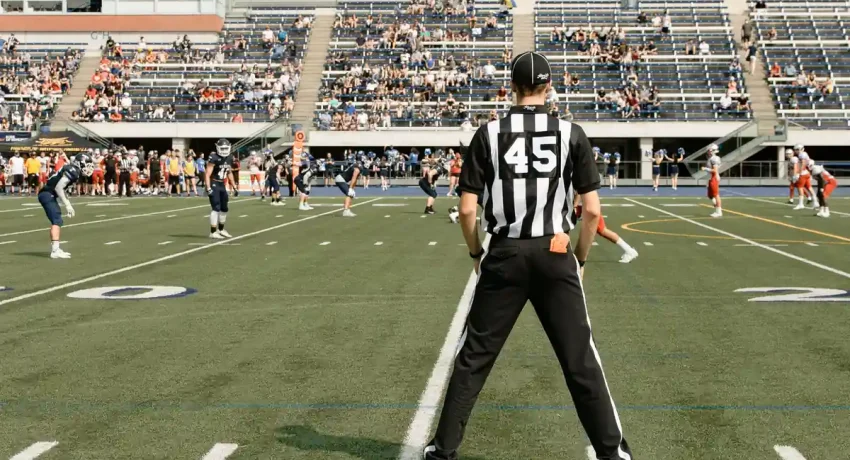

American Football Rules Explained: The Game in Plain English
American football can look like a puzzle to a first-time viewer. Players line up, the ball moves a few yards, and everyone stops again. Yet the game rests on a simple idea. One team tries to move the ball down the field and score, while the other team tries to stop them. This guide gives you american football rules explained in plain English, so you can follow a game from kickoff to the final whistle.
Below you will find how american football works in plain order. Firstly, the guide covers the field, the players and the aim. Secondly, it explains downs, scoring and penalties. Finally, it walks through overtime and the flow of a drive. In short, you will finish able to read a game, a scoreline and a referee’s call.
What Is American Football?
American football is a team sport played on a rectangular field with an oval ball. Each team fields eleven players at a time. The aim is to score more points than the other team. The attacking team, called the offense, tries to advance the ball down the field. The defending team, called the defense, tries to stop them. Teams switch roles when possession changes.
In fact, the NFL, the professional league in the United States, sets the most-watched rules. College football uses similar rules with small differences. This is an american football rules for beginners guide, so every term is explained as it appears. The rules below follow the NFL. College differences are noted where they matter.
How Many Players in American Football?
Eleven players from each team are on the field at a time. A full roster carries many more players, because offense, defense and special teams use different groups. In practice, a team may use fifty or more players across a game. Substitutions are free between plays. Coaches swap whole units in and out.
In general, each unit has specialists. The offense includes the quarterback, running backs, receivers and the offensive line. The defense includes the defensive line, linebackers and the secondary. Special teams handle kicks and punts. A player usually plays on only one unit. That is why rosters are so large.
American Football Positions Explained
American football positions explained simply start with the quarterback. The quarterback leads the offense. They take the snap, then pass, hand off or run. The running back carries the ball on running plays. Receivers catch passes down the field. The offensive line blocks defenders and protects the quarterback.
Meanwhile, on defense, the defensive line rushes the passer and stops runs. Linebackers do a bit of everything: they tackle, cover receivers and rush the quarterback. Cornerbacks cover receivers. Safeties cover deep passes and help against the run. Meanwhile, the kicker and punter handle special teams. Each position has a clear job, yet modern players often do more than one.
What Is a Down in Football?
A down is one of a team’s four chances to advance the ball ten yards. The offense starts at first down. If they gain ten yards, they earn a new set of downs. That is called a first down. If they fail after four downs, the other team takes over. The down and distance appear on screen as, for example, third and seven. That means third down with seven yards to go.
Above all, downs shape every decision. Early downs give teams a choice: they may run or pass. On third down, the play must gain the remaining yards. On fourth down, teams usually punt the ball away or kick a field goal. Going for it on fourth down is a gamble. Coaches weigh the field position, the score and the clock. In short, downs are the clockwork of the game.
How Does Scoring Work in American Football?
Scoring in American football uses four values. A touchdown scores six points. The team carries the ball into the opponent’s end zone or catches it there. After a touchdown, the team kicks an extra point for one more point. Alternatively, they may try a two-point conversion from the two-yard line. A field goal scores three points. A safety scores two points.
For example, teams score in different ways. A long pass may lead to a touchdown. A running back may break through the line. A defense may score by returning an interception or a fumble. In addition, special teams can score on kick returns. The variety keeps games open. A team can trail by two scores yet still win with one big play.
What Is a Touchdown?
A touchdown is the main score in American football, worth six points. The attacking team must get the ball into the opponent’s end zone. A runner must cross the goal line with the ball. A receiver must catch the ball in the end zone with both feet in bounds. The ball only needs to break the plane of the goal line. It does not need to touch the ground.
Indeed, touchdowns bring the biggest celebrations. Players spike the ball or perform a rehearsed dance. The crowd roars. After a touchdown, the scoring team attempts the extra point. The kicker usually makes it. The two-point conversion is riskier, yet it can change a game late on. Coaches choose based on the score and the time left.
What Is a Field Goal?
A field goal is a kick through the goalposts, worth three points. The team attempts it on fourth down when they are close enough to the posts yet too far to reach the end zone. A holder places the ball on the ground. The kicker strikes it through the uprights and above the crossbar. The kick must be accurate and long enough.
In short, field goals reward drives that stall near the end zone. Three points are better than none. However, a missed field goal gives the other team good field position. Kickers practise constantly because their job is narrow and high-pressure. A single kick can decide a playoff game. The best kickers are calm under pressure.
What Is the Line of Scrimmage?
The line of scrimmage is the imaginary line where each play begins. The ball sits on the line. The offense lines up behind it. The defense lines up on the other side. Neither side may cross the line before the snap. The line moves after each play to the spot where the ball was stopped.
In practice, everything in the game is measured from the line of scrimmage. Downs count yards gained from the line. Penalties move the line forwards or backwards. Television shows the line as a coloured stripe. The yellow line marks the first-down target. The blue line marks the line of scrimmage. Once you watch those two lines, the game becomes easy to follow.
American Football Field Explained
An American football field is one hundred yards long between the goal lines, with an end zone of ten yards at each end. The field is just over fifty yards wide. Yard lines cross the field every five yards. Numbers mark every ten yards. Hash marks show where the ball is spotted. The goalposts stand at the back of each end zone.
Moreover, the field is divided into two halves by the fifty-yard line. Each team defends one end zone and attacks the other. Teams switch ends after each quarter. The field markings look busy at first. In practice, only a few matter to a new fan: the goal lines, the fifty-yard line and the first-down marker. The rest is detail.
How Long Is an American Football Game?
A professional game has four quarters of fifteen minutes each, sixty minutes of playing time in total. The clock stops often, so a real game lasts around three hours. College games use the same quarter length, yet the clock rules differ slightly. Half-time lasts about twelve minutes in the NFL and longer in college.
Above all, clock management is a skill in itself. Teams use timeouts to stop the clock. The two-minute warning gives each team a pause late in each half. In the final minutes, every second matters. Coaches plan their timeouts carefully. A team with no timeouts left cannot stop the clock. That often decides close games.
American Football Penalties Explained
American football penalties explained simply cover rule-breaking. Common penalties include holding, pass interference, offside and false start. Holding means illegally grabbing an opponent. Pass interference means unfairly blocking a receiver. Offside means crossing the line before the snap. A false start means an offensive player moves before the snap.
Consequently, penalties cost yards. The referee throws a yellow flag onto the field. The officials announce the penalty and move the ball. Some penalties are automatic first downs. Others push the team backwards. A team that gives away many penalties hands the game to the opponent. Discipline is a quiet skill that wins matches.
What Is a Fumble in Football?
A fumble happens when a player loses possession of the ball before being down. The ball is live. Either team may recover it. A fumble recovered by the defense is a turnover. A fumble recovered by the offense keeps the drive alive. Fumbles often happen when a runner is hit hard or a quarterback is sacked.
In the end, turnovers change games. A fumble in the red zone can cost a certain score. A fumble returned for a touchdown swings the momentum. Coaches drill ball security constantly. Runners hold the ball high and tight. Quarterbacks protect it in the pocket. Despite the drills, fumbles still happen every week. The ball is hard to hold when defenders hit it.
How Does Overtime Work in NFL?
Overtime in the NFL gives both teams a chance to possess the ball in playoff games. In the regular season, each team gets one possession, unless the first team scores a touchdown and the other cannot match it. A touchdown on the opening drive ends the game in the regular season. In the playoffs, both teams get a possession even if the first team scores a touchdown.
Nevertheless, if the scores are still level after both teams have had the ball, the game continues. The next score wins. That is sudden death. In the regular season, a tied game after overtime ends in a draw. Playoff games continue until someone wins. The overtime rules have changed in recent years, so older games may look different.
How Can a New Fan Follow American Football?
Finally, following American football gets easier with a few habits. Firstly, watch the down and distance on screen. It tells you what the offense needs. Secondly, watch the line of scrimmage. The battle there decides most plays. Thirdly, notice the quarterback’s decisions. A good quarterback reads the defense before the snap. Finally, watch the clock in the last two minutes. That is when games are won and lost.
Football is also a travel sport. Texas is famous for its football culture, and a guide to places to visit near Austin, Texas doubles as a plan for a football weekend. Michigan is another great football state, and a guide to the top places in Michigan’s Upper Peninsula suits a trip built around the game. Young players often start at organised camps, and a youth sports camps guide explains how summer camps introduce children to team sports.
Training matters as much as talent. Players track their workload with modern tools, and an fitness tracker guide covers the watches many athletes use. Sleep and recovery matter too, and a smart rings guide looks at the trackers that measure rest. The gaming world has its own football scene, covered in an esports guide. Pressure affects players as well, and a mental health guide explains how people protect their wellbeing under stress.
NFL Rules Explained for Beginners
NFL rules explained for beginners in short: eleven against eleven, four downs to gain ten yards, and the team with more points wins. Touchdowns score six, field goals three, safeties two. Penalties cost yards. Turnovers change games. Overtime gives both teams a chance in the playoffs. That is the whole game in a paragraph.
In short, watch a game with this guide in mind. Count the downs, spot the line of scrimmage, and watch the quarterback. Within a few games, the rules will feel natural. Then the fun begins: great passes, huge hits and last-second field goals. American football rewards the new fan with one of the most dramatic games in sport.